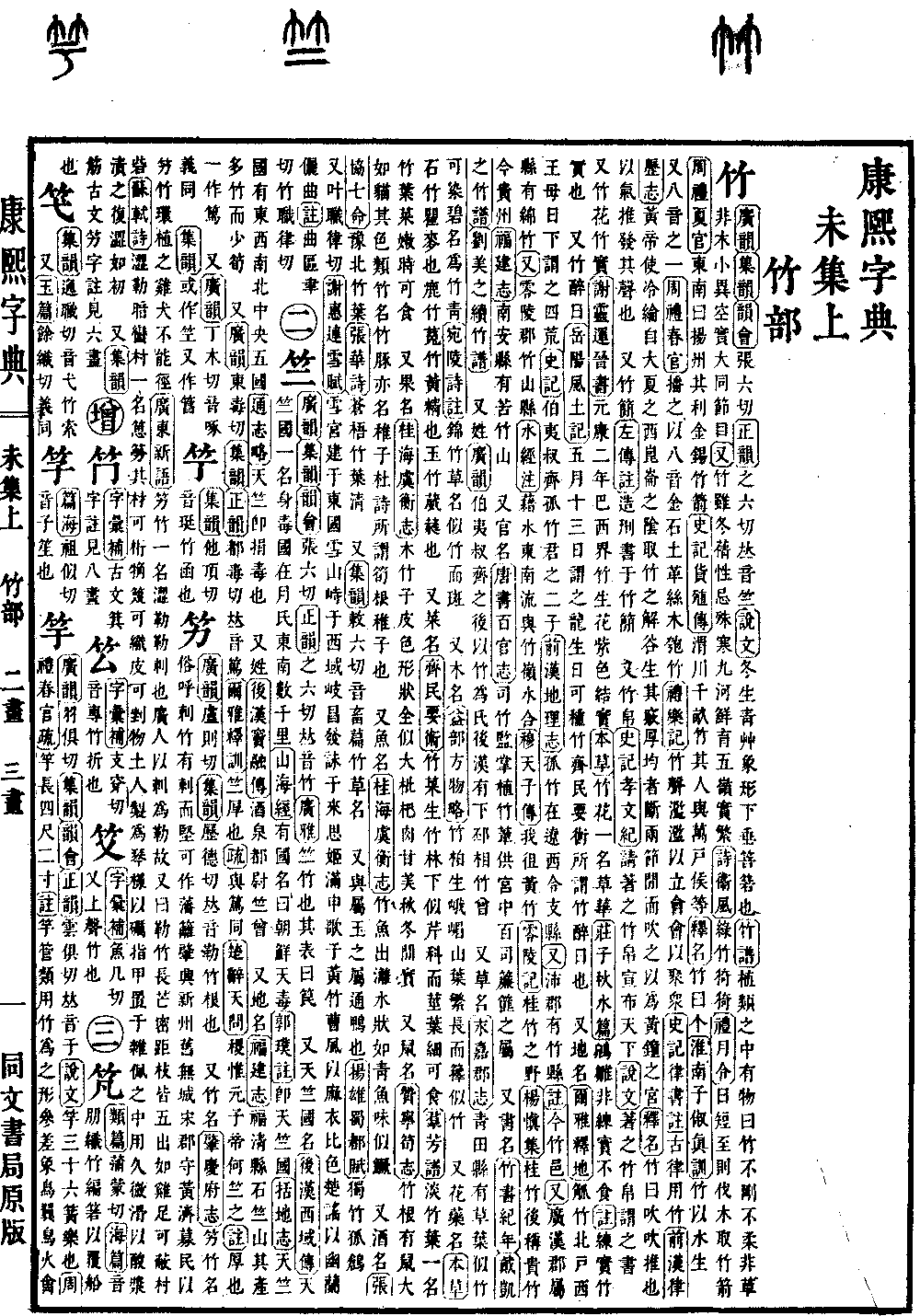
Wei Collection, Upper Volume
Radical: Bamboo (zhú)
Page 877, Entry 01
Pronounced zhu.
According to the Explaining Graphs and Analyzing Characters (Shuowen Jiezi), a green plant that grows in winter, with a shape similar to bamboo. Refers to the hanging bamboo skin and bamboo leaves.
According to the Bamboo Treatise (Zhupu), among plant species, there is one called bamboo. It is neither hard nor soft; it is neither grass nor tree. There are minor differences in whether they are hollow or solid, but they are generally the same in their nodes.
Also, although bamboo flourishes in winter, its nature is particularly afraid of the cold. It rarely grows in the area of the Nine Rivers, but it is indeed abundant in the Five Ridges region.
Book of Odes (Shijing), Odes of Wei: The green bamboo, elegant and long.
Book of Rites (Liji), Monthly Ordinances (Yueling): At the winter solstice, fell the trees and cut the bamboo arrows.
Rites of Zhou (Zhouli), Summer Official (Xiaguan): The southeast is called Yangzhou; its products include metal, tin, and bamboo arrows.
Records of the Grand Historian (Shiji), Biographies of the Money-makers (Huozhi Zhuan): If one has a thousand-acre bamboo grove in the Wei River valley, the owner's wealth is equal to that of a lord of a thousand households.
Explanation of Names (Shiming): The unit for bamboo is called ge.
Huainanzi, Explaining Truth (Chuzhen Xun): Bamboo grows by the water.
Also one of the Eight Sounds (bayin).
Rites of Zhou (Zhouli), Spring Official (Chunguan): Use eight types of materials to make musical instruments for performance: metal, stone, earth, leather, silk, wood, gourd, and bamboo.
Book of Rites (Liji), Record of Music (Yueji): Instruments made of bamboo have a wide range of sound; wide sounds can establish unity, and unity can gather the multitudes.
Records of the Grand Historian (Shiji), Notes on the Book of Pitch Pipes (Lushu Zhu): Ancient pitch pipes were made of bamboo.
History of the Former Han (Qianhan Shu), Treatise on Harmonics and Calendars (Lüli Zhi): The Yellow Emperor sent Ling Lun to go to the west of Daxia and the north of the Kunlun Mountains to collect bamboo growing in Jiegu, selecting those with walls of uniform thickness, and cutting a section between two nodes to blow, using it as the Gongsheng pitch of the Huangzhong scale.
Explanation of Names (Shiming): Instruments made of bamboo are called chui (to blow). Chui means to push; one uses breath to push the sound out.
Also refers to bamboo slips (zhujian).
Commentary on Zuo Tradition (Zuo Zhuan Zhu): To write on bamboo slips.
Also refers to bamboo slips and silk scrolls (jianbo).
History of the Former Han (Qianhan Shu), Annals of Emperor Xiao Wen (Xiaowen Ji): Request to record it on bamboo slips and silk scrolls to announce it to the world.
According to the Explaining Graphs and Analyzing Characters (Shuowen Jiezi), writing on bamboo slips and silk scrolls is called shu (book/writing).
Also refers to bamboo flowers and bamboo seeds (zhushi).
Xie Lingyun, Book of Jin (Jin Shu): In the second year of Yuankang, bamboo flowered in the Bazhou area; the flowers were purple and produced fruit.
Materia Medica (Bencao): Bamboo flowers are also called cao hua.
Zhuangzi, Autumn Floods (Qiushui Pian): The Yuan-chu phoenix will not eat anything but bamboo seeds.
Commentary: Lian-shi is bamboo seeds.
Also refers to the Bamboo-Drunken Day (Zhuzui Ri).
Yueyang Local Gazetteer (Yueyang Fengtu Ji): The thirteenth day of the fifth lunar month is called the Dragon's Birthday, on which bamboo can be planted; this is what the Essential Arts for the People (Qimin Yaoshu) calls the Bamboo-Drunken Day.
Also refers to a place name.
Erya, Explaining Geography (Shidi): Guzhu, Beihu, Xiwangmu, and Rixia are called the Four Wildernesses.
Records of the Grand Historian (Shiji): Bo Yi and Shu Qi were the two sons of the Lord of Guzhu.
History of the Former Han (Qianhan Shu), Treatise on Geography (Dili Zhi): Guzhu was in Lingzhi County, Liaoxi.
Also: Pei Commandery had Zhu County.
Commentary: Modern-day Zhuyi.
Also: Guanghan Commandery included the county of Mianzhu.
Also: Lingling Commandery had Zhushan County.
Commentary on the Classic of Waterways (Shuijing Zhu): The Jie River flows southeast and joins the Zhuling River.
Biography of Mu, Son of Heaven (Mu Tianzi Zhuan): I traveled to Huangzhu.
Lingling Record (Lingling Ji): The wilds of Guizhu.
Collected Works of Yang Shen (Yang Shen Ji): Guizhu, later called Guizhu, is modern-day Guizhou.
Fujian Gazetteer (Fujian Zhi): Nan'an County has Kushu Mountain.
Also refers to an official title.
Old Book of Tang (Tang Shu), Treatise on Officials (Baiguan Zhi): The Directorate of Bamboo and Reed managed the planting of bamboo and reeds to supply the palace departments with curtains, bamboo chests, and the like.
Also refers to book titles:
Bamboo Annals (Zhushu Jinian)
Dai Kaizhi, Bamboo Treatise (Zhupu)
Liu Meizhi, Continued Bamboo Treatise (Xu Zhupu)
Also refers to a surname.
Guangyun: The descendants of Bo Yi and Shu Qi used Bamboo as their surname. In the Eastern Han, there was a Chancellor of Xiapi named Zhu Zeng.
Also refers to a grass name.
Yongjia Commandery Gazetteer (Yongjia Junzhi): In Qingtian County, there is a grass with leaves like bamboo that can be dyed blue-green; its name is zhuqing.
Wanling Poetry Commentary (Wanling Shizhu): Jinzhu is the name of a grass; it resembles bamboo but has markings.
Also refers to a tree name.
Yibu Local Products Overview (Yibu Fangwu Lue): Zhubai grows on Mount Emei; its leaves are dense and long, and its sheath resembles bamboo.
Also refers to a flower or medicinal herb name.
Materia Medica (Bencao): Shizhu is qumai (Dianthus). Luzhu and Tuzhu are huangjing (Polygonatum). Yuzhu is weiru (Polygonatum odoratum).
Also refers to a vegetable name.
Essential Arts for the People (Qimin Yaoshu): Zhucai grows under bamboo forests; it resembles celery but has thin stems and leaves and is edible.
Treatise of Many Flowers (Qunfang Pu): Danzhuye, also called zhuyecai, can be eaten when tender.
Also refers to a fruit name.
Record of Things Seen and Heard in the Southern Seas (Guihai Yuhang Zhi): Muzhu; its peel, color, and shape are exactly like a large loquat, and the flesh is sweet; it bears fruit in autumn and winter.
Also called...
Zanning, Bamboo Shoot Treatise (Sun Zhi): Bamboo roots have something, the size of a cat, its color resembles bamboo, its name is zhutun (bamboo pig), also called zhizi, which is the "bamboo shoot root zhizi" mentioned in Du Fu's poetry.
Also refers to a fish name.
Record of Things Seen and Heard in the Southern Seas (Guihai Yuhang Zhi): The bamboo fish is produced in the Li River; its shape resembles a black carp, and its taste resembles a mandarin fish.
Also refers to a wine name.
Zhang Xie, Seven Admonitions (Qi Ming): Zhuye from north of Yu.
Zhang Hua's Poetry: The Zhuye of Cangwu is clear.
Also pronounced chu. Pianzhu is the name of a grass.
Also interchangeable with the "shu" in "shuyu" (a type of duck), referring to a duck.
Yang Xiong, Chengdu Rhapsody (Shudu Fu): A solitary bamboo and a lone crane.
Also rhymes with the sound of "zhi" and "lü."
Xie Huilian, Rhapsody on Snow (Xue Fu): A snow palace was built in the eastern land, and a snow mountain stood in the western regions. Qi Chang expressed his chant in "Laisi," and Ji Man extended his song in "Huangzhu." The Cao style of poetry compares the color to hemp garments, and the Chu style of songs pairs the music with the fragrant orchid.
Commentary: Qu is pronounced in the manner of "qu" and "yu." Zhu is pronounced in the manner of "zhi" and "lü."