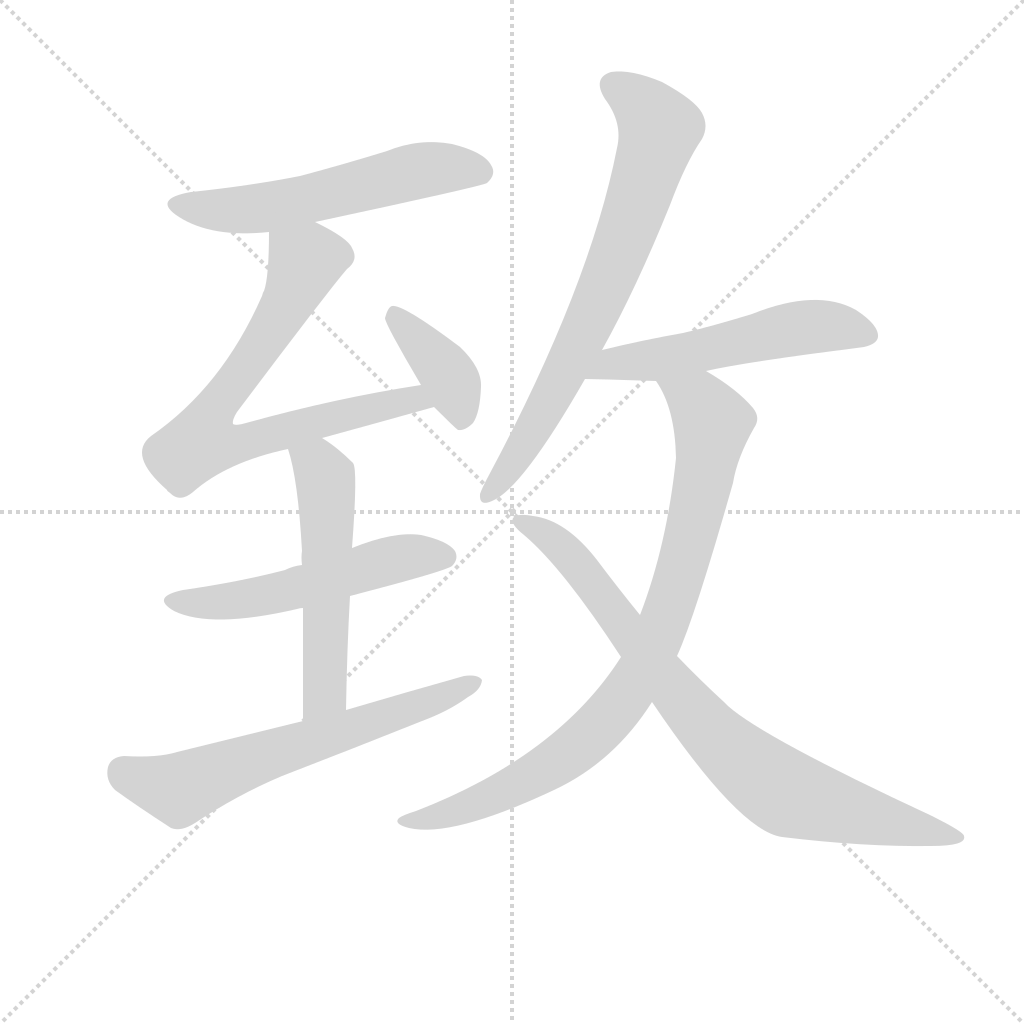
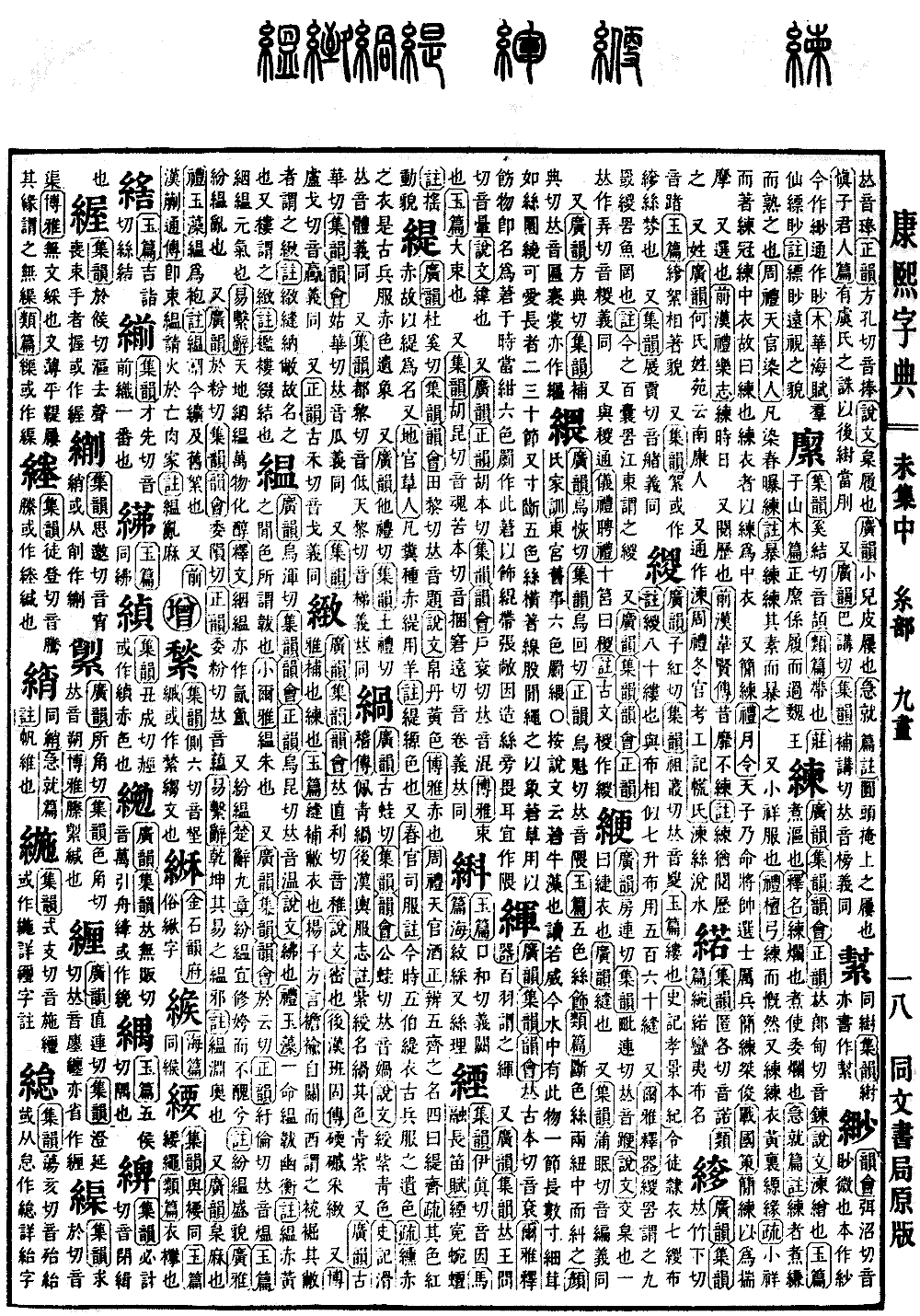
Wei Collection, Lower Volume
Radical: Arrive (zhì)
Page 932, Entry 09
Guangyun, Jiyun: Pronounced zhi. Same sound as zhi.
Shuowen Jiezi: Defined as to deliver or to send.
Spring and Autumn Annals (Chunqiu), Ninth Year of Duke Cheng: In the summer, Jisun Xingfu traveled to the State of Song to deliver a bride (zhi nü).
Commentary: Three months after a woman is married, a high official is sent to accompany her to make inquiries; this is called delivering a bride.
Book of Rites (Liji), Qu Li: Those who offer fields and dwellings must bring documents recording the details to deliver them.
Commentary: Documents specifying the amount of land and dwellings, delivered to the other party.
Also defined as to attract or to lure.
Yang Sheng'an Waiji: Zhi carries the meaning of acquiring.
Book of Changes (Yijing), Xici: Prepare items for use.
Sub-commentary: This refers to preparing the myriad things of the world and attracting what the world requires.
Book of Zhou (Zhouli), Earth Officials, Suiren: Whenever managing suburban land, summon the people according to the lowest service requirements.
Commentary: Zhi is like gathering. Although the people hold superior, medium, and inferior fields, they are to be gathered and calculated according to the lowest service standards.
Also defined as to return or to restore.
Book of Rites (Liji), Qu Li: An official, upon reaching the age of seventy, shall relinquish his duties (zhi shi).
Commentary: To return the duties one manages to the sovereign and retire due to old age.
Sub-commentary: It does not say zhi (to place), but says zhi (to deliver), because zhi means to discard or sever, while zhi means to hand over to another, indicating that the imperial court surely has capable people to succeed one.
Also defined as to convey or to transmit.
Book of Odes (Shijing), Xiaoya: The invocator (a priest presiding over sacrifices) transmits the words of the deity.
Commentary: The invocator then transmits the intentions of the filial grandson, reporting to the impersonator (the one representing the deceased) that the sacrifice has been completed successfully.
Also defined as extreme or to reach the limit.
Book of Documents (Shangshu), Pan Geng: You all, carefully convey my warnings.
Commentary: To exhaust my sincerity in warning you all.
Book of Rites (Liji), Li Qi: There are those who imitate but cannot reach the extreme.
Sub-commentary: Zhi means the extreme.
Also Book of Rites (Liji), Yue Ji: Penetrate and contemplate music to cultivate the inner self.
Commentary: Zhi is like examining or experiencing deeply.
Also defined as to entrust or to sacrifice.
Book of Changes (Yijing), Kun Gua: The superior man does not hesitate to sacrifice his life to realize his aspirations.
Analects (Lunyu): Serving the sovereign, one is able to sacrifice one's life.
Zhu Commentary: Zhi is like entrusting or sacrificing.
Also defined as sincerity or affection.
Laozi, Daodejing: To cause them to reach (a certain state).
Commentary: Zhi means sincerity and focus.
Also refers to a challenge, called zhi shi.
Zuo Zhuan, Twelfth Year of Duke Xuan: Xu Bo of the State of Chu drove for Le Bo, with She Shu as the right-hand chariot warrior, going to challenge the Jin army.
Sub-commentary: Zhi shi means to express a determination to seek battle.
Also defined as mood, charm, or flavor.
Commentary on the Water Classic (Shuijing Zhu): The dense bamboo forest is beautiful and lovely, with a mood worth savoring.
Liutie: Cui Yuan had a strict and imposing demeanor and charm.
Poetry of Wang Jin: Naturally forming an elegant interest.
Also defined as to arrive or to reach.
Book of Zhou (Zhouli), Spring Officials, Da Bu: Oversee the three methods of dream divination. The first is called zhi meng.
Sub-commentary: Explains zhi as to reach, being the place where the dream arrives.
Also defined as to regulate or to control.
Guanzi, Baixin Pian: Take regulation as the standard.
Commentary: Zhi is used to regulate those matters, so it serves as the standard.
Also Book of Changes (Yijing), Xici: Returning to one goal yet having a hundred thoughts.
Sub-commentary: Although the goal returned to is consistent, there are necessarily a hundred thoughts; this means that although there are a hundred thoughts, they must return to one.
Also defined as to approach or to press close to.
Laozi, Daodejing: Therefore, approaching to count the parts of the carriage, (one cannot see the whole) carriage.
Commentary: Zhi means to approach. It says that a person approaches a carriage to count its parts—the spokes, the wheel, the hub, the shafts, the carriage box—no single part can be called a carriage alone.
Also Book of Odes (Shijing), Daya: Thus summon the spirits, thus cause them to descend.
Commentary: Zhi means to summon the various spirits of the state.
Sub-commentary: Zhi is a way of saying to cause arrival.
Also defined as fine, dense, or precise.
Book of Rites (Liji), Li Qi: The capacity of heaven and earth to transform the myriad things is extremely refined.
Commentary: Zhi means fine and dense.
Book of the Former Han (Qian Hanshu), Biography of Yan Yannian: The documents and laws were dense and impenetrable.
Commentary: Refers to his case files and documents being strict and orderly.
Also a variant of zhi (dense).
Book of Rites (Liji), Yue Ling: In the first month of winter, the tenth month, the craftsmen are ordered to present their results, arrange the sacrificial vessels, and follow the specifications; excellence in workmanship is considered superior.
Commentary: Refers to the workmanship being dense and fine. Zhi and zhi are the same in this meaning.