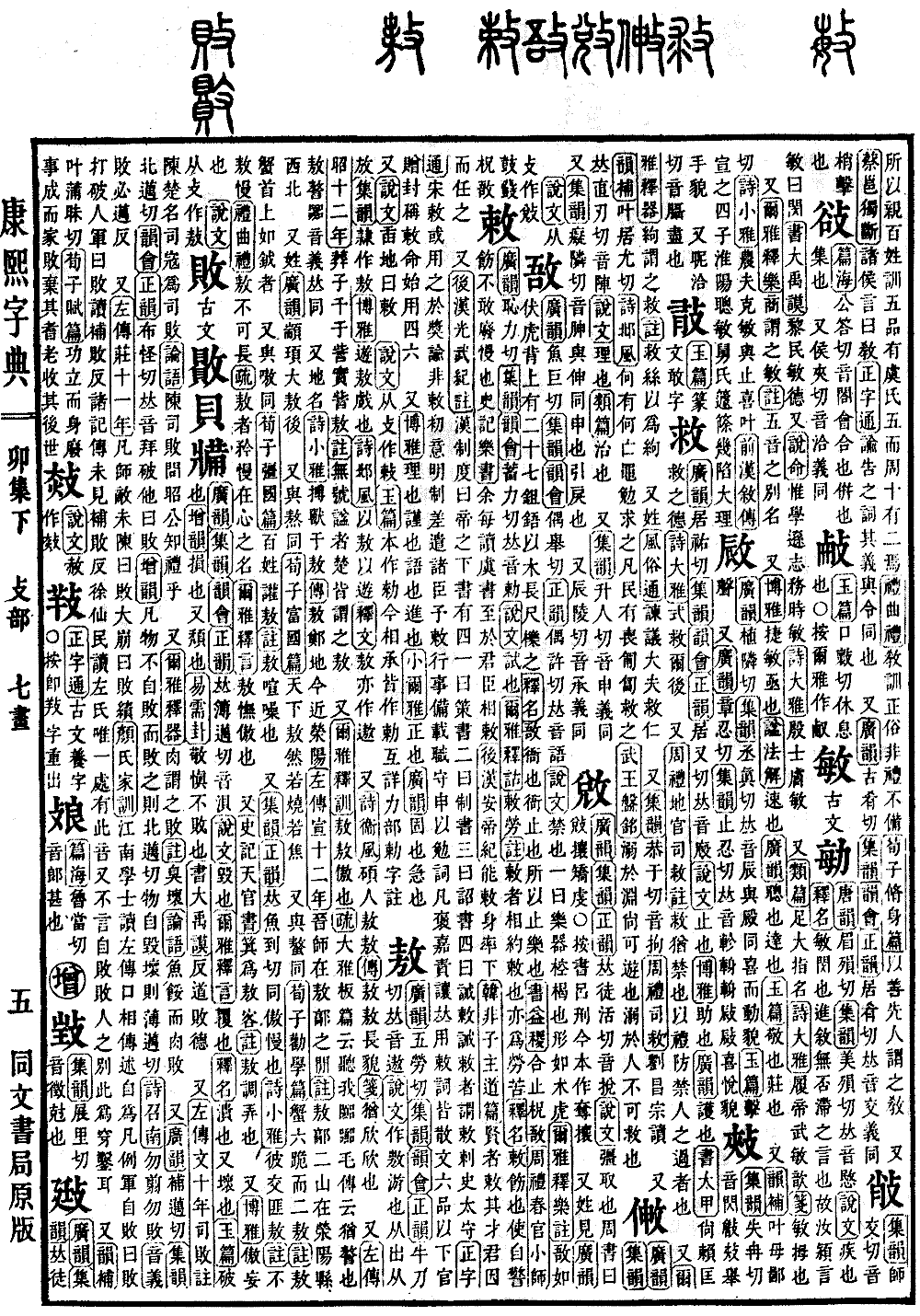
Mao Collection, Lower Volume
Radical: Tapping (pū)
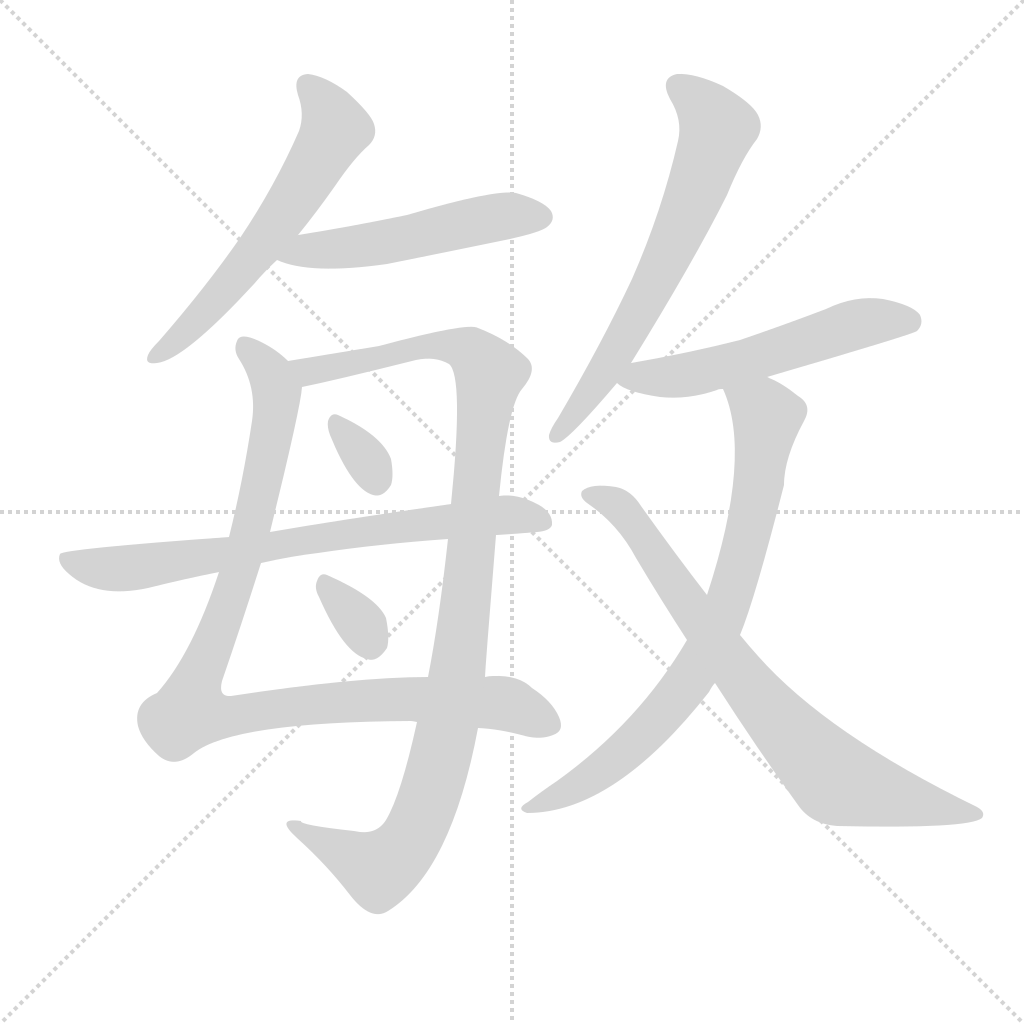
Min; Kangxi strokes: 11; Page 471, Entry 04
Ancient form is min.
Tang Rhymes (Tangyun): Pronounced min (rising tone).
Collected Rhymes (Jiyun): Pronounced min (rising tone).
The pronunciation is min.
Explanation of Characters (Shuowen): Rapid.
Explication of Names (Shiming): Min means to be distressed or anxious. It refers to speech that advances and is narrated without obstruction or stagnation. Therefore, in the regions of Ru and Ying, to speak with agility is called min.
Book of Documents (Shujing), Counsels of Great Yu: The common people are agile in virtue.
Also, in the Announcement of Yue: Only by learning with a humble mind can one strive to be timely and agile.
Book of Odes (Shijing), Greater Odes: The officers of Yin were handsome and agile.
Also, in the Categorized Compendium (Leipian): The big toe is called min.
Book of Odes (Shijing), Greater Odes: He trod on the big toe of the deity's footprint, and became pregnant.
Annotation: Min is the big toe.
Also, in the Erya, Explaining Music: In the Shang dynasty, this was called min.
Annotation: A name for one of the five notes.
Also, in the Extensive Refinements (Boya): To be quick and agile is to be urgent.
Explanation of Posthumous Titles: Swift.
Extended Rhymes (Guangyun): Intelligent, insightful.
Jade Compendium (Yupian): Respectful, dignified.
Also, in the Supplement to the Rhymes (Yunbu): Rhymes with the sound bi (rising tone).
Book of Odes (Shijing), Lesser Odes: The farmers are able and agile.
Rhymes with the character zhi and xi.
History of the Former Han (Qianhan Shu), Narrative Account: Of the four sons of Emperor Xuan, the Prince of Huaiyang was intelligent and agile; his uncle was a sycophant, nearly causing him to fall into the hands of the Grand Minister of Justice.
The character min is derived from the character for work.