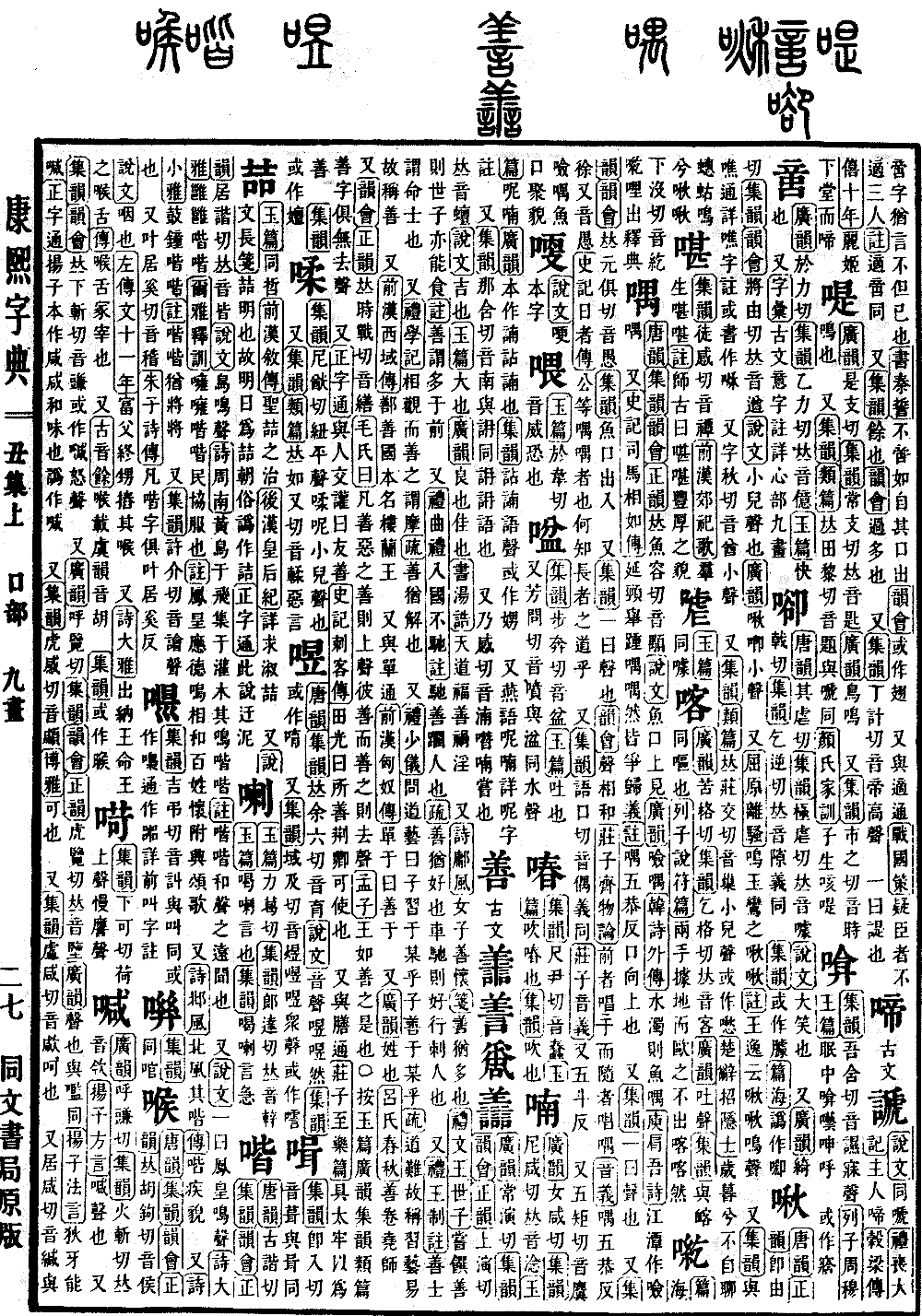
Chou Collection, Upper Volume
Radical: Mouth (kǒu)
Kangxi strokes: 12
Page 197, Entry 33
In the Expanded Dictionary of Sounds and Meaning (Guangyun), pronounced han. In the Collected Rites (Jiyun), pronounced huo zhan, with the same sound as qian. In the Dialect (Fangyan) by Yang Zi, it refers to the sound of shouting.
Also, in the Collected Rites (Jiyun) and the Compendium of Rhymes (Yunhui), pronounced xia zhan, with the same sound as xian. Sometimes written in a variant form, representing the sound of anger.
Also, in the Expanded Dictionary of Sounds and Meaning (Guangyun), pronounced hu lan. In the Collected Rites (Jiyun), the Compendium of Rhymes (Yunhui), and the Proper Dictionary (Zhengzitong), pronounced hu lan, with the same sound as lan. In the Expanded Dictionary of Sounds and Meaning (Guangyun), it refers to a sound, synonymous with lan. In the Model Sayings (Fayan) by Yang Zi, it states Di Ya can shout. In the Proper Dictionary (Zhengzitong), it notes that in the original text by Yang Xiong, the character xian was used, referring to the blending of flavors, which was later mistakenly written as han.
Also, in the Collected Rites (Jiyun), pronounced hu gan, with the same sound as an. In the Er Ya (Boya), it means acceptable.
Also, in the Collected Rites (Jiyun), pronounced xu xian, with the same sound as xian. It means to scold or berate.
Also, pronounced ju xian, with the same sound as jian. It is synonymous with jian. It means to persist in one's own opinion and remain silent.
Also, pronounced ku lan, with the same sound as kan. It means to scold or berate. It is synonymous with lan.