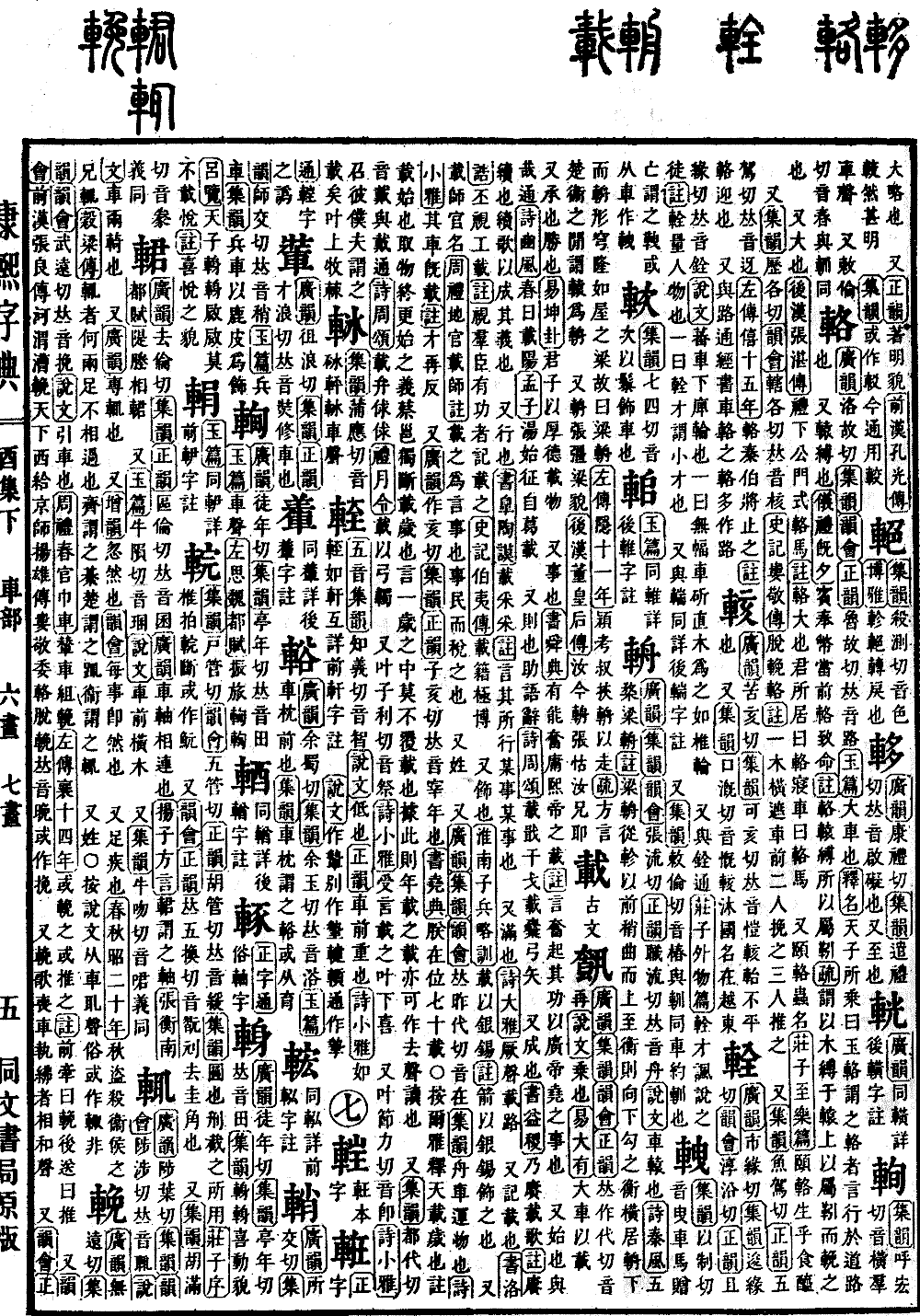
You Collection, Lower Volume
Radical: Carriage (chē)
Kangxi Strokes: 13
Page 1243, Entry 01
Archaic forms in Broad Rhymes (Guangyun), Collection of Rhymes (Jiyun), Rhyme Meetings (Yunhui), and Orthodox Rhymes (Zhengyun) are written as dai. Pronounced zai (falling tone).
According to Explaining Graphs and Analyzing Characters (Shuowen Jiezi), it means to ride or board.
Book of Changes (Yijing): Large carriages are used for transport.
It also means to sustain or to support.
Book of Changes (Yijing): The gentleman uses thick virtue to sustain all things.
It also means affairs or matters.
Book of Documents (Shangshu): There are those who can exert their efforts to broaden the deeds of the Emperor. Commentary: It means to exert one’s efforts to broaden the affairs of Emperor Yao.
It also means to begin. Used interchangeably with zai.
Book of Odes (Shijing): In the spring, the sunshine begins.
Mencius: Tang began his punitive expeditions, starting from Ge.
It also acts as a connective particle or an auxiliary word.
Book of Odes (Shijing): Then store the shields and spears, then case the bows and arrows.
It also means to complete or to accomplish.
Book of Documents (Shangshu): Then they continued the song. Commentary: Geng means to continue. To continue the song to complete its meaning.
It also means to conduct or to perform.
Book of Documents (Shangshu): Conduct the various tasks. Commentary: It refers to the various affairs being performed.
It also means to fill or to be full.
Book of Odes (Shijing): Their voices filled the roads.
It also means to record or a record.
Book of Documents (Shangshu): Grandly examine the meritorious deeds and records. Commentary: Examine the officials who have merit and record them.
Records of the Grand Historian (Shiji): The records are extremely extensive.
It also means to decorate or to ornament.
Huainanzi: Decorated with silver and tin. Commentary: The arrows are decorated with silver and tin.
It also refers to the Zai Shi, an official title.
Rites of Zhou (Zhouli): The Zai Shi is a title for a position, meaning to manage the affairs of the people and collect taxes from them.
It is also a surname.
Pronounced zai (falling tone).
Collection of Rhymes (Jiyun): The transport of goods by boat or carriage.
Book of Odes (Shijing): The carriages are already loaded. Commentary: Pronounced zai (falling tone).
Pronounced zai (rising tone).
Meaning a year.
Book of Documents (Shangshu): I have been on the throne for seventy years.
According to the Erya, Zai means a year. Commentary: Zai means to begin. It takes the meaning that after things finish, they begin again.
Cai Yong’s Juduan states that Zai means a year, saying that within a year, there is nothing that is not covered and sustained. According to this, the Zai in the sense of year can also be read in the falling tone.
Pronounced dai (falling tone).
Used interchangeably with dai.
Book of Odes (Shijing): Wearing caps in a respectful manner.
Record of Rites (Liji): Decorated with bow cases.
Also rhymes with ji (falling tone).
Book of Odes (Shijing): Receive them and carry them.
Also rhymes with ji (entering tone).
Book of Odes (Shijing): Summon the carriage driver and tell him to load them.
Textual Research:
Book of Documents (Shangshu): In the phrase grandly examine the works and records, the original text used the character gong (work); it has been corrected to the character gong (merit) based on the context of the commentary.