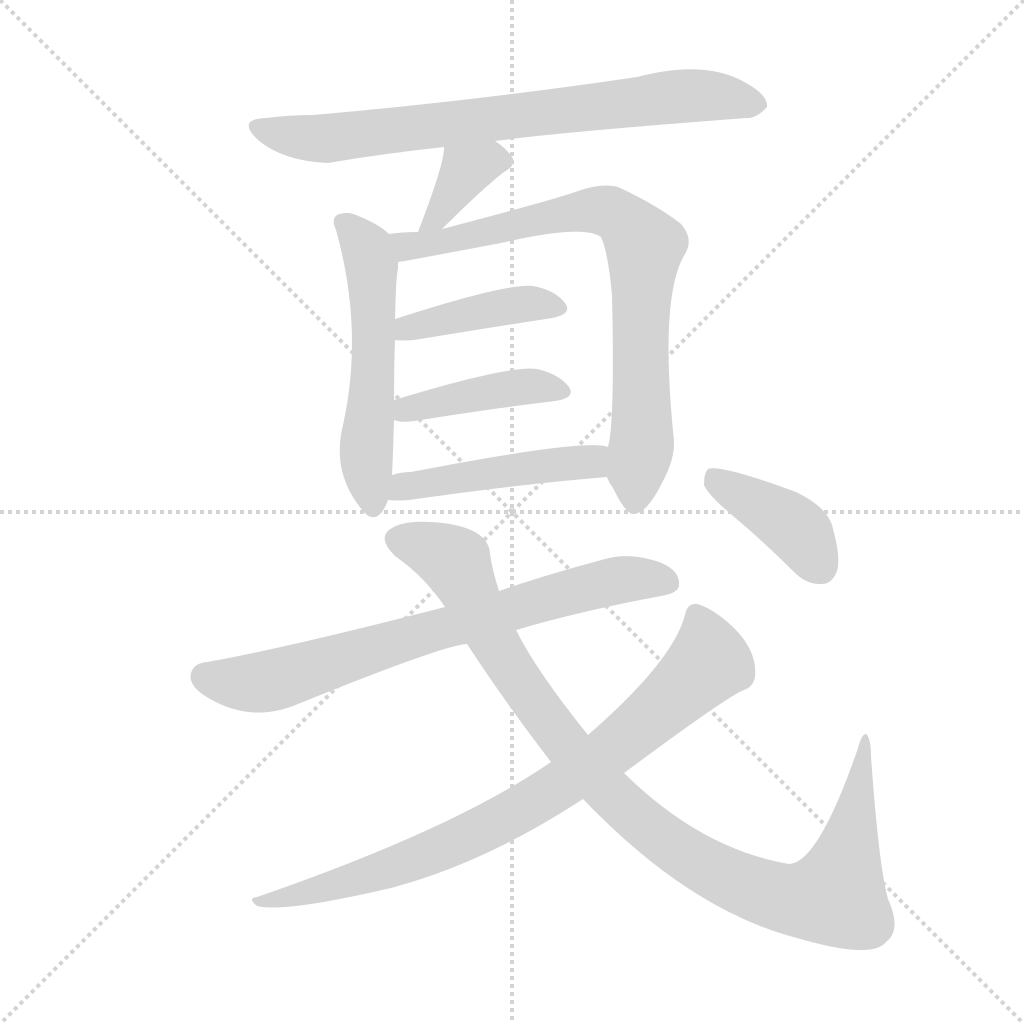
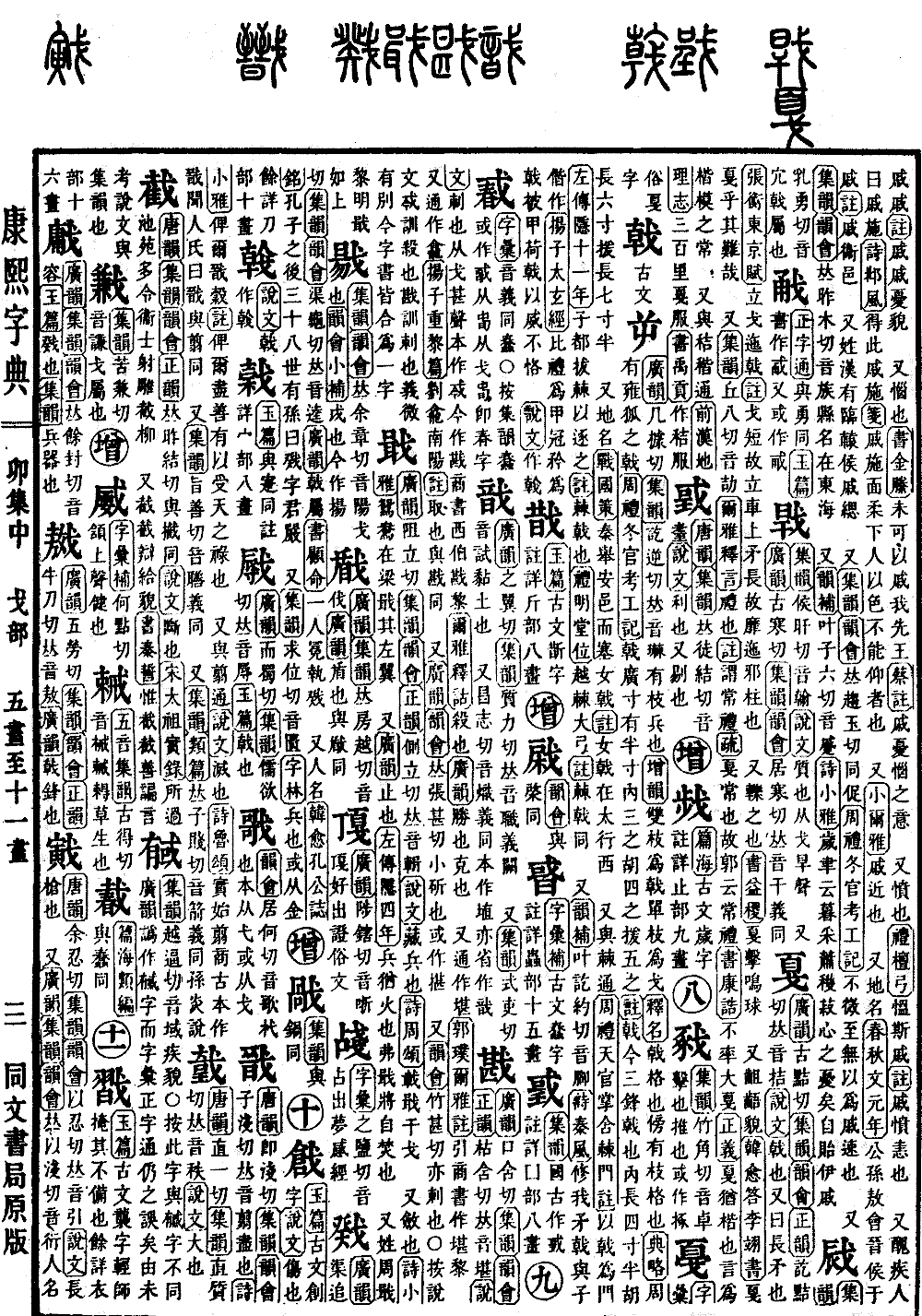
Mao Collection, Middle Volume
Radical: Dagger-axe (gē)
Kangxi Strokes: 11
Page 413, Entry 04
Guangyun: Pronounced jie
Jiyun, Yunhui, Zhengyun: Pronounced jie
Shuowen: A dagger-axe. Also said to be a long spear.
Zhang Heng, Eastern Capital Rhapsody (Dongjing Fu): To set up a dagger-axe and lean it.
Commentary: The dagger-axe is short, so it is set up on the chariot. The spear is long, so it is leaned obliquely.
Also, to run over.
Book of Documents (Shangshu), Yi and Ji: Striking the resonant stone chimes.
Also, the appearance of being incompatible.
Han Yu, Reply to Li Yi: It is difficult, indeed.
Also Jiyun: Pronounced jie.
Erya, Explanations of Words: Propriety.
Commentary: This refers to constant propriety.
Commentary: Jia means constant, which is why Guo says constant propriety.
Book of Documents (Shangshu), Announcement of Kang: Do not follow the great constant.
Orthodox Meaning: Jia is synonymous with model, meaning a constant that serves as a pattern.
Also interchangeable with the characters jie and jie.
Book of Han (Qian Hanshu), Treatise on Geography: Three hundred li of the jia tribute zone.
Book of Documents (Shangshu), Tribute of Yu: Written as jie tribute.
Textual Research: In Zhang Heng, Eastern Capital Rhapsody (Dongjing Fu), the text reads to set up a dagger-axe and lean the halberd. The original text has been corrected to read jia.