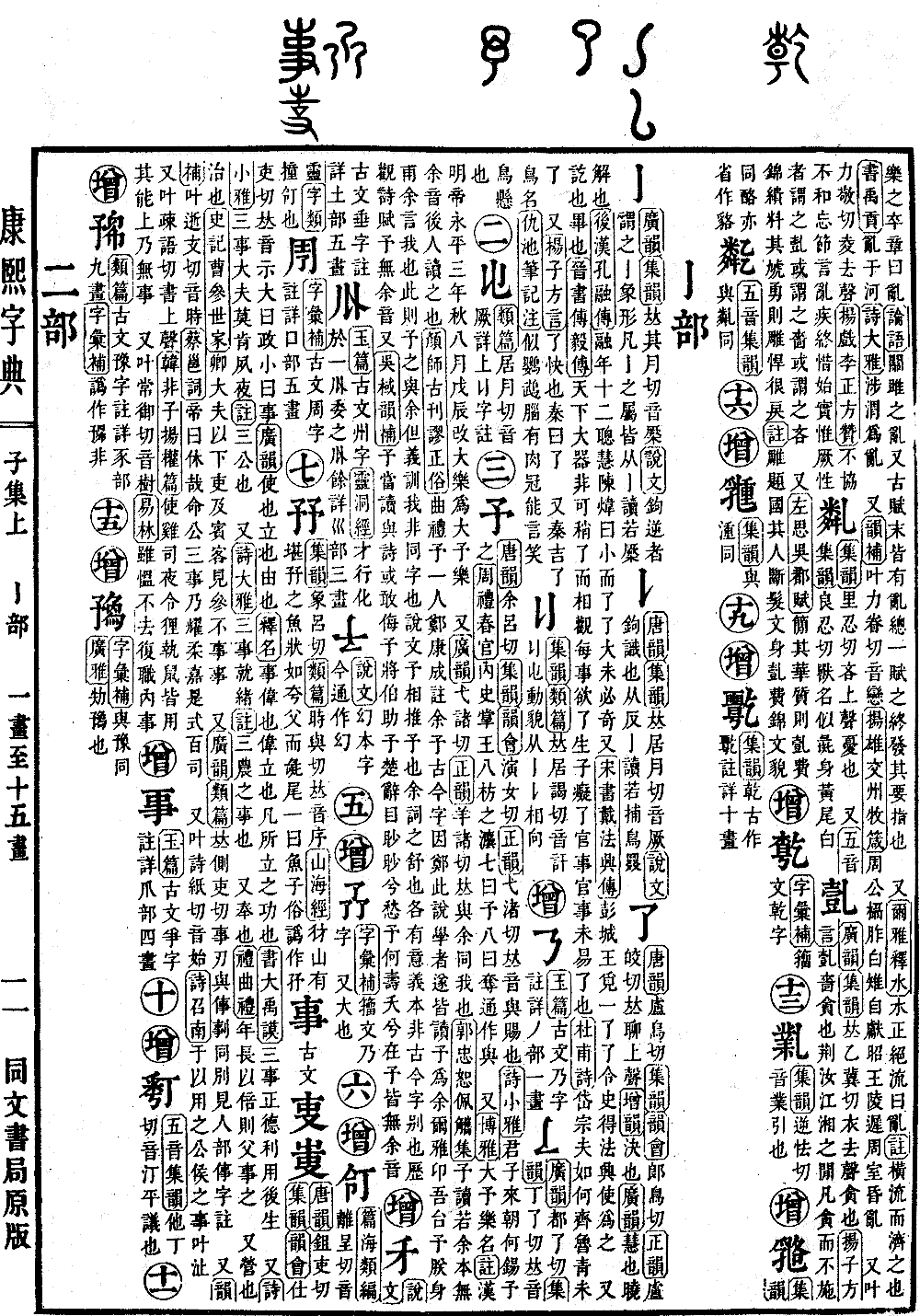
Zi Collection, Page Position: Upper
Radical: Hook (jué)
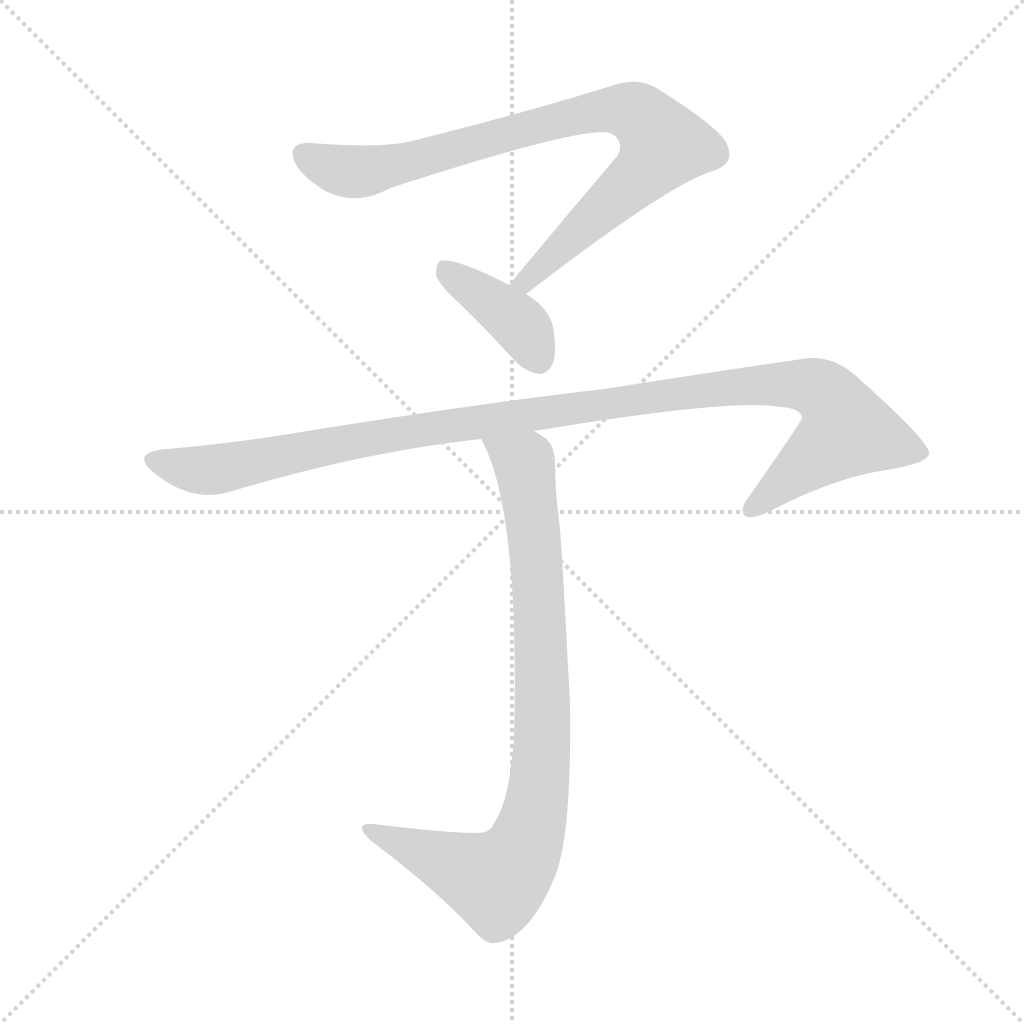
Character: Yu
Kangxi Stroke Count: 4
Page 85, Number 16
Tang Phonology: Yu-Lü cut. Collected Rhymes and Rhyme Assembly: Yan-Nü cut. Correct Rhymes: Yi-Zhu cut. Pronounced the same as yǔ. Meaning: To bestow or give.
When the gentleman comes to court, what shall be bestowed upon him? — Book of Odes (Shijing).
The Inner Secretary manages the eight methods of the sovereign's authority; the seventh is bestowing, and the eighth is seizing. — Rites of Zhou (Zhouli).
Commonly used interchangeably with the character pronounced yǔ.
Also, according to the Refined Definitions (Boya), Dayu is the name of a ritual dance. Note: In the third year of the Yongping era of Emperor Ming of Han, in the eighth month of autumn on the day of Wuchen, the Great Music was renamed the Dayu Music.
Also, according to the Broad Rhymes (Guangyun): Yi-Zhu cut. Correct Rhymes: Yang-Zhu cut. Same as the character pronounced yú. Meaning: I or me.
In the Collection of Carved Horns (Peixi Ji) by Guo Zhongshu: The character is read like yú. Originally, there was no such pronunciation; it was adopted by later generations.
In the Correction of Errors and Rectification of Customs (Kanmiao Zhengsu) by Yan Shigu: In the Book of Rites (Liji), the phrase I, the one man appears. Zheng Kangcheng's commentary states that the characters for yú and yǔ are ancient and modern forms of each other. Because of Zheng Xuan's explanation, scholars all read the character as yú.
The Literary Expositor (Erya) lists various terms including áng, wú, tái, yǔ, zhèn, shēn, fǔ, yú, and yán as all meaning I or me. This indicates that while both characters share the meaning of I, they are not the same character.
Explaining Graphs and Analyzing Characters (Shuowen Jiezi) states: The character yǔ means to push toward each other and give. The character yú is a particle indicating a relaxed tone. Each has its own distinct meaning; they were not originally ancient and modern variants. Throughout various poems and rhapsodies, the character is never read with the pronunciation of yú.
Also, in the Rhyme Supplement (Yunbu) by Wu Yu: The character should be read as yǔ. In the Book of Odes, phrases like Who dares insult me? and Would that you would help me. In the Songs of the South (Chuci): My eyes gaze into the distance, grieving me, and Whether life is long or short depends on me. None of these are read with the pronunciation of yú.