Wu Collection, Middle Volume
Radical: Eye (mù)
Kangxi Strokes: 11
Page 807, Entry 11
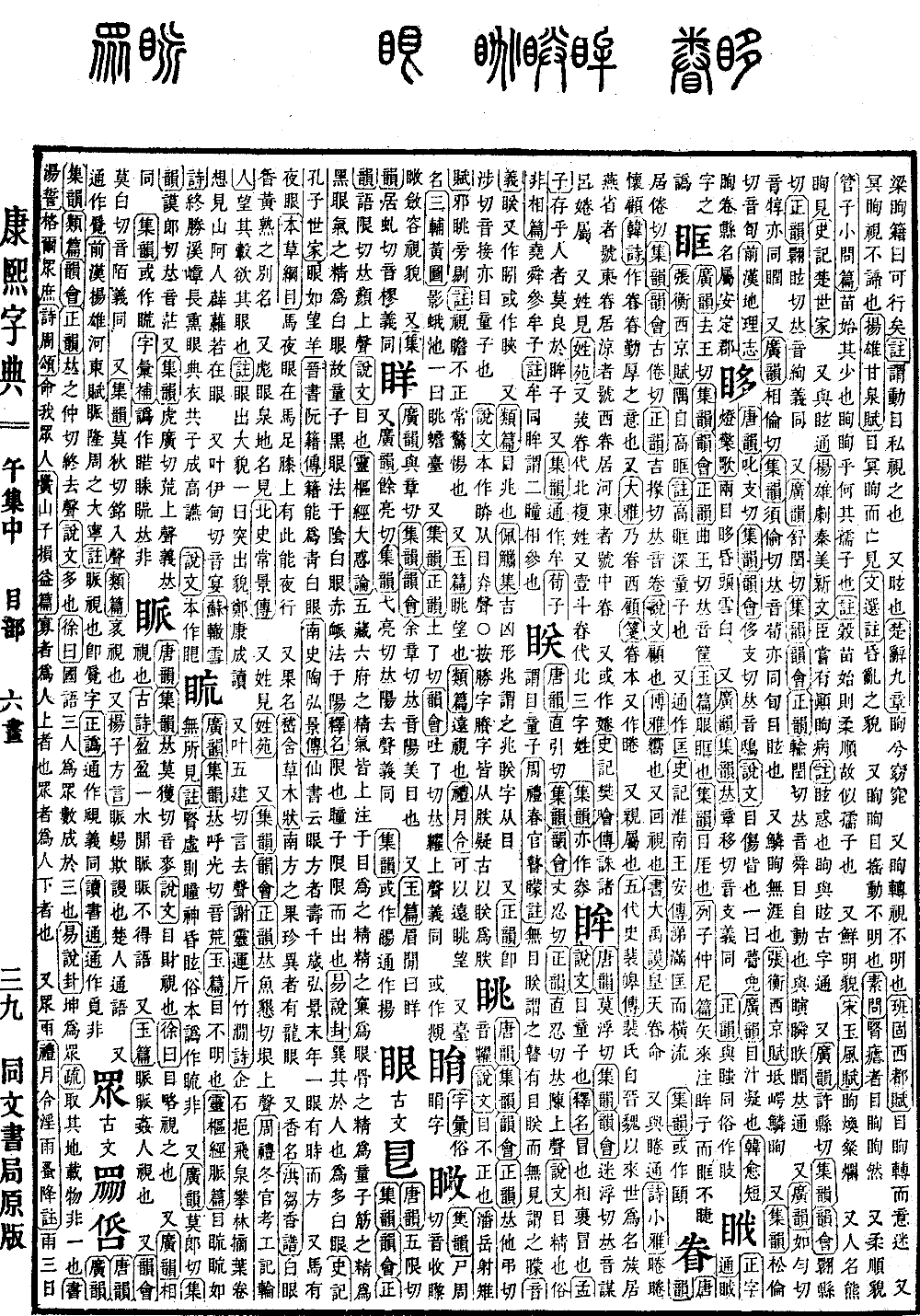
Pronounced yan (rising tone). According to the Tang Rhyme (Tangyun), Collection of Rhymes (Jiyun), Compendium of Rhymes (Yunhui), and Orthodox Rhymes (Zhengyun), it is pronounced yan (rising tone). The Explanation of Script and Elucidation of Characters (Shuowen Jiezi) defines it as the organ of sight. The Spiritual Axis (Lingshu Jing), Chapter on Great Confusion (Dahuolun) states: The vital energy (qi) of the five viscera and six entrails all flows upward to the eyes to form the faculty of vision. The cavity where the vital energy gathers is the eye; the vital energy of the bones forms the pupil, the vital energy of the sinews forms the iris, and the vital energy of the qi forms the sclera. Thus, the pupil and iris are modeled after the yin principle, while the sclera and blood vessels are modeled after the yang principle. The Explanation of Names (Shiming) interprets the term as a boundary, meaning the pupil is constrained within the eye socket. The Book of Changes (Yijing), Discussion of the Trigrams (Shuogua) states: In relation to the human body, the Xun trigram represents eyes with prominent whites. The Records of the Grand Historian (Shiji), Hereditary House of Confucius describes Confucius as having eyes as high and distant as one gazing at a flock of sheep. The Book of Jin (Jinshu), Biography of Ruan Ji records that Ruan Ji was able to display blue-green eyes and white eyes (expressions of favor and disfavor). The History of the Southern Dynasties (Nanshi), Biography of Tao Hongjing states: Immortal texts claim that those with square-shaped pupils can live for a thousand years. In his later years, one of Tao Hongjing’s eyes occasionally appeared square. Additionally, horses possess night eyes. The Compendium of Materia Medica (Bencao Gangmu) states: The night eye of a horse is located on the knee of the leg; horses with night eyes can travel at night. There is also a fruit name. Ji Han’s Flora and Fauna of the South (Caomu Zhuang) notes that among the precious and exotic fruits of the south, there is the longan. There is also a name for a spice. The Fragrance Manual (Xiangpu) by Hong Chu records that white eye is an alias for yellow-ripe incense (gaharu). There is also Biaoyan Spring, a geographical name found in the History of the Northern Dynasties (Beishi), Biography of Chang Jing. It is also a surname, as seen in the Garden of Surnames (Xingyuan).
Also pronounced yin (rising tone) according to the Collection of Rhymes (Jiyun), Compendium of Rhymes (Yunhui), and Orthodox Rhymes (Zhengyun). In the Rites of Zhou (Zhouli), Winter Officer, Record of Artisans (Kaogongji), regarding wheel-makers: Observe the wheel hub, hoping it appears to protrude. The commentary explains it as the appearance of being convex. Another interpretation suggests it means protruding. This is the reading provided by Zheng Kangcheng.
Also used as a rhyming word, pronounced yan (falling tone). Xie Lingyun’s Poem on Jinzhu Bamboo writes: Stepping on stones to scoop up flying springs, climbing through woods to pluck curled tender leaves. Imagining the person in the mountain bend, it is as if seeing them draped in creeping fig and dodder right before my eyes.
Also used as a rhyming word, pronounced yan (falling tone). Su Zhe’s Poem on Snow writes: Ultimately better than the mountain stream mist long obscuring the eyes, pawning clothes with my son to attend this elegant feast of poetry and wine.
The original form in the Explanation of Script and Elucidation of Characters (Shuowen Jiezi) was written with a different character structure.