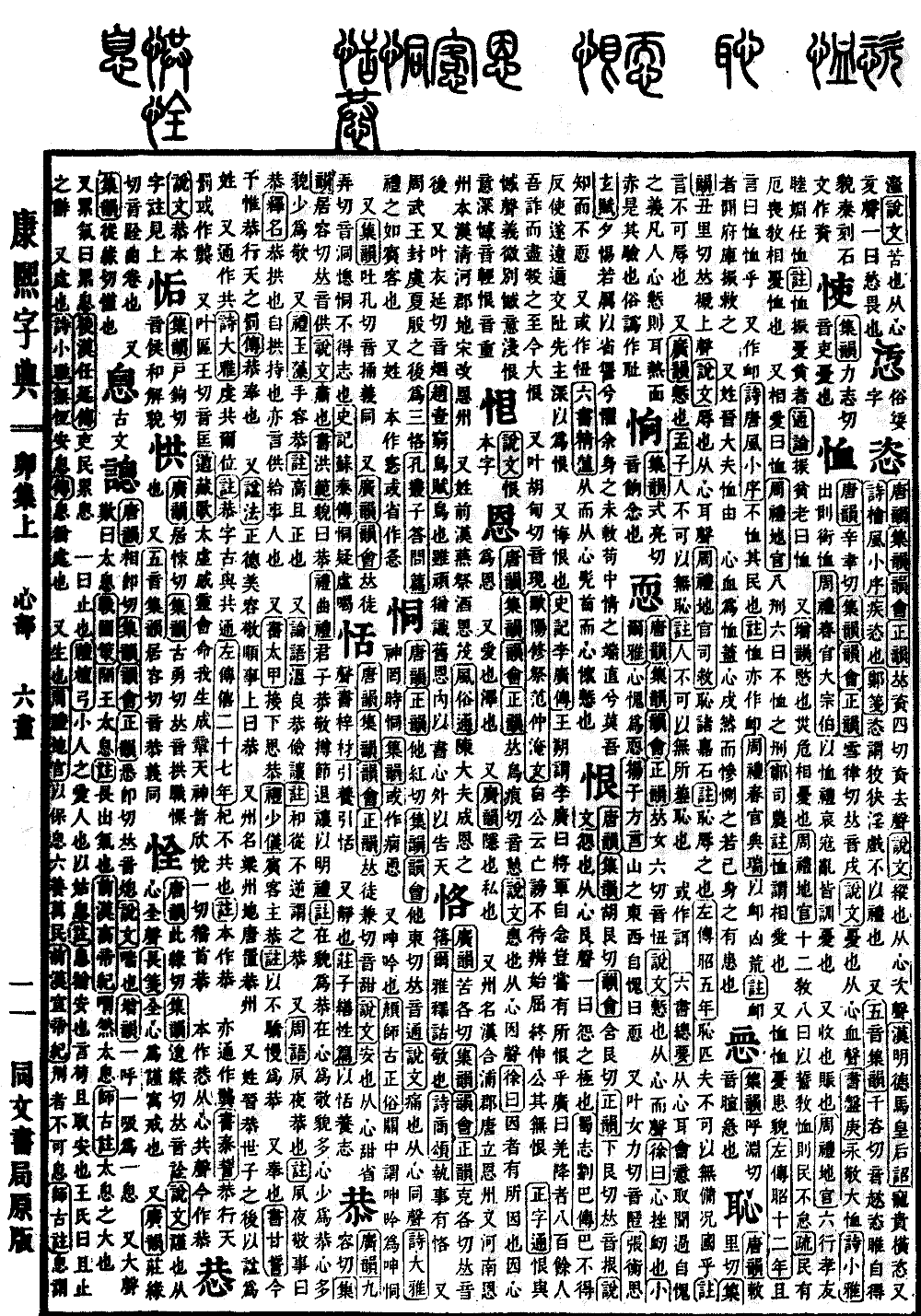
Mao Collection, Upper Volume
Radical: Heart (xīn)
恨
Kangxi strokes: 10
Page 385, Entry 09
Tang Rhymes (Tangyun), Collected Rhymes (Jiyun), Rhyme Meetings (Yunhui), and Orthodox Rhymes (Zhengyun) all pronounce it hen.
According to the Explaining Graphs and Analyzing Characters (Shuowen), it means resentment. Formed by the radical for heart and the phonetic component gen. Another definition is the height of resentment.
In the Records of the Three Kingdoms (Shuzhi), Biography of Liu Ba, it is written: Ba was unable to return, and went far away to Jiaozhi. The First Emperor deeply felt this as a regret.
It also means to regret. In the Records of the Grand Historian (Shiji), Biography of Li Guang, Wang Shuo said to Li Guang: General, do you ever reflect on having any regrets? Guang said: Eight hundred surrendered Qiang tribesmen were tricked and killed by me; to this day, I feel great regret.
It also rhymes with dian, pronounced xian. In Ouyang Xiu’s Eulogy for Fan Zhongyan, it is written: Since you passed away, the slanders do not need to be clarified. Beginning in obscurity and ending in glory, may you have no regrets.
According to the Comprehensive Dictionary of Characters (Zhengzitong), there is a subtle difference between the sounds and meanings of hen and han. Han implies a shallow feeling, while hen implies a deep feeling; han is light in sound, while hen is heavy.