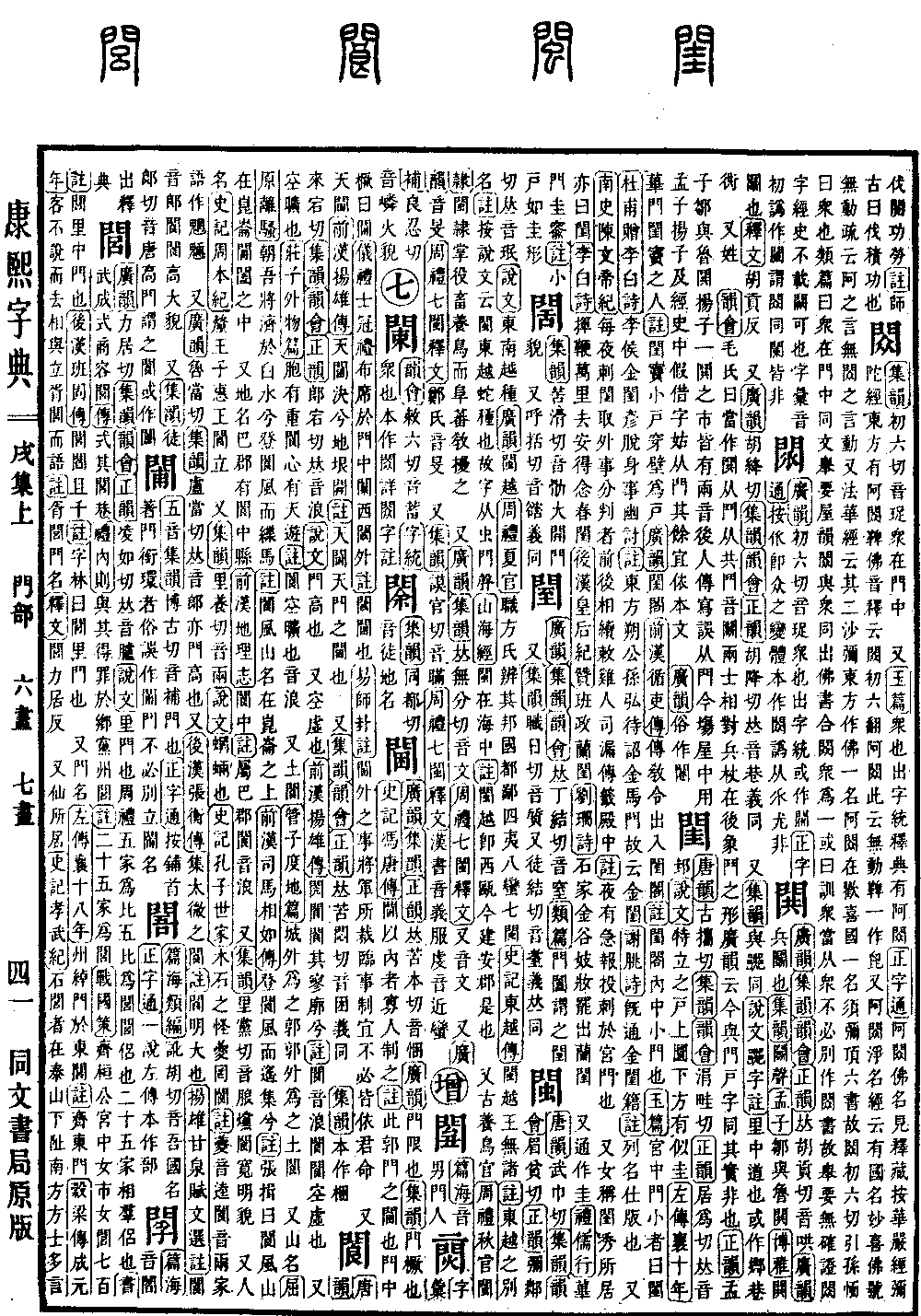
Xu Collection, Upper Volume
Radical: Gate (mén)
Lang
Kangxi strokes: 15
Page 1335, Entry 01
Pronounced lang (falling tone) according to Tang Rhyme (Tangyun). Pronounced lang (falling tone) according to Collected Rhymes (Jiyun), Rhyme Compendium (Yunhui), and Correct Rhymes (Zhengyun).
According to Explanation of Simple and Compound Characters (Shuowen), it means a high gate. It also means empty or void.
In the Biography of Yang Xiong in the History of the Former Han (Qianhan Shu), it is written: Vast and empty is the great expanse. The commentary states: Pronounced lang (falling tone). Langlang means empty and void. It also means open and spacious.
In the External Objects chapter of the Zhuangzi, it is written: The bladder has multiple cavities, the heart has celestial wanderings. The commentary states: Lang means open and spacious. Pronounced lang (falling tone).
Also refers to an earthen embankment (tulang). In the Measuring the Land chapter of the Guanzi, it is written: Outside the city walls are the outer ramparts, and outside the outer ramparts are the earthen embankments.
Also a mountain name. In the Encountering Sorrow (Lisao) by Qu Yuan, it is written: In the morning I will cross the White Water, and ascend Langfeng to tether my horse. The commentary states: Langfeng is the name of a mountain located atop Mount Kunlun.
In the Biography of Sima Xiangru in the History of the Former Han (Qianhan Shu), it is written: Ascending Langfeng to gather from afar. The commentary states: Zhang Yi says that Langfeng Mountain is located within the Changhe gates of Kunlun.
Also a place name. In Ba Commandery there is Langzhong County. In the Treatise on Geography in the History of the Former Han (Qianhan Shu), it is written: Langzhong. The commentary states: Belonging to Ba Commandery. Lang is pronounced lang (falling tone).
According to Collected Rhymes (Jiyun), pronounced lang (rising tone). Tanglang means wide and bright in appearance.
Also a person's name. In the Annals of Zhou in the Records of the Grand Historian (Shiji), it is written: Upon the death of King Li, his son King Hui Lang ascended the throne.
According to Collected Rhymes (Jiyun), pronounced liang (rising tone). According to Explanation of Simple and Compound Characters (Shuowen), it refers to mountain demons (wangliang). In the Hereditary House of Confucius in the Records of the Grand Historian (Shiji), it is written: The strange creatures of wood and stone are the Kui and the Wangliang. The commentary states: Kui is pronounced kui (rising tone). Lang is pronounced liang (rising tone). The School Sayings of Confucius (Kongzi Jiayu) renders this as wangliang.
According to Wide Rhymes (Guangyun), pronounced lang (level tone). According to Collected Rhymes (Jiyun), pronounced lang (level tone). Also refers to a high gate.
In the Biography of Zhang Heng in the History of the Later Han (Houhan Shu), it is written: Gathering at the Lang of the Supreme Tenuity star. The commentary states: Lang means bright and large. In the commentary to the Selection of Literature (Wenxuan) for Yang Xiong's Rhapsody on the Sweet Spring Palace, it is noted: Lang is pronounced lang (level tone). Langlang means high and large in appearance.
According to Collected Rhymes (Jiyun), pronounced tang (level tone). A high gate is called a Lang. Sometimes written as a variant form.