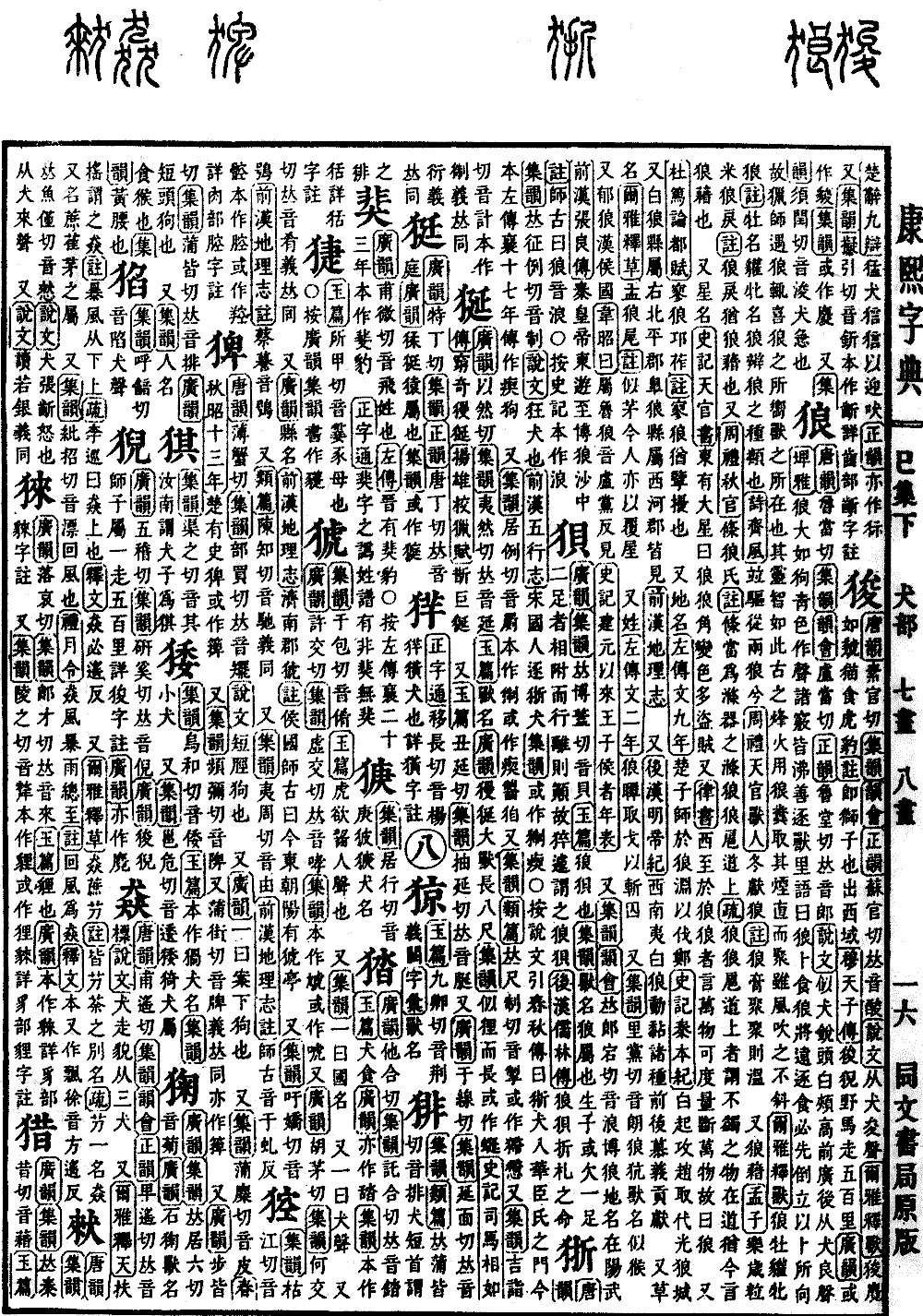
Si Collection, Lower Volume
Radical: Dog (quǎn)
Kangxi Strokes: 11
Page 712, Entry 02
Pronounced lang.
In the Explanation of Graphs (Shuowen), it is described as resembling a dog, with a pointed head, white cheeks, high shoulders, and a broad hindquarters. Derived from the radical for dog, with lang acting as the phonetic component.
In the Expanded Encyclopedia (Piya), the wolf is described as being as large as a dog, greyish in color, and when it howls, all its orifices appear as if boiling; it is adept at chasing wild beasts. Popular folk belief suggests that wolves can divine for food. When a wolf must travel far to hunt, it is said to stand on its hind legs to divine the direction; therefore, hunters are pleased to encounter one. The direction the wolf faces is where the prey is located, demonstrating such spiritual intelligence. In ancient times, wolf dung was used in signal fires because its smoke rises straight and gathered, remaining upright even in the wind.
In the Literary Expositor (Erya), section on beasts: the male is called huan, and the female is called lang. Commentary: The male is named huan and the female is named lang; this distinguishes the sex of the wolf.
In the Book of Odes (Shijing), Qi Odes: Driving side by side to pursue two wolves.
In the Rites of Zhou (Zhouli), Offices of Heaven, the beast-keeper: In winter, offer wolves. Commentary: The fat of the wolf gathers, and when it gathers, it is warm.
There is also the term langji (scattered and in disarray).
In the Mencius: In a bountiful year, grain is so abundant that it is thrown about in disorder. Commentary: Langli is synonymous with the meaning of langji.
There is also the Tiaolangshi mentioned in the Rites of Zhou (Zhouli), Offices of Autumn. Commentary: Tiao should be understood as di, meaning to cleanse or sweep. Langlanghu refers to unclean things cluttering the road, similar to the current usage of langji.
There is also a star name. In the Records of the Grand Historian (Shiji), Treatise on the Celestial Offices: In the east, there is a large star called the Wolf Star (Langxing). When the color of the Wolf Star changes, bandits become numerous.
There is also the Book of Statutes (Lüshu): Extending westward to the Wolf Star. Lang refers to the capacity to measure all things; hence, the term for judging all things is derived from lang.
There is also Du Du’s Rhapsody on the Capital (Lun Du Fu): Liaolang Qiongzhuo. Commentary: Liaolang is similar to the meaning of disturbance or agitation.
There are also place names. In the Zuo Tradition (Zuo Zhuan), ninth year of Duke Wen: The King of Chu stationed his troops at Langyuan to attack the state of Zheng.
In the Records of the Grand Historian (Shiji), Annals of Qin: Bai Qi attacked the state of Zhao and seized Guanglang City in the Dai region.
There is also Bailang County, belonging to Youbeiping Commandery, and Gaolang County, belonging to Xihe Commandery. Both appear in the History of the Former Han (Qianhan Shu), Treatise on Geography.
In the Annals of Emperor Ming of the Later Han (Houhan Shu): The southwestern tribes, including the Bailang and Dongnian, came to offer tribute in admiration of righteousness.
There is also a grass name. In the Literary Expositor (Erya), section on grasses: Meng langwei. Commentary: Resembles cogon grass; people today use it to thatch roofs.
There is also a surname. In the Zuo Tradition (Zuo Zhuan), second year of Duke Wen: Lang Tan took up a spear to execute a prisoner.
Pronounced lang. Langkang is the name of a wild beast resembling a monkey.
There is also Yulang, a marquisate during the Han dynasty. Wei Zhao states it belonged to the land of Lu. The pronunciation of lang is indicated as lu-dang. It appears in the Records of the Grand Historian (Shiji), Table of Princes and Marquises since the Jianyuan Era.
Pronounced lang. Bolang is a place name located in Yangwu. In the History of the Former Han (Qianhan Shu), Biography of Zhang Liang: The First Emperor of Qin traveled east and arrived at Bolangsha. Commentary: Shigu states that lang is pronounced as lang. According to the original text of the Records of the Grand Historian (Shiji), it is written as lang.