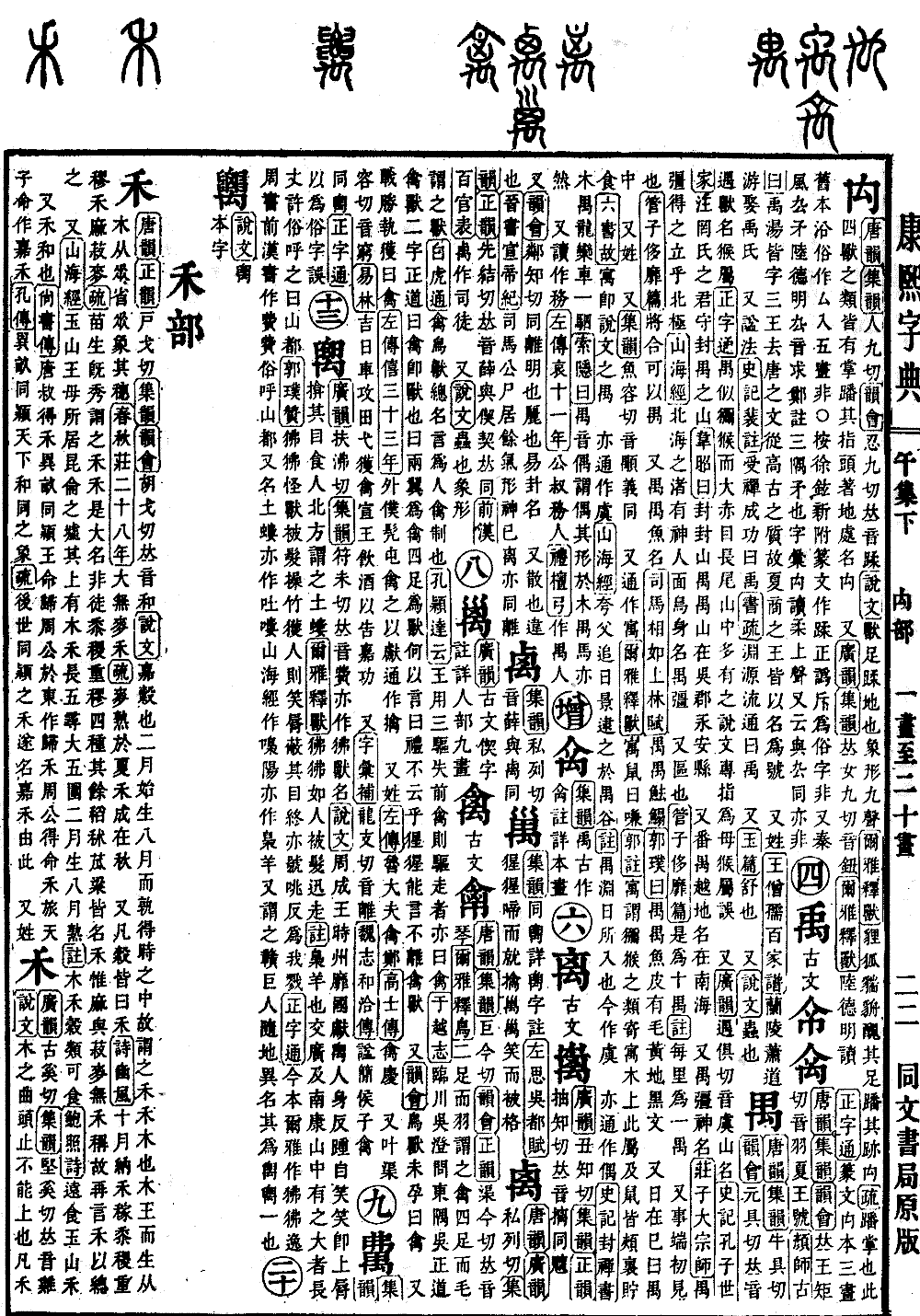
Wu Collection, Lower Volume
Radical: Claw (ròu)
Page 848, Entry 05
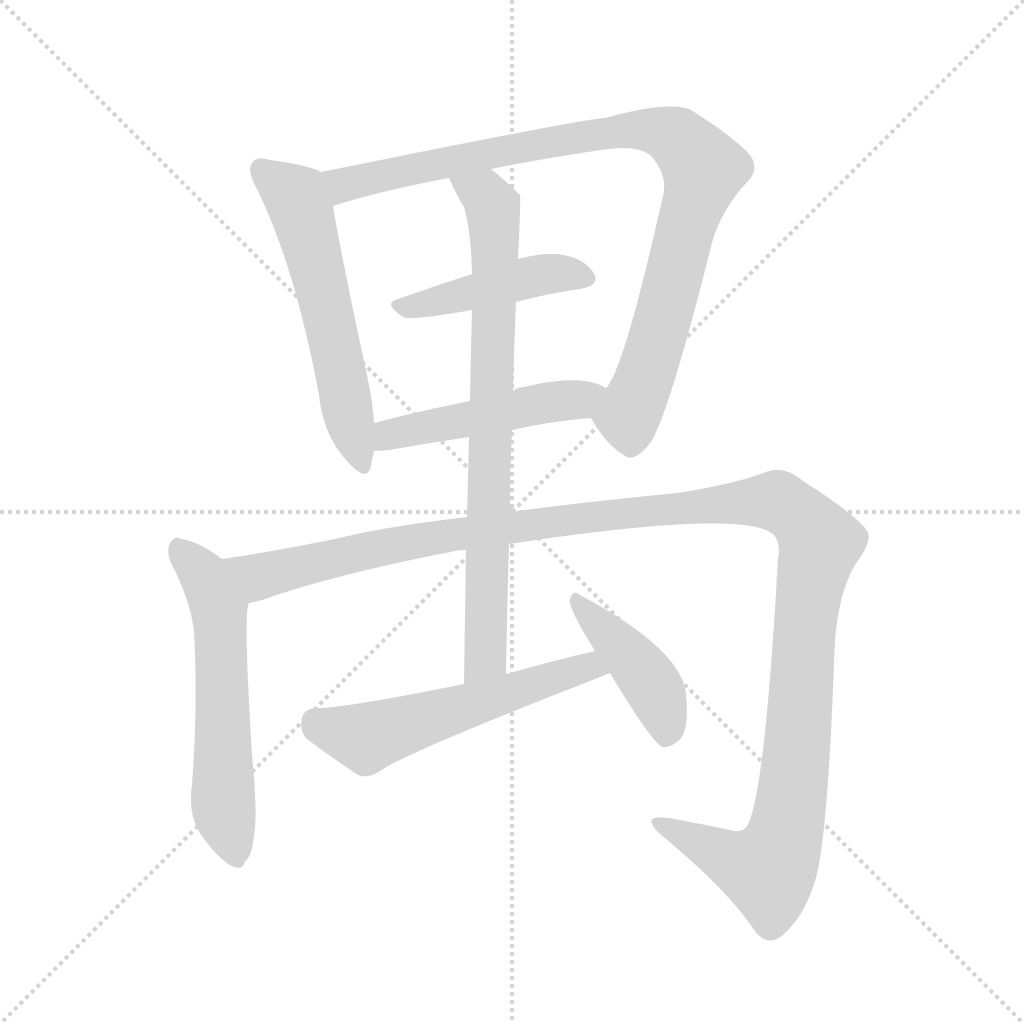
Pronounced yu (falling tone). Name of a beast, of the monkey species.
Correct Meaning (Zhengzitong): The yu resembles a macaque but is larger, with red eyes and a long tail; it is found in large numbers in the mountains. The explanation in the Explaining Graphs and Analyzing Characters (Shuowen Jiezi) that it specifically refers to a female monkey is incorrect.
Also pronounced yu (level tone). Name of a mountain.
Records of the Grand Historian (Shiji), Hereditary House of Confucius: The ruler of the Wangwang clan guarded Mount Feng and Mount Yu.
Wei Zhao states: Feng is Mount Feng. Yu is Mount Yu. It is located in Yong'an County, Wu Commandery.
Also Fanyu, a place name in the Yue region. Located in Nanhai.
Also Yuqiang, name of a deity. Zhuangzi, The Great and Venerable Teacher: Yuqiang obtained it and stood at the North Pole. Classic of Mountains and Seas (Shanhaijing): In the small islets of the North Sea there is a deity with a human face and a bird's body, named Yuqiang.
Also signifies a region. Guanzi, On Extravagance: This is called ten yu. Commentary: Each li constitutes one yu.
Also refers to the initial signs of an event. Guanzi, On Extravagance: When one is about to form an alliance, one may begin from the yu.
Also Yuyu, name of a fish. Sima Xiangru, Rhapsody on the Shanglin Park: Yuyu, qu, and ta fish. Guo Pu states: The yuyu has hair on its skin, with a yellow background and black markings.
Also, the sun during the si-hour (approximately 9:00 to 11:00 a.m.) is called yuzhong.
Also a surname.
Also pronounced yong (level tone). The meaning is the same.
Also used interchangeably with the variant form (yu). Er'ya, Explaining Beasts: The yu is called qian. Guo's Commentary: The yu refers to the macaque species, which resides in trees; these creatures and others store food in their cheeks. Six Writings (Liushu Gu): The character yu is the same as the yu in the Explaining Graphs and Analyzing Characters (Shuowen Jiezi).
Also used interchangeably with the variant form (yu). Classic of Mountains and Seas (Shanhaijing): Kua Fu chased the sun's shadow and caught up with it at Yugu. Commentary: Yuyan is the place where the sun sets. It is now written as yu.
Also used interchangeably with the variant form (ou). Records of the Grand Historian (Shiji), Treatise on the Feng and Shan Sacrifices: A team of four wooden yu horses drawing a carriage. Suoyin states: Yu is pronounced ou. It means to replicate its shape in wood; the same applies to wooden horses.
Also pronounced wu (falling tone). Zuo Tradition (Zuo Zhuan), 11th Year of Duke Ai: Gongshu Wuren. Book of Rites (Liji), Tan Gong: Written as Yuren.