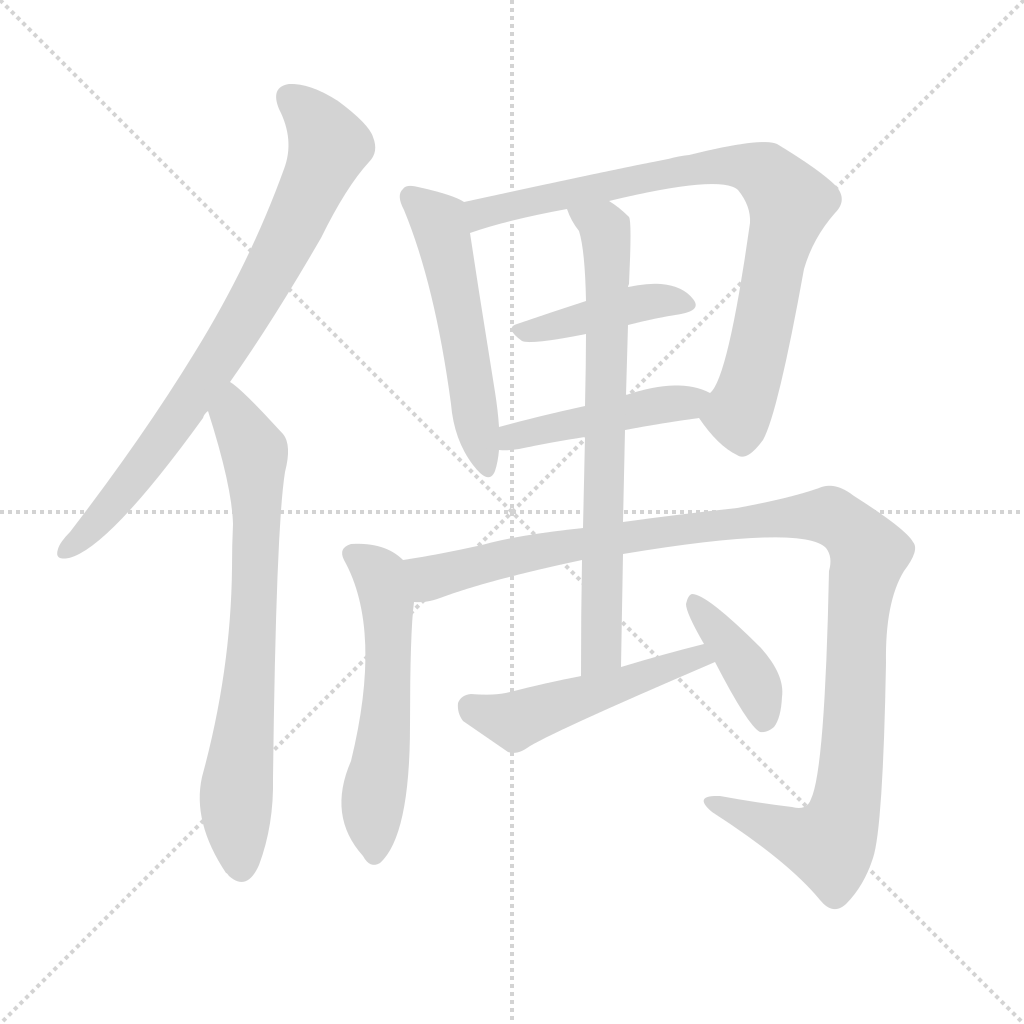
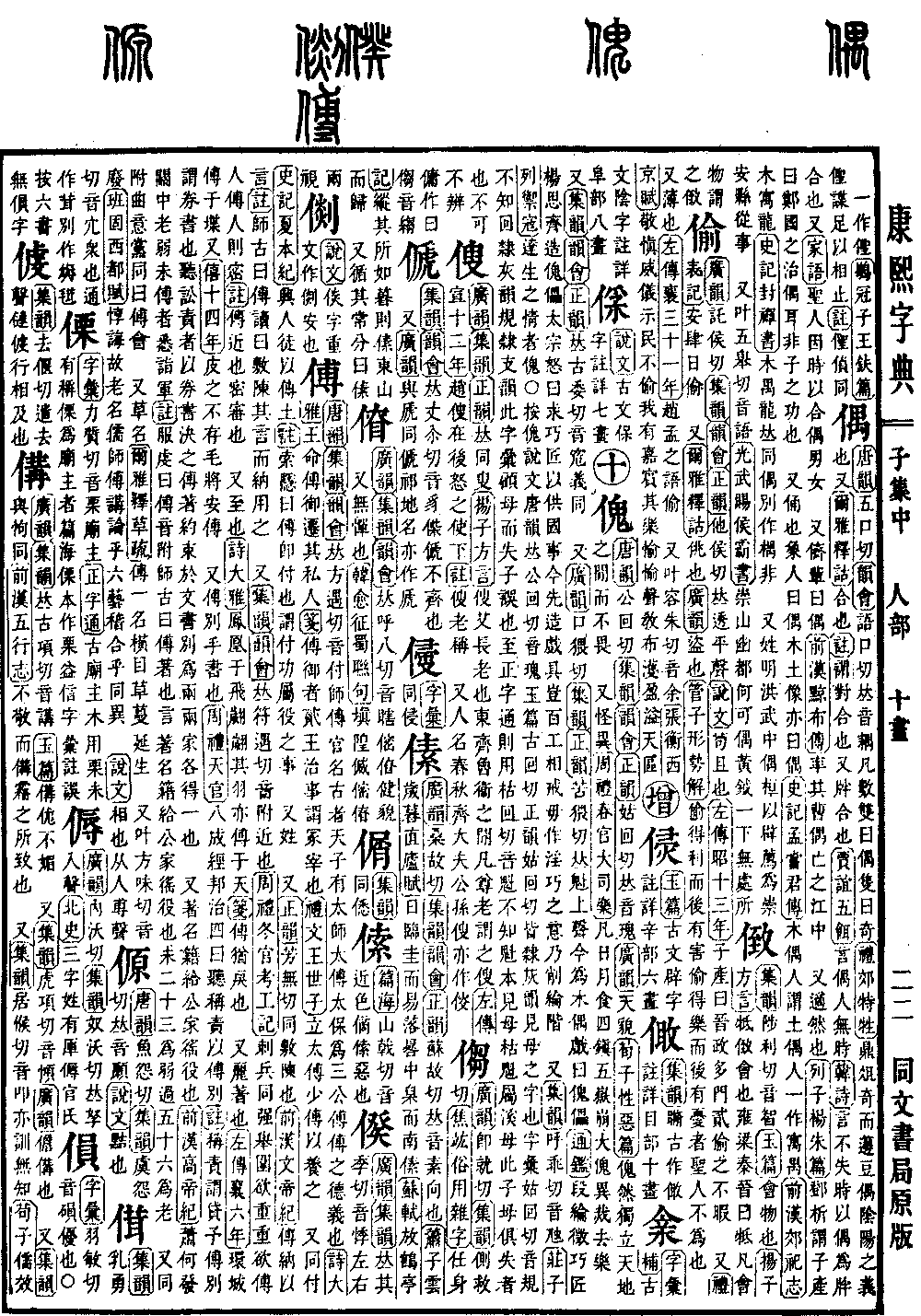
Zi Collection, Middle Volume
Radical: Person (rén)
Ou; Kangxi brush strokes: 11; Page number: Page 112, entry 01
According to Tang Yun (Tang yun) and Yunhui (Yun hui), pronounced ou (third tone). Any number that is a pair is called ou, while an odd number is called ji. In the Book of Rites (Liji), specifically the Jiao Tesheng chapter, it states that sacrificial vessels such as the ding and zu are used in odd numbers, while the bian and dou are used in even numbers; this follows the principles of yin and yang. It also means to join, as noted in the Erya: Shi Gu (Erya: shi gu). The commentary explains this as objects corresponding and joining together. It also refers to matching or pairing. In the Five Baits (Wu er) by Jia Yi, it says that connecting with people has no fixed time. The Han Poetry (Han shi) mentions not missing the opportunity, using the term ou to mean matching or pairing. According to the Family Sayings (Jia yu), the sage follows the trends of the times to facilitate the marriage and union of men and women. It also refers to peers as ou. In the Biography of Qing Bu in the History of the Former Han (Qian han shu: Qing bu zhuan), it mentions he led his associates and fled into the river. It also means accidentally or by chance. In the Yang Zhu chapter of the Liezi (Liezi), Deng Xi says to Zichan: The governance of the State of Zheng is merely a matter of chance; it is not your merit. It also refers to an idol. An image resembling a person is called an ou, and figures made of wood or clay are also called ou. In the Biography of Lord Mengchang in the Records of the Grand Historian (Shiji: Meng chang jun zhuan), it mentions a wooden puppet speaking to a clay puppet. It is also written as yu or yu. In the Treatise on Suburban Sacrifices in the History of the Former Han (Qian han shu: Jiao si zhi), it refers to a wooden dragon image. In the Records of the Grand Historian: Treatise on the Feng and Shan Sacrifices (Shiji: Feng shan shu), it uses a wooden image of a dragon, which is the same as ou. Another variant is written, which is incorrect. It is also a surname. During the Hongwu reign of the Ming Dynasty, Ou Huan was recommended to serve as an official in Chong'an County. Furthermore, for the sake of rhyme, it is pronounced yu (third tone). In the Letter from Emperor Guangwu to Hou Ba, it asks how could the deep recesses of the lofty mountains possibly match this, and if the yellow axe is wielded, there will be no place to take refuge.