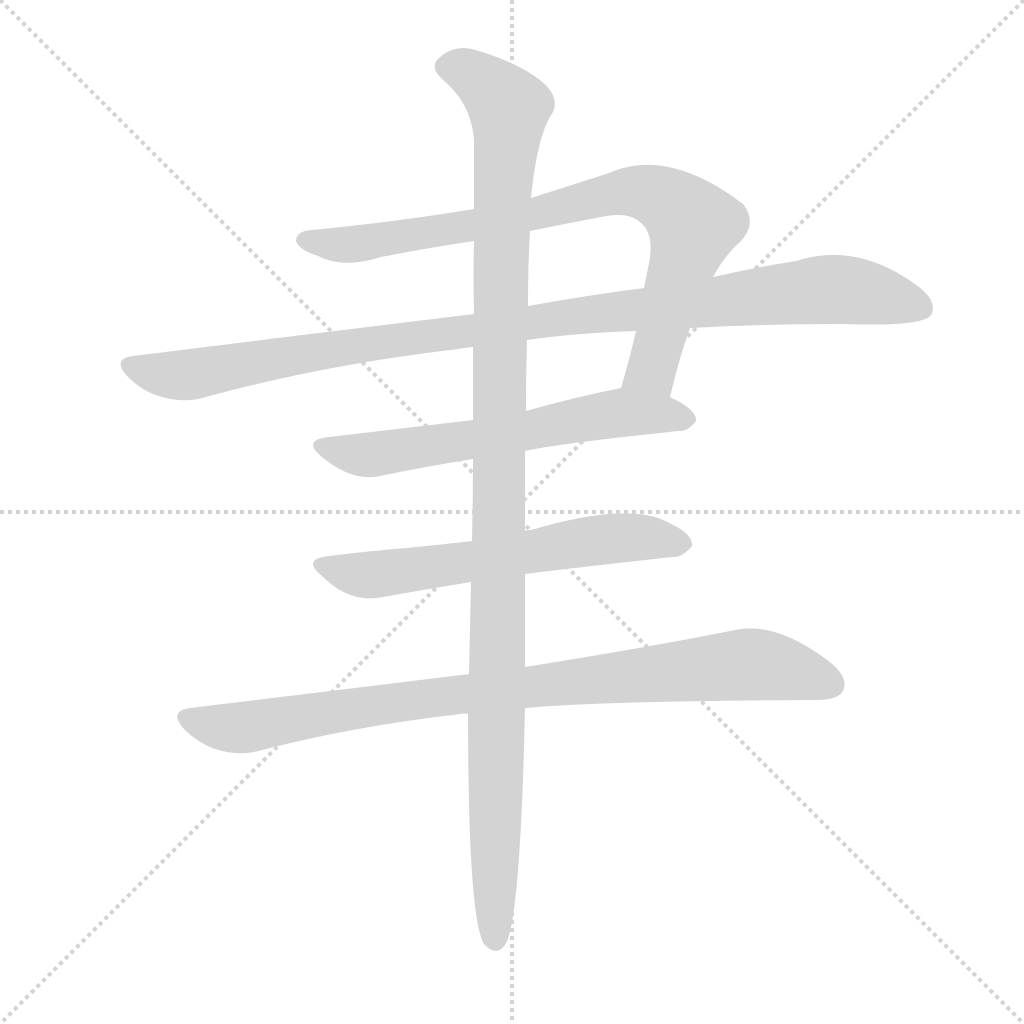
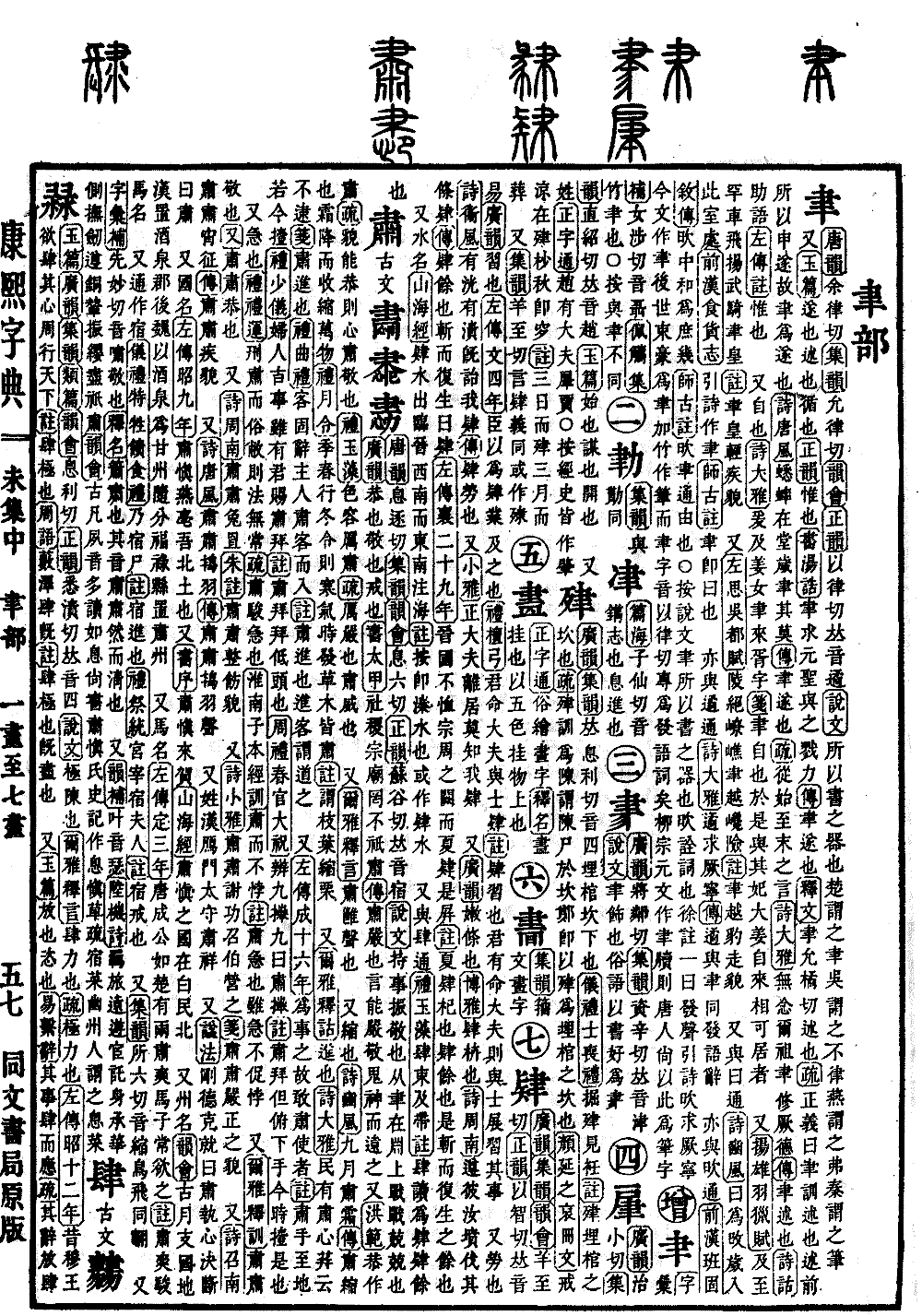
Wei Collection, Middle Volume
Radical: Writing Brush (yù)
Kangxi Strokes: 6
Page 971, Entry 01
Pronounced yù.
According to the Explaining Graphs and Analyzing Characters (Shuowen Jiezi), it is an instrument used for writing. In the Chu region, it is called yu; in the Wu region, it is called bulü; in the Yan region, it is called fu; and in the Qin region, it is called bi (writing brush).
According to the Jade Chapters (Yupian), it also means "thereupon," "to state," or "to follow."
According to the Correct Rhymes (Zhengyun), it can also mean "only" or "merely."
Book of Documents (Shangshu), Tanggao: "Thereupon seeking a great sage, to work with him in harmony." The commentary states: "Yu means thereupon."
The Explication of Texts (Shiwen) notes: "Yu, pronounced as yu, means to state." The sub-commentary explains: "The standard interpretation states that yu is interpreted as stating. By stating the cause, one clarifies the result, thus yu carries the meaning of thereupon."
Book of Odes (Shijing), Tangfeng: "The cricket is in the hall, the year is coming to an end." The commentary states: "Yu means thereupon." The sub-commentary explains: "It signifies the entire process from beginning to end."
Book of Odes (Shijing), Daya: "Keep in mind your ancestors, state and cultivate their virtues." The commentary states: "Yu means to state."
Exegesis of the Odes (Shigu): A grammatical particle.
Commentary on the Zuo Tradition (Zuozhuan Zhu): Means "only."
It also refers to oneself or one's own person.
Book of Odes (Shijing), Daya: "Thereupon with the lady of the Jiang surname, he personally came to inspect the dwelling." The笺 (Jian) commentary states: "Yu means oneself. Thereupon with his wife Taijiang, he personally came to inspect the place where they could live."
Yang Xiong, Yulie Fu: "Wait until the rare carriages gallop, the martial riders are light and swift." The commentary states: "Yuhuang, the appearance of being light and swift."
Zuo Si, Wudu Fu: "Striding over the extremely high mountain peaks, leaping over the precipices as swiftly as a leopard." The commentary states: "Yuyue, the appearance of a leopard running."
It is also interchangeable with yue.
Book of Odes (Shijing), Binfeng: "Saying it is time to pass the year, enter this room to live."
History of the Former Han (Qianhan Shu), Treatise on Food and Money: Quotes the Book of Odes (Shijing) using the character yu. The commentary by Shigu states: "Yu is the same as yue."
It is also interchangeable with yu.
Book of Odes (Shijing), Daya: "Thereupon seeking that peace." The commentary states: "Yu and yu are the same. It is an initial particle."
It is also interchangeable with yu.
History of the Former Han (Qianhan Shu), Ban Gu Xuzhuan: "Following the path of moderation is nearly sufficient." The commentary by Shigu states: "Yu and yu are similar in meaning, signifying 'from' or 'by'."
According to the analysis in the Explaining Graphs and Analyzing Characters (Shuowen Jiezi), yu is an instrument used for writing. Yu is a word used to explain other terms. Xu's commentary notes that some say it indicates a vocal sound. Quoting the Book of Odes (Shijing): "Thereupon seeking that peace." In current texts, it is written as yu, but in later generations, hair was bundled to make a yu, and with the addition of the bamboo radical, it became bi (brush). The character yu, pronounced as yu, is specifically used as an initial particle. Liu Zongyuan's writings use the phrase yudu (brush and tablet), so people in the Tang dynasty still used this character to represent a brush.