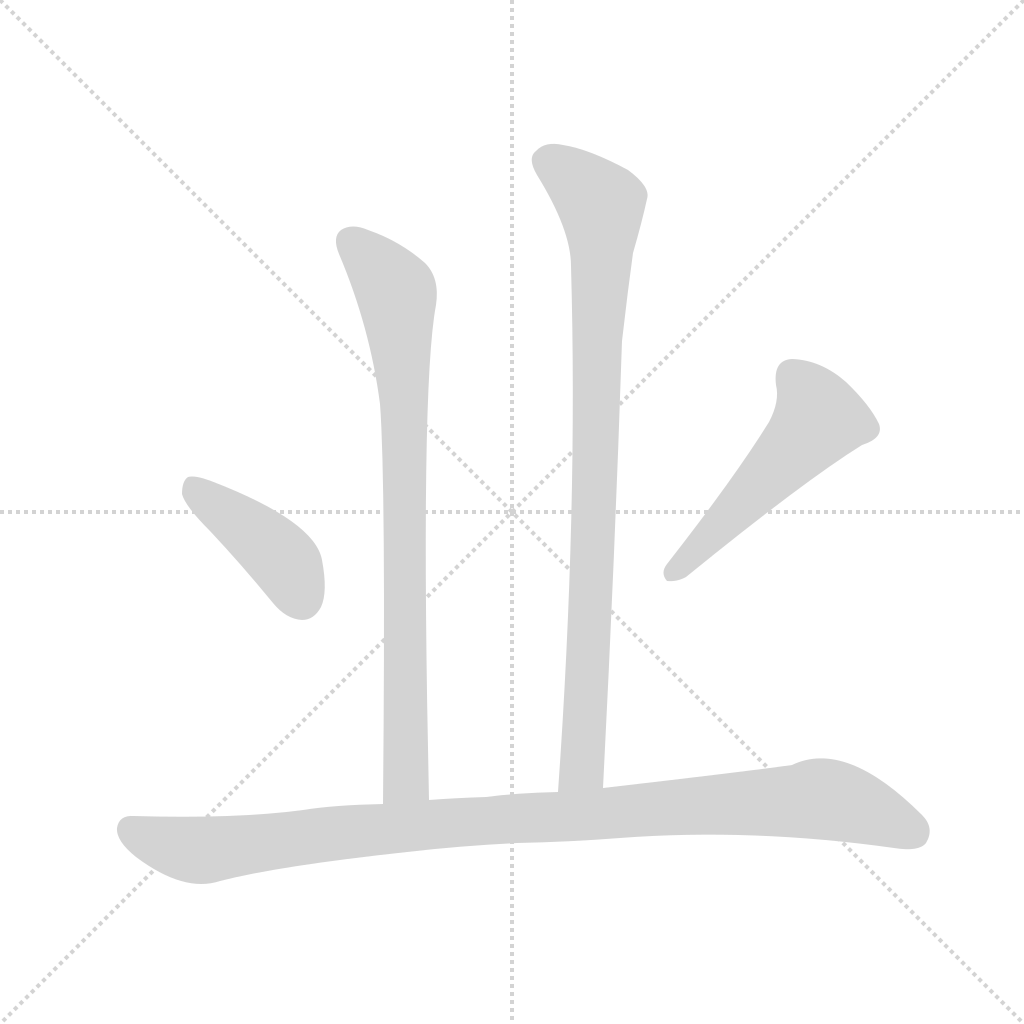
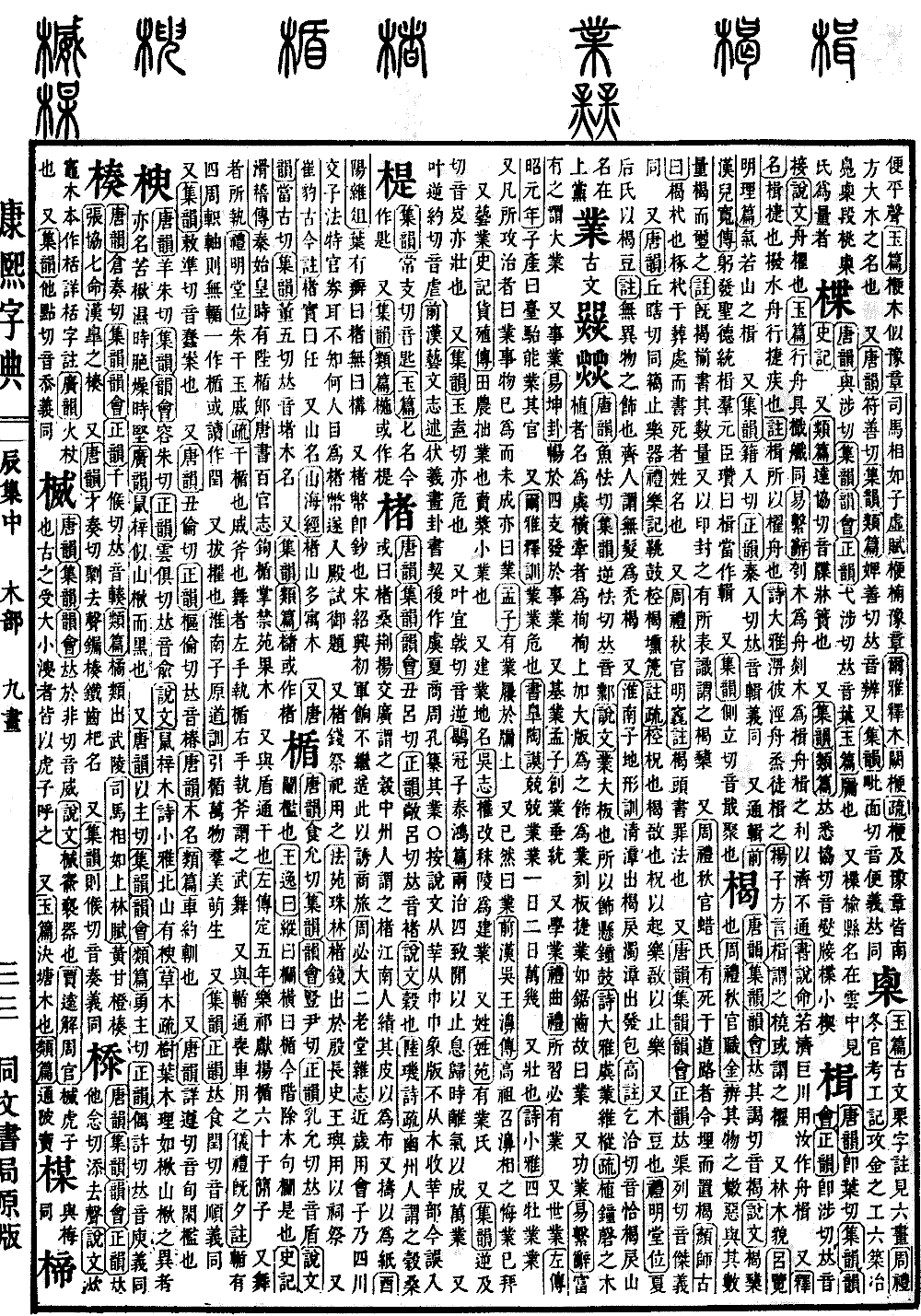
Chen Collection, Middle Volume. Radical: Wood (mù). Ye; Kangxi Stroke Count: 13; Page 541. Ancient script form. Tang Rimes (Tangyun): yú and qiè cut. Collected Rimes (Jiyun): nì and qiè cut. Sounding like yè. Analytical Dictionary of Characters (Shuowen Jiezi): Ye means a large board used to decorate the frame for hanging bells and drums. The bell frames and their boards are tall and jagged — Book of Odes (Shijing). Commentary: The wooden frame supporting bells and chimes; the vertical posts are called jù, the horizontal crossbars are called xún, and the large decorative boards added to the crossbars are called yè. The boards are carved with serrated edges like saw teeth, which is why they are called yè. It also refers to meritorious achievements. Abundance is called the Great Achievement — Book of Changes (Yijing). It also refers to undertakings or career. It flows through the four limbs and manifests in undertakings — Book of Changes (Yijing). It also refers to a foundation or legacy. Establishing a foundation and passing down a tradition — Mencius (Mengzi). It also refers to studies or academic work. What one practices must have a specific course of study — Book of Rites (Liji). It also refers to a hereditary profession or a continuing task. Zichan said that Taitai was able to make a profession of his office — Zuo Commentary (Zuozhuan). Also, Erya: Yeye describes a state of being cautious and fearful. Be cautious and apprehensive, for in one or two days, ten thousand matters arise — Book of Documents (Shujing). It also refers to being tall, large, and majestic. The four stallions are tall and strong — Book of Odes (Shijing). Generally, any work one is engaged in is called yè; a task that has begun but is not yet finished is also called yè. There were unfinished shoes on the windowsill — Mencius (Mengzi). It also means already. Emperor Gaozu summoned Bi to read his face and regretted that he had already been appointed — Book of the Former Han (Qian Hanshu). It also refers to a skill or trade. Farming is a clumsy trade; selling congee is a small trade — Records of the Grand Historian (Shiji). It also refers to Jianye, a place name. Sun Quan changed Moling to Jianye — Records of the Three Kingdoms (Sanguozhi). It is also a surname. There is a Ye clan — Dictionary of Surnames (Xingyuan). Also, Collected Rimes (Jiyun): nì and jí cut, sounding like jí. It also means majestic and strong. Also, Collected Rimes (Jiyun): yù and hé cut. It also means cautious and fearful. Also used as a rhyming word with the pronunciation nì. Two govern and four arrive, with intervals of rest. When the time returns and the qi departs, the ten thousand tasks are completed — Heguanzi. Also used as a rhyming word with the pronunciation nüè. Fuxi drew the hexagrams, and writing was created later. Through the eras of Yu, Xia, Shang, and Zhou, Confucius compiled his legacy — Book of the Former Han (Qian Hanshu). Note: According to the Analytical Dictionary of Characters (Shuowen Jiezi), the character is composed of the components shēn and jīn. The component jīn represents the board. It does not derive from the wood radical and was originally categorized under the shēn radical; its inclusion here is an error.