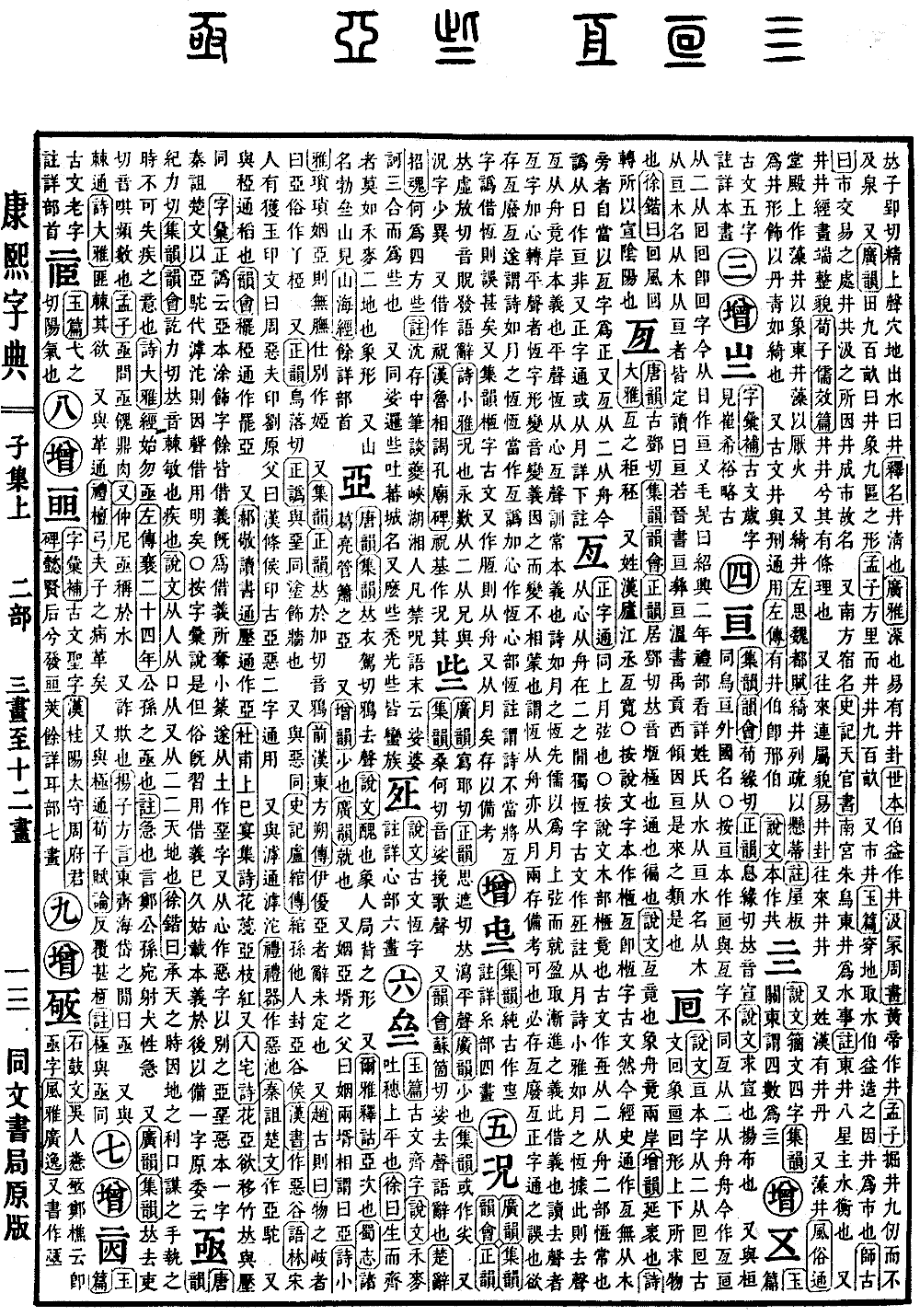
Zi Collection, Page Position: Upper
Radical: Two (èr)
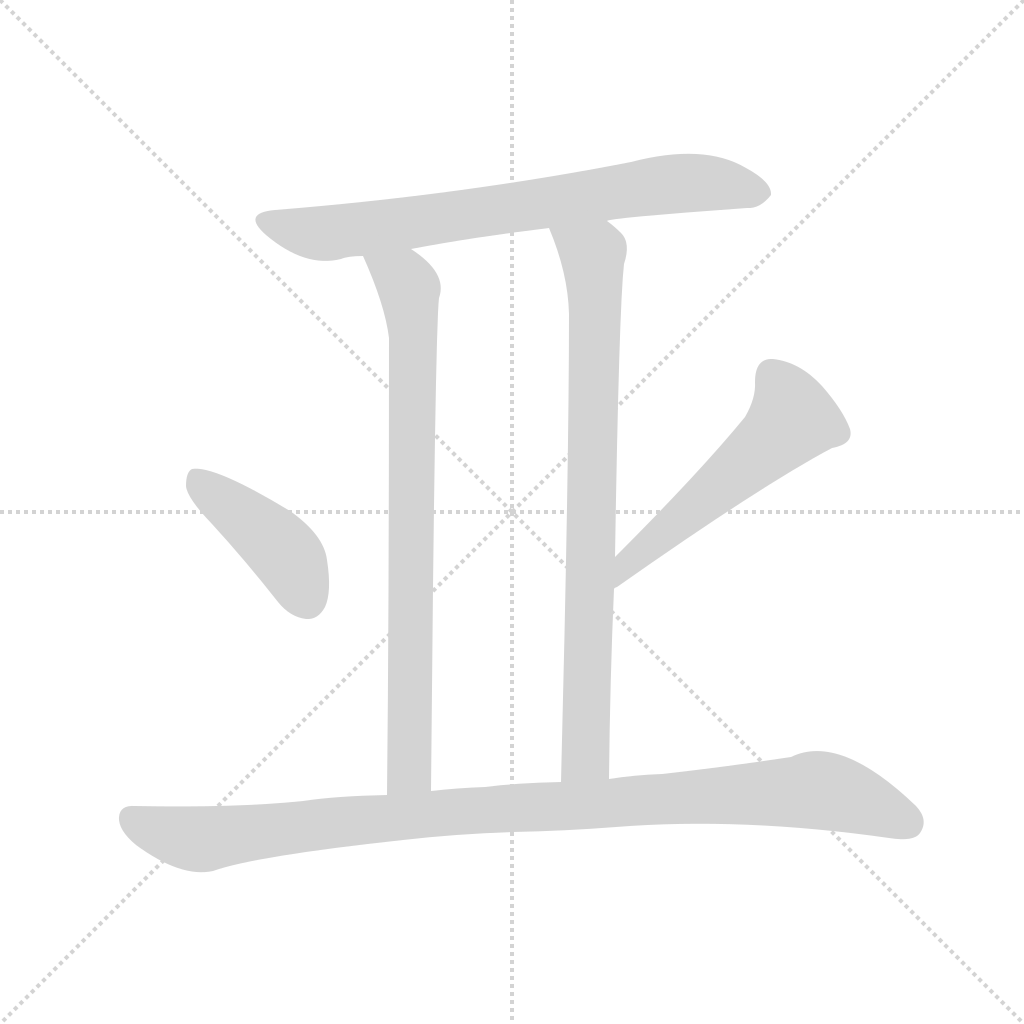
Character: yà
Kangxi stroke count: 8
Page 87, Number 08
The Tang Rhymes (Tangyun) and Collected Rhymes (Jiyun) state the pronunciation is derived from the sounds yì and jià, similar to the departing tone of the sound yā.
Explaining Graphs and Analyzing Characters (Shuowen Jiezi) defines the character as ugly or deformed, noting that the character shape resembles a person with a hunched back.
Also, Approaching the Correct (Erya), in the section Explaining Words (Shiyan), defines it as being of a secondary rank.
The Records of Shu (Shuzhi) states that Zhuge Liang was a figure of the same class as Guan Zhong and Xiao He, though slightly secondary to them.
Also, Supplemented Rhymes (Zengyun) defines it as few or small in amount.
Expanded Rhymes (Guangyun) defines it as close to or approaching.
It also refers to matrimonial relations: the father of a son-in-law is called yīn, while two sons-in-law refer to each other as yà.
The Minor Odes of the Kingdom (Xiaoya) within the Book of Odes (Shijing) says regarding those distant matrimonial relatives, do not grant them high office or rich salaries. It is also written in a variant form pronounced yà.
Also, Collected Rhymes and Correct Rhymes (Zhengyun) state the pronunciation is derived from the sounds yú and jiā, sounding like yā.
In the History of the Former Han (Qian Han Shu), Biography of Dongfang Shuo (Dongfang Shuo Zhuan), the phrase yī yōu yà indicates speech that is unsettled or hesitant.
Also, Zhao Guze states that the forked shape of an object is called yà. In common forms, it is written as yā or yā.
Also, Correct Rhymes states the pronunciation is derived from the sounds wū and luò.
Correcting Errors (Zheng'e) states it is identical to the character è, referring to whitewashing a wall.
It is also interchangeable with the character è, meaning evil.
In the Records of the Grand Historian (Shiji), Biography of Lu Wan (Lu Wan Zhuan), Lu Wan's grandson Taren was enfeoffed as the Marquis of Yagu. In the Book of Han (Hanshu), this is written as Egu.
The Forest of Sayings (Yulin) records that a person of the Song dynasty obtained a jade seal with the inscription Seal of Zhou Efu. Liu Yuanfu remarked that on the seal of the Marquis of Tiao from the Han dynasty, the characters yà and è were used interchangeably in ancient times.
It is also interchangeable with the character hū, referring to the Hutuo River.
In the Ritual Vessels (Liqi) within the Book of Rites (Liji), it is written as Echi. In the Cursing Chu Texts (Zu Chu Wen) of the Qin dynasty, it is written as Yatuo.
It is also interchangeable with the character yà, referring to rice grain.
Collected Rhymes (Yunhui) records that yà is also used interchangeably as bàyà.
Also, Hao Jing's Mastery of Reading (Dushu Tong) records that the character yā, meaning to press down, is interchangeable with yà.
In the poem Gathering for the Third Day of the Third Month (Shangsi Yanji Shi) by Du Fu, there is the line: flower stamens weigh down the branches with red. Also, in his poem People and Residences (Ren Zhai Shi), there is the line: flowers weigh down as if wanting to move the bamboo. Here, the character yà has the same meaning as yā, to weigh down.
The Correcting Errors section of the Character Collection (Zihui) states: The character yà was originally used to mean applying plaster or decoration; all other meanings are borrowed uses. Because the borrowed meanings became so frequent, the Small Seal script added the radical for Earth (tǔ) to write it as è for whitewashing, and added the radical for Heart (xīn) to write it as è for evil to distinguish them. Originally, the characters for yà, whitewash, and evil were one and the same. The use of Yatuo for the Hutuo River in the Cursing Chu Texts is clear evidence of borrowing based on identical pronunciation. The explanation in the Character Collection is correct, but since common usage has followed the borrowed meanings for a long time, the original meaning is recorded last to provide an understanding of the character's origins.