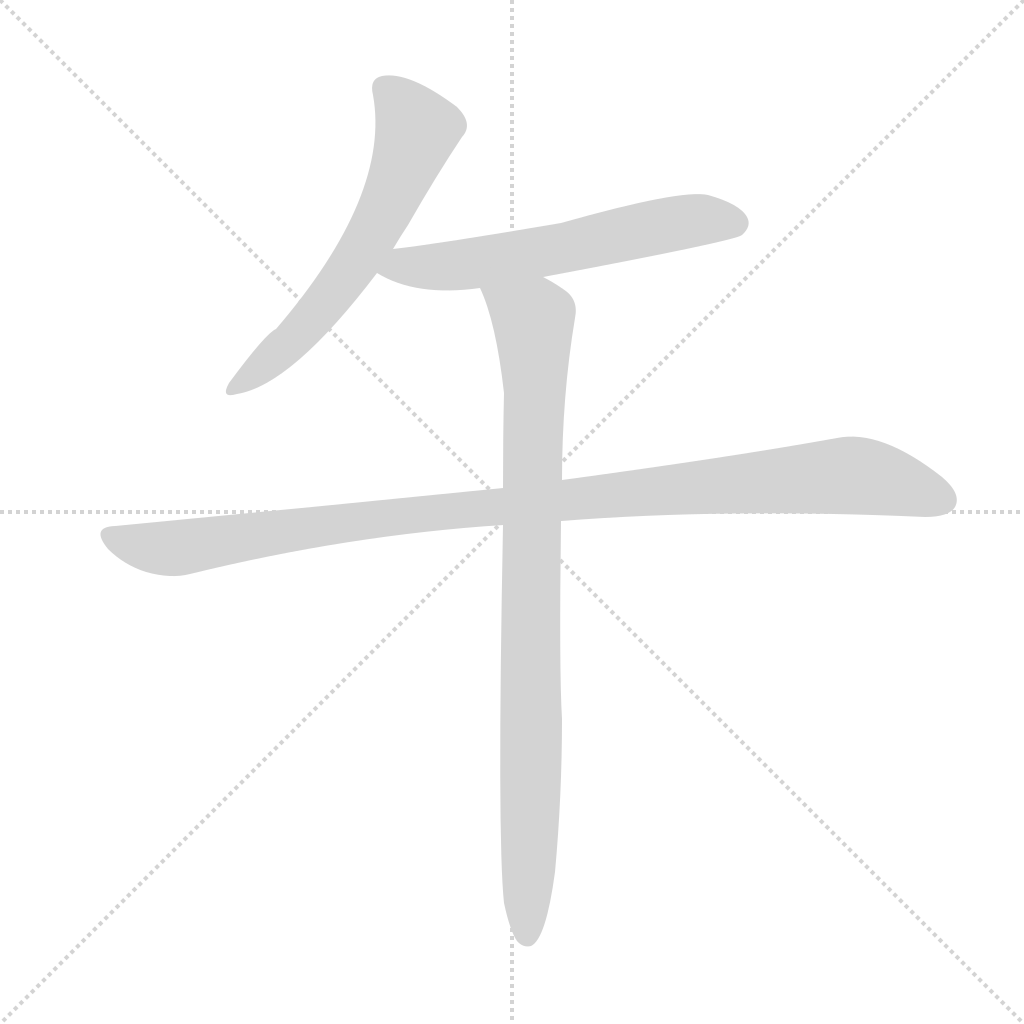
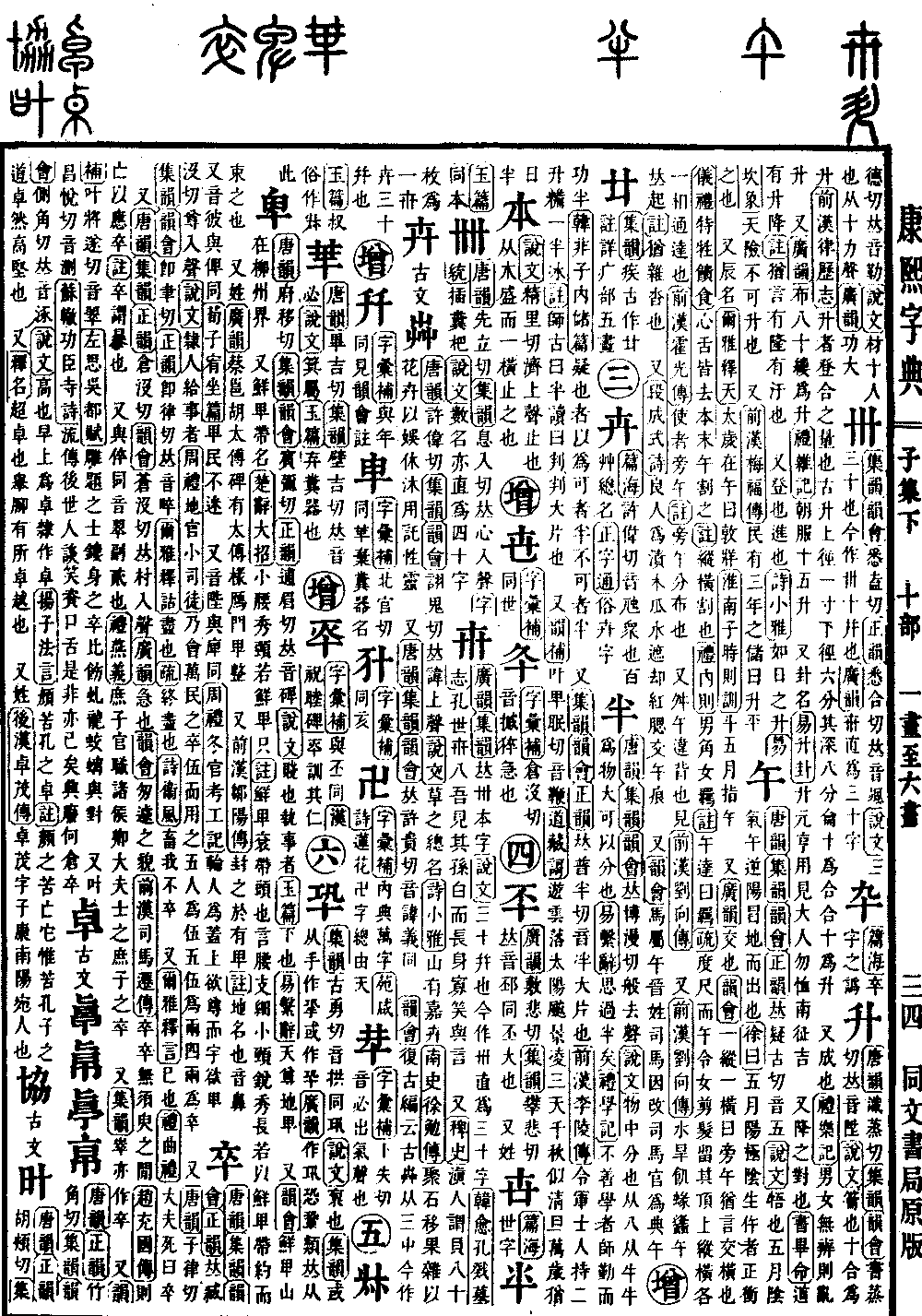
Zi Collection, Page Position: Lower
Radical: Ten (shí)
Wu. Kangxi stroke count: 4. Page 156, Entry 04.
Pronounced wu (rising tone).
As defined in the Analytical Dictionary of Characters (Shuowen Jiezi), it means to resist. In the fifth lunar month, the yin energy resists the wu; it is the time when the yang energy breaks through the earth. As Xu stated, in the fifth month, the yang energy reaches its zenith and the yin energy is born. Wu signifies a direct conflict.
Also, the name of a cyclical sign. According to the Literary Expositor (Erya), the section on the interpretation of heaven, when the great year (taisui) is in wu, it is called dunzang. The Huainanzi, in the chapter on time, states that the handle of the dipper points to wu in the fifth month.
Also, it means to intersect. According to the Rhyme Compendium (Yunhui), one vertical and one horizontal is called pangwu, which means crossing or intersecting. In the Book of Etiquette and Ceremonial (Yili), in the section on offerings for sacrificial animals, it states that the heart and tongue are both removed, and the base and tip are cut crosswise. The commentary states that this refers to cutting vertically and horizontally. In the Book of Rites (Liji), in the section on inner teachings, it mentions boys having horns and girls having jisi (tufted hairstyles). The commentary explains that when it reaches the wu, it is called a jisi. The sub-commentary clarifies that measuring a foot and crossing it refers to girls cutting their hair and leaving the top part in a vertical and horizontal intersection that connects.
In the History of the Former Han (Qian Hanshu), biography of Huo Guang, it is written that envoys came and went in great numbers. The commentary states that pangwu means to be distributed widely.
Also, it means to deviate or conflict. See the biography of Liu Xiang in the History of the Former Han.
Also, in the biography of Liu Xiang in the History of the Former Han, it is mentioned that floods, droughts, famines, and locusts arose in a chaotic, tangled manner. The commentary states that this means to be jumbled or mixed.
Also, in the poem by Duan Chengshi, it is written: The beloved soaks it in quince water, obscuring the red cheeks with intersecting traces.
Also, according to the Rhyme Compendium (Yunhui), the horse belongs to the category of wu. The Jin dynasty imperial surname was Sima; therefore, the office of Sima was changed to the office of Dianwu.