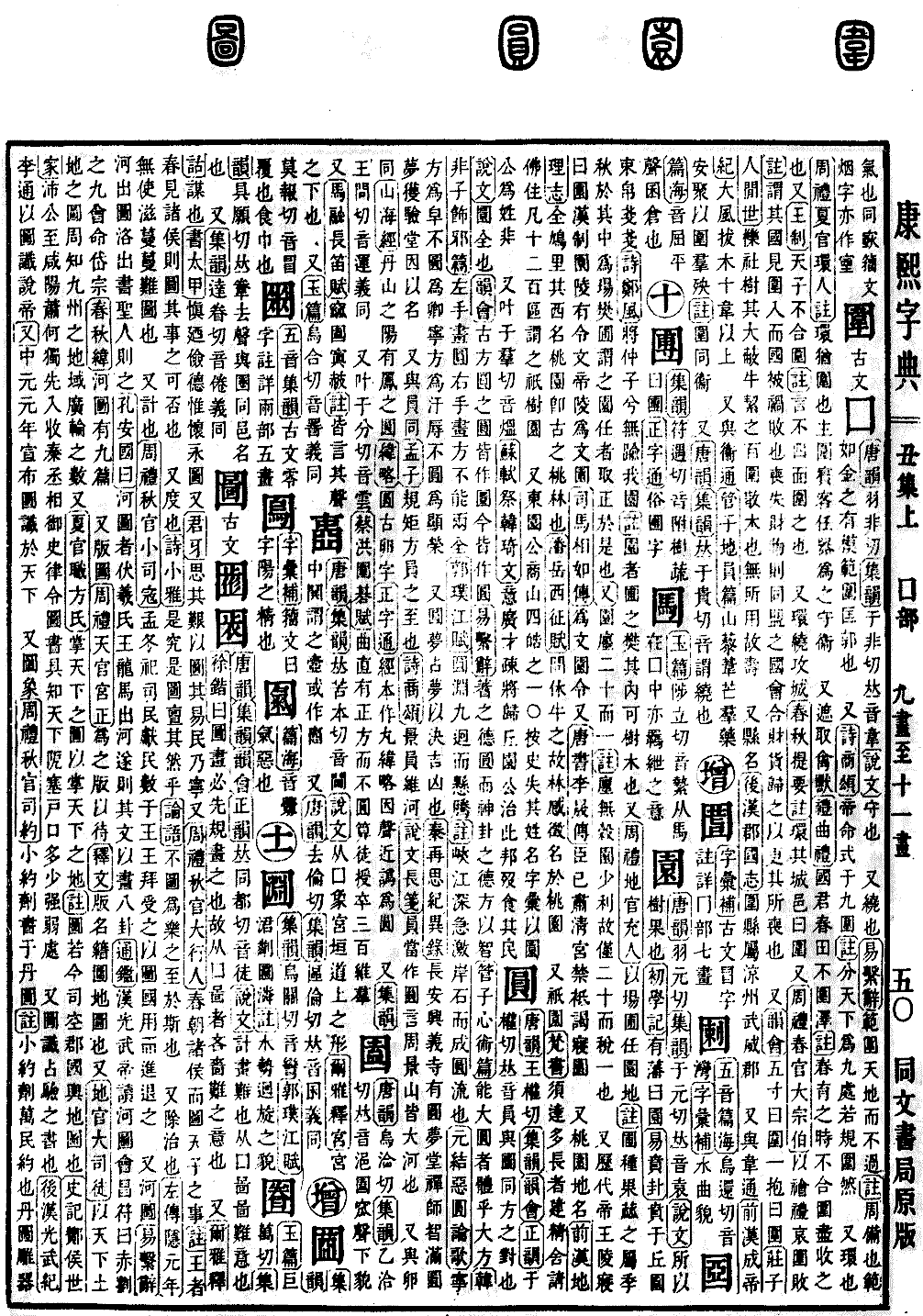
Chou Collection, Upper Volume
Radical: Enclosure (wéi)
Kangxi Strokes: 14
Page 220, Entry 18
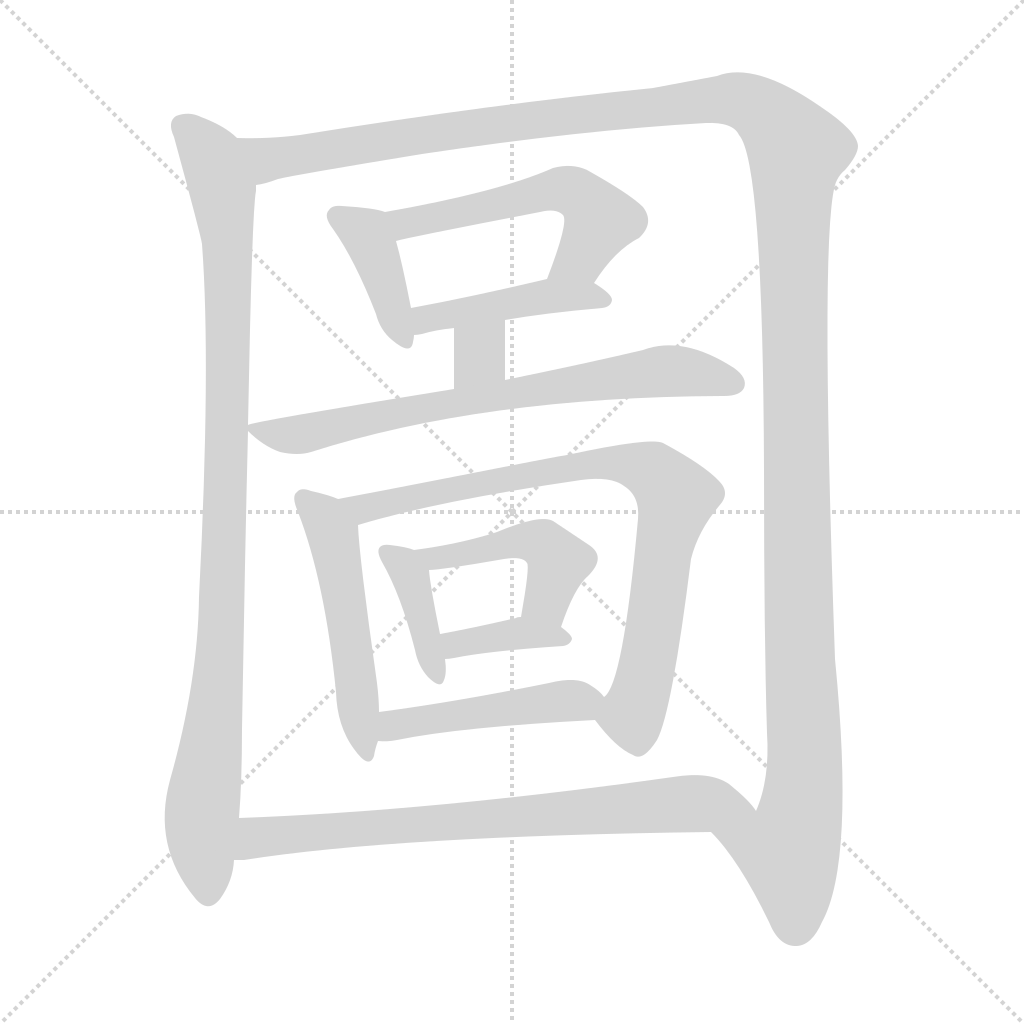
According to the Tang Rhymes (Tangyun), Collected Rhymes (Jiyun), Rhyme Compendium (Yunhui), and Correct Rhymes (Zhengyun), it is pronounced tu. According to the Analytical Dictionary of Characters (Shuowen), it denotes the difficulty of planning or scheming. The character is composed of the enclosure (wéi) and the element (bǐ). The element (bǐ) contains the meaning of difficulty. Xu Kai stated that drawing or painting must first involve planning, hence it is written with the enclosure. The element (bǐ) denotes stinginess and difficulty.
Also, according to the Er Ya, Explanation of Words (Erya Shigu), it means to plan. In the Book of Documents (Shujing), specifically the Taijia chapter, it says, Exercise caution in your virtuous frugality and consider long-term plans. In the Junya chapter, it says, Consider the difficulties of affairs and plan for what is simple and feasible; only then will the people be at peace. In the Rites of Zhou (Zhouli), Office of Autumn, Greater Minister of Instruction, it mentions that in the spring, the monarch meets with the feudal lords to plan the affairs of the Son of Heaven. The commentary notes that when the monarch meets with the lords in spring, he plans whether their affairs are feasible.
It also denotes to estimate or consider. In the Book of Odes (Shijing), Lesser Odes, it says, To investigate and consider in this way—could it really be so? In the Analects (Lunyu), it says, I did not think that the appreciation of music could reach such a level. It also denotes to deal with or handle. In the Zuo Tradition (Zuo Zhuan), first year of Duke Yin, it says, Do not let it grow and spread. If it spreads, it will be difficult to handle.
It also denotes to calculate or prepare. In the Rites of Zhou, Office of Autumn, Lesser Minister of Justice, it says, In the tenth month of winter, during the sacrifice to the Ministry of the People star, the state reports the population count to the King. The King bows and accepts it, using it to calculate national expenditures and decide the progress or retreat of policies.
It also refers to the River Map (Hetu). In the Book of Changes (Yijing), Appended Statements, it says, The River Map appeared from the Yellow River, and the Turtle Book appeared from the Luo River; the sages modeled themselves after these. Kong Anguo stated, The River Map is what appeared when a dragon-horse emerged from the Yellow River during the reign of Fuxi; he based the drawing of the Eight Trigrams on its markings. The Comprehensive Mirror (Tongjian) notes that when Emperor Guangwu of the Han dynasty read the River Map meeting of auspicious omens, he said, The ninth-generation descendant of the Red Emperor Liu Bang shall perform the feng and shan sacrifices at Mount Tai. According to the Spring and Autumn Weft (Chunqiu Wei), the River Map consists of nine chapters.
It also refers to maps and population registers. In the Rites of Zhou, Office of Heaven, Palace Administrator, it says, Create registers to manage [the people]. The Explication of Characters (Shiewen) states that the character ban refers to population registers, and the character tu refers to maps. In the Office of Earth, Great Minister of Instruction, it says, Based on the land registers of the world, understand in detail the size of the territory of the Nine Provinces. In the Office of Summer, Officials of Regions, it says, Manage the maps of the world to control the land of the world. The commentary notes that the maps are like the current maps of commanderies and states managed by the Minister of Works. In the Records of the Grand Historian (Shiji), Biography of the Marquis of Zan, it says, When the Prince of Pei reached Xianyang, Xiao He was the first to enter the city; he collected the laws, edicts, and books and maps of the Qin dynasty, thereby gaining full command over the mountain passes, strategic points, population numbers, and the distribution of strength across the empire.
It also refers to prognostications (tuchen), books that predict good or ill fortune. In the History of the Later Han (Hou Hanshu), Chronicle of Emperor Guangwu, it says, Li Tong used prognostications to persuade Emperor Guangwu. Also, in the first year of the Zhongyuan era, prognostications were promulgated to the world.
It also refers to images or paintings. In the Rites of Zhou, Office of Autumn, Minister of Contracts, it says, Minor contract documents are written in red on vessels with images. The commentary notes that minor contracts are agreements regarding the myriad people. Red images refer to vessels like the fu and gui that are carved with images. In the Rhapsody on the Jingfu Palace (Jingfu Dian Fu) by He Yan, it says, Paintings depict ancient deeds to serve as warnings. In the Rhapsody on the Lingguang Palace of Lu (Lu Lingguang Dian Fu) by Wang Yanshou, it says, Paintings depict heaven, earth, and all things, distinguishing between the various types of living creatures.
It also refers to the fútu, meaning Buddhism. Buddhist pagodas are also called fútu. Du Fu has a poem titled Matching Gao Shi’s Ascent to the Fútu of Ci’en Temple. In the Wang Junyu Guolao Tanyuan, it says, Li Yunze defended Xiong Prefecture and used treasury funds to build a pagoda. The supervisory officials impeached him, and Emperor Zhenzong of Song secretly notified him. Li Yunze said, It is not that I have my heart set on Buddhism; it is actually just for building an observation tower for border defense. In the Epitaph for Wang Zhongshu by Han Yu, it says, He forbade monks and Taoists from building pagodas within his territory, as they used deceptive means to seek profit and plunder the property of the common people.
It is also pronounced tu. In the Book of Odes (Shijing), Greater Odes, it says, I estimate and consider, only Zhong Shanfu is able to recommend him. In the Forest of Changes (Yilin), it says, Schemed against by a servant, he is grouped with the masses.