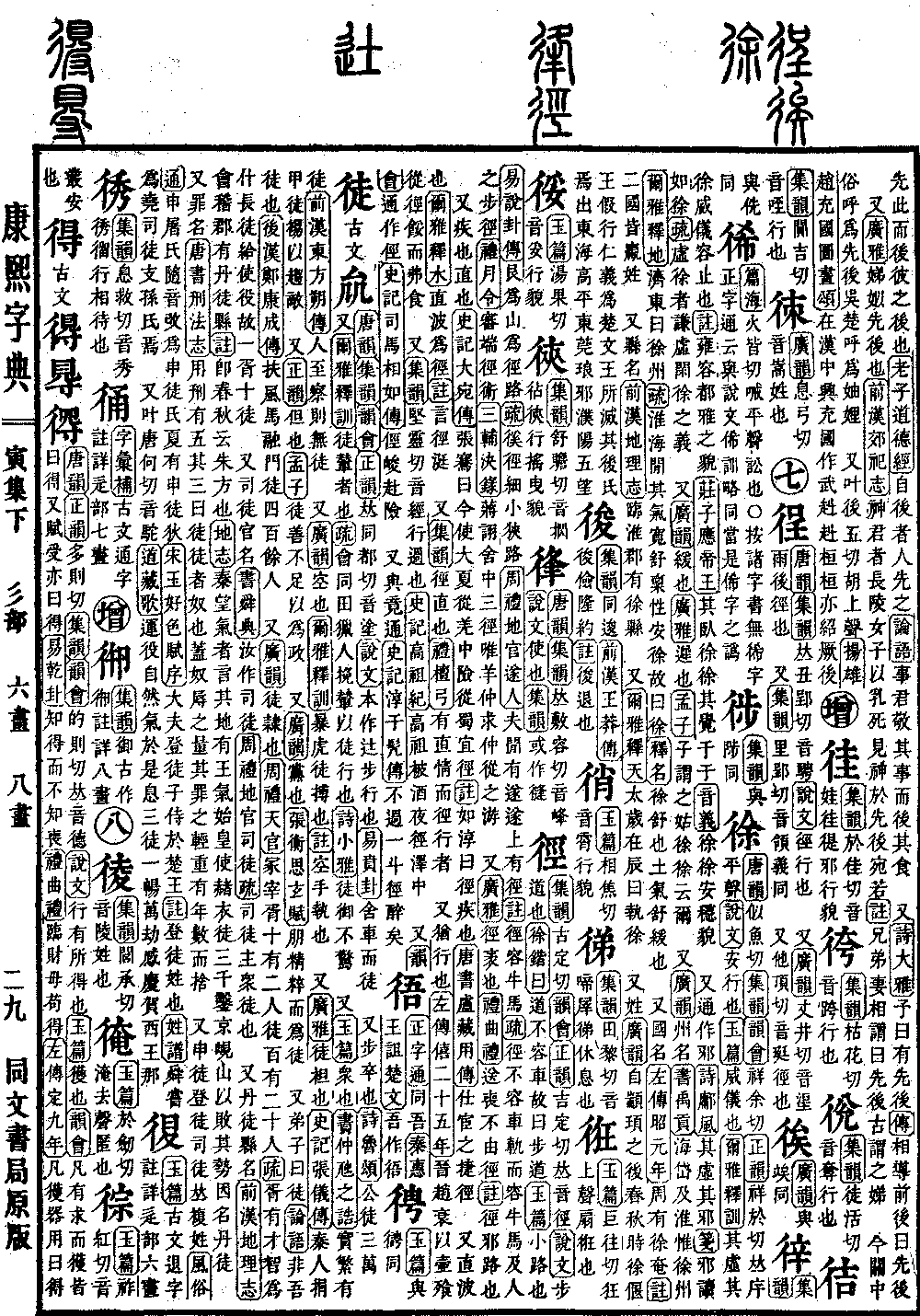
Yin Collection, Lower Volume
Radical: Step (chì)
Page 367, Entry 22
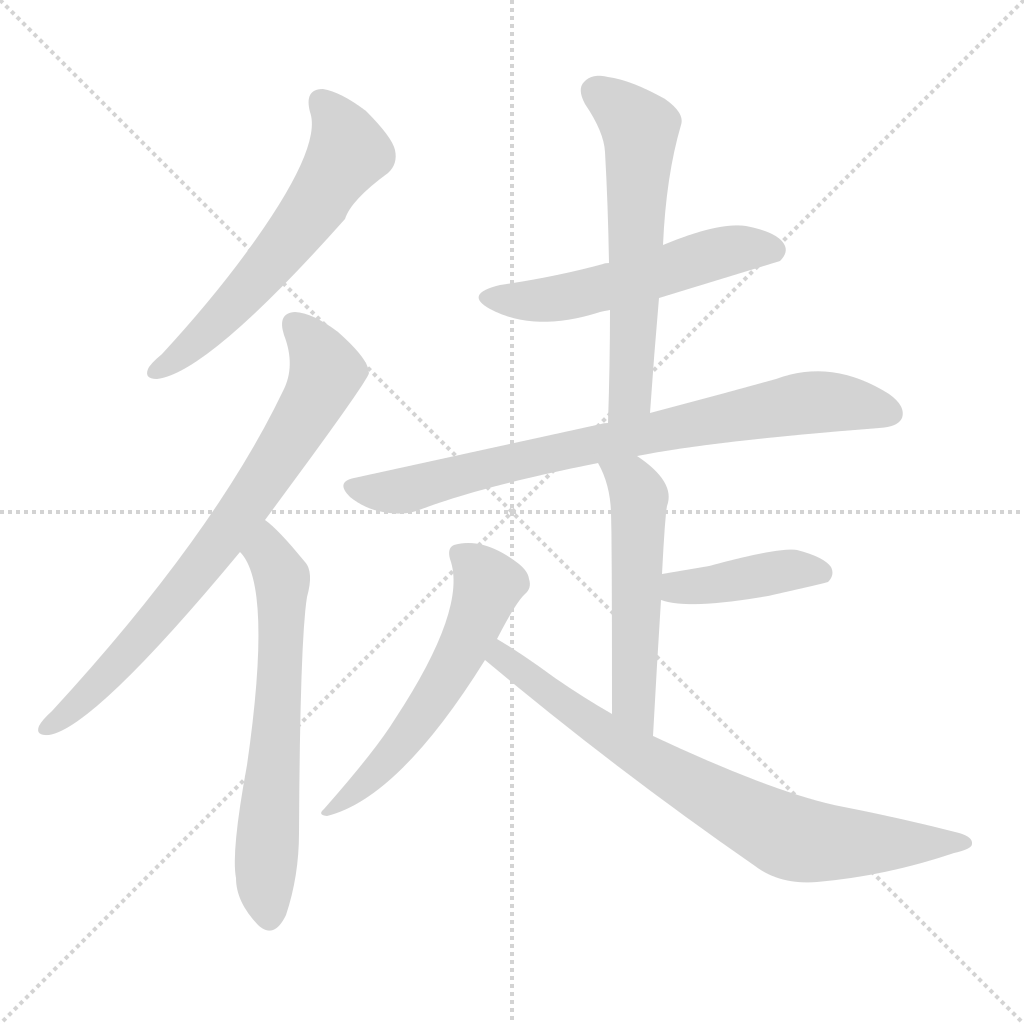
Ancient form. Pronounced tu. According to the Explaining Graphs and Analyzing Characters (Shuowen Jiezi), it was originally written as a character meaning to walk on foot. Book of Changes (Yijing), Hexagram of Grace (Bi): To discard one's carriage and proceed on foot. Also refers to infantry. Book of Odes (Shijing), Eulogies of Lu (Lu Song): The Duke of Lu had thirty thousand infantry. According to the Literary Expositor (Erya), the term refers to those who pull carriages. The Commentary (Shu) states: This refers to situations where, during feudal alliances or hunting, men pull the carriages on foot. Book of Odes (Shijing), Minor Odes of the Kingdom (Xiaoya): Neither those who pull the carriages nor those who drive them are alarmed. According to the Jade Compendium (Yupian), it refers to the masses. Book of Documents (Shangshu), Charge of Zhong Hui (Zhonghui Zhi Gao): Indeed, there are many accomplices. History of the Former Han (Qian Hanshu), Biography of Dongfang Shuo: If a person is overly discerning, they will have no companions. According to the Broad Rhymes (Guangyun), it means empty-handed or unarmed. Literary Expositor (Erya): To attack a tiger refers to struggling with it with bare hands. The Note states: Capturing with empty hands. According to the Expanded Literary Expositor (Guangya), it refers to being exposed or bare. Records of the Grand Historian (Shiji), Biography of Zhang Yi: The people of Qin discarded their armor and, bare-bodied, rushed toward the enemy. According to the Correct Rhymes (Zhengyun), it means merely or only. Mencius: Merely having a benevolent heart is insufficient to govern affairs. According to the Broad Rhymes (Guangyun), it refers to a faction or group of the same kind. Zhang Heng, Rhapsody on Contemplating the Profound (Sixuan Fu): Scholars of pure intent with shared aspirations become companions. Disciples are also called by this term. Analects (Lunyu): They are not my disciples. History of the Later Han (Hou Hanshu), Biography of Zheng Xuan: Ma Rong of Fufeng had over four hundred disciples. According to the Broad Rhymes (Guangyun), it refers to criminals performing forced labor. Rites of Zhou (Zhouli), Offices of Heaven (Tianguan): Under the Prime Minister there are twelve clerks and one hundred and twenty forced laborers. The Commentary (Shu) states: The clerks possess talent and act as squad leaders, while the laborers provide manual service; thus, one clerk oversees ten laborers. Minister of Instruction (Situ) is the name of an official post. Book of Documents (Shangshu), Canon of Shun (Shundian): You shall serve as Minister of Instruction. Rites of Zhou (Zhouli), Offices of Earth (Diguan), Commentary on the Minister of Instruction (Situ Shu): The Minister of Instruction is the official who manages the masses. Dantu is the name of a county. History of the Former Han (Qian Hanshu), Treatise on Geography (Dilizhi): Kuaiji Commandery contains Dantu County. The Note states: This is what was known as Zhufang in the Spring and Autumn period. The Local Gazetteer (Dizhi) states: During the Qin dynasty, an observer of celestial vapors claimed the place had the aura of an emperor. Qin Shi Huang sent three thousand convicts dressed in ochre-colored clothes to cut through Jingxian Mountain to destroy the geomantic energy, and thus it was named Dantu. It is also a type of legal punishment. History of the Tang (Tangshu), Treatise on Criminal Law (Xingfazhi): There are five types of punishments; the third is forced labor. Forced labor means becoming a bondservant. It involves the humiliation of servitude, requiring the performance of labor for a fixed duration based on the severity of the crime before being released. Shentu, Dengtu, and Situ are compound surnames. Popular Customs (Fengsutong): The Shentu clan changed their name due to phonetic shifts; in the Xia dynasty, there was Shentu Di. Song Yu, Preface to the Rhapsody on Lord Dengtu being Lustful (Dengtuzi Haose Fu Xu): Grandee Lord Dengtu served at the side of the King of Chu. The Note states: Dengtu is a surname. Genealogical Records (Xingpu): Shun once served as the Minister of Instruction for Yao, and his collateral descendants took this as their clan name. Also pronounced tuo. Daoist Canon Songs (Daozang Ge): Exercising and driving the natural breath, thus ceasing three types of labor. Once enlightened and reaching through the myriad eons, celebrate with the Queen Mother of the West.