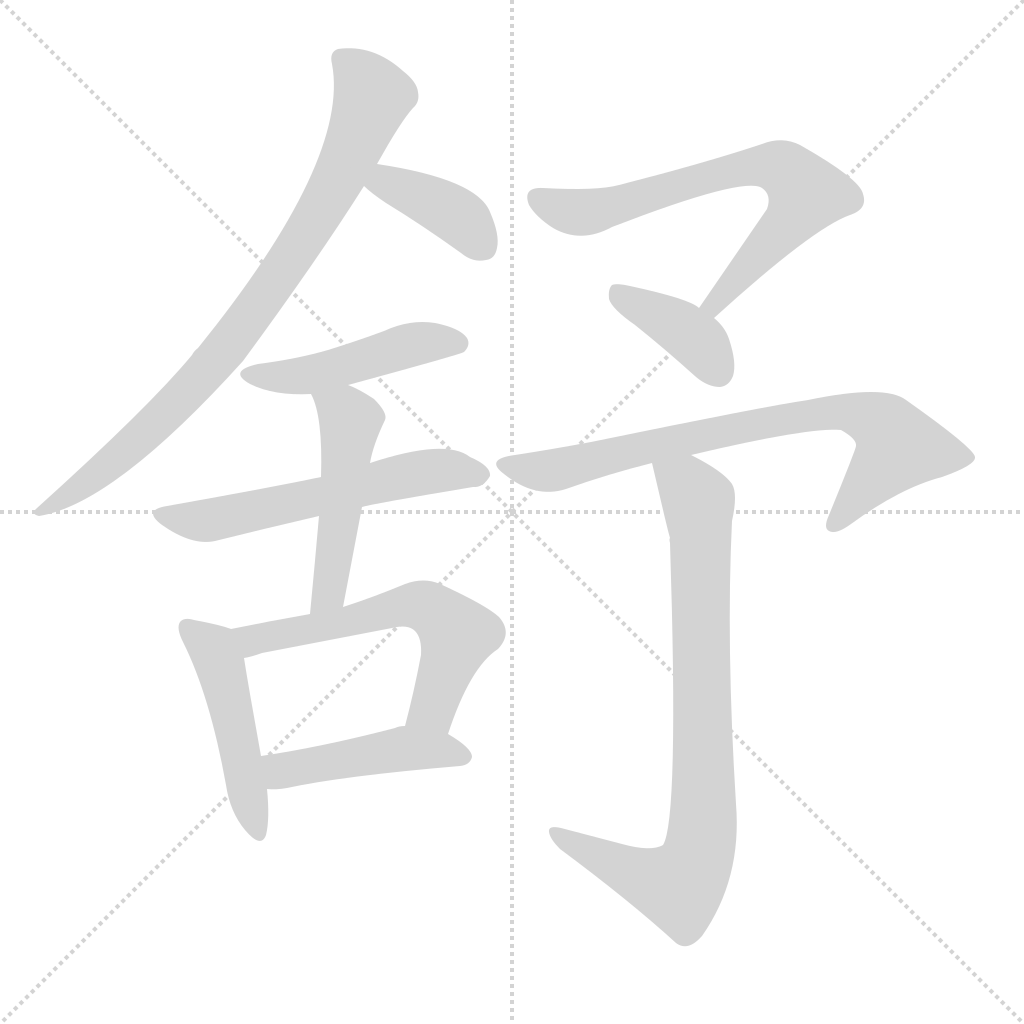
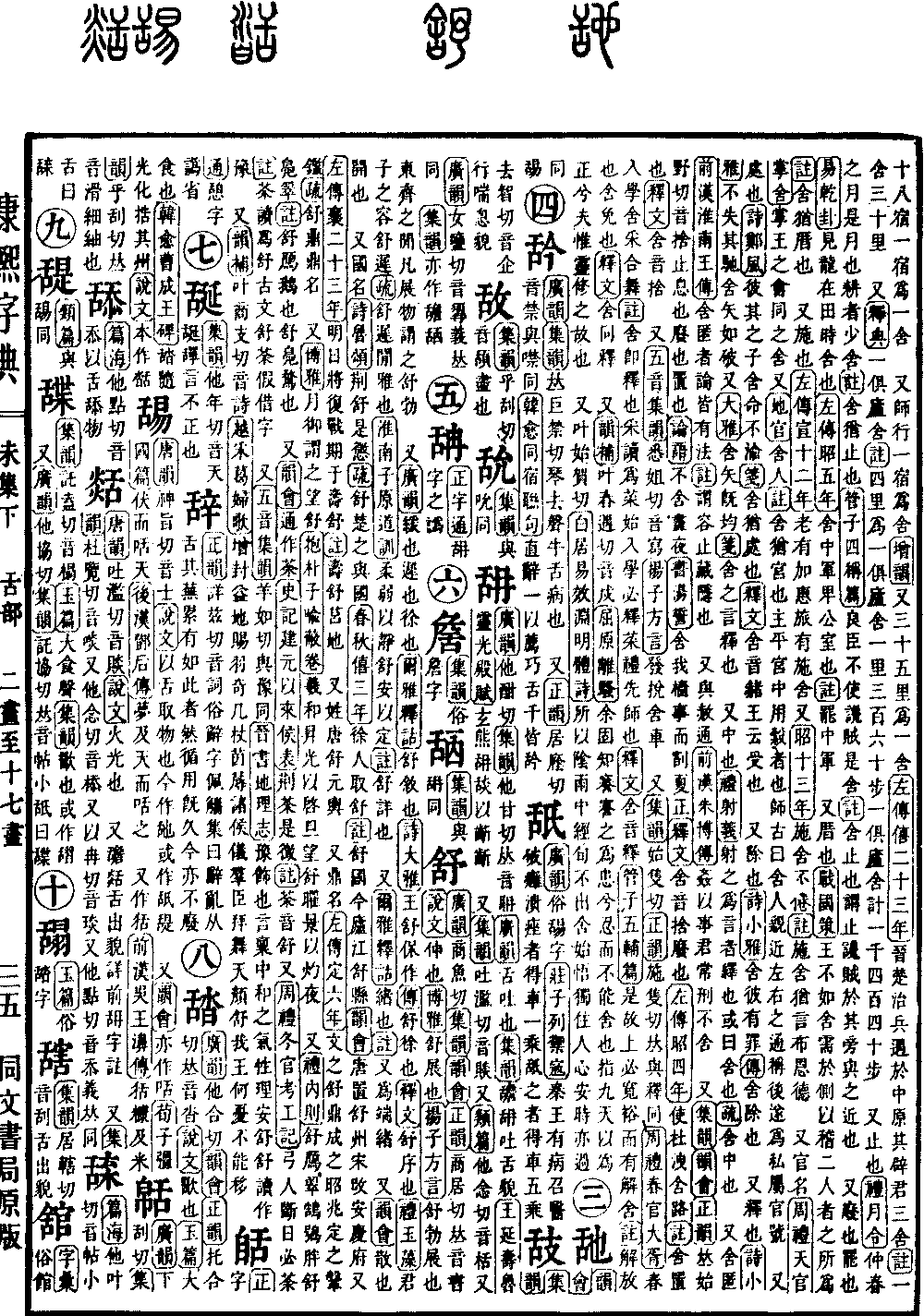
Wei Collection, Lower Volume
Radical: Tongue (shé)
Kangxi Strokes: 12
Page 1007, Entry 11
Pronounced shu.
Shuowen Jiezi: To extend.
Guangya: Shu means to unfold.
Fangyan by Yang Xiong: Shu means to spread out. In the regions east of Qi, to spread something out is called shu-bo.
Also, Guangya: Slow, delayed, leisurely.
Erya: Shu means to arrange in order.
Book of Odes (Shijing): The King slowly maintained his work. Commentary: Shu means leisurely. Shiwens: Shu means to arrange in order.
Book of Rites (Liji): The demeanor of a gentleman is leisurely and slow. Commentary: Leisurely and slow means composed and elegant.
Huainanzi: Yielding and gentle yet quiet, leisurely and calm yet steady. Commentary: Shu means detailed and careful.
Also, Erya: A beginning. Commentary: Also signifies the start of something.
Yunhui: To scatter, to open.
Also, a country name.
Book of Odes (Shijing): Chastising the Jing-Shu states. Commentary: Shu was an allied state of Chu.
Spring and Autumn Annals (Chunqiu): The people of Xu seized Shu. Commentary: The state of Shu is the present-day Shu County in Lujiang.
Yunhui: During the Tang Dynasty, Shu Prefecture was established; during the Song Dynasty, it was changed to Anqing Prefecture.
Also, Zuo Zhuan: Tomorrow we shall fight again, meeting at Shushu. Commentary: Shushu is a location in the state of Ju.
Also, a surname. There was Shu Yuanxing of the Tang Dynasty.
Also, the name of a tripod vessel.
Zuo Zhuan: The Shu tripod of the Wen era, the auspicious omens of the Cheng era, the ornamental sash and mirror of the Ding era. Commentary: The Shu tripod is the name of a vessel.
Also, the charioteer of the moon is called Wangshu.
Baopuzi: Xihe rises with light to begin the dawn, Wangshu shines with radiance to illuminate the night.
Also, Book of Rites (Liji): Domesticated goose, swan, owl meat, and domesticated duck. Commentary: Domesticated goose is a goose. Domesticated duck is a mallard.
Also, Yunhui: Interchangeable with the character tu.
Records of the Grand Historian (Shiji): Chastising the Jing-Tu states. Commentary: Tu is pronounced shu.
Also, Rites of Zhou (Zhouli): When the bow-maker carves the notches, they must be tu. Commentary: Tu is read as shu. In ancient texts, shu and tu are loan characters for one another.
Also, Wuyin Jiyun: Pronounced yu. Equivalent to the character yu.
Book of Jin (Jinshu): Yu means to decorate. It refers to those endowed with harmonious spirit, whose nature and principles are calm and comfortable. Shu is read as yu.
Also, Yunbu: Rhymes with shi.
Song of the Herb-Gathering Woman of Yue: With increased fiefs and added lands, gifts of feathers are bestowed; staff, mat, and cushion are the rites of the feudal lords. When the courtiers bow and dance, the King's countenance is relaxed; why should our King worry that he cannot prevail?
Textual Corrections:
Rites of Zhou: When the bow-maker carves the notches... following the original text, corrected from "cuts the day" to "carves the notches."
Wuyin Jiyun: Pronounced yu... following the original text, corrected from "yang-ru" to "yang-ru."