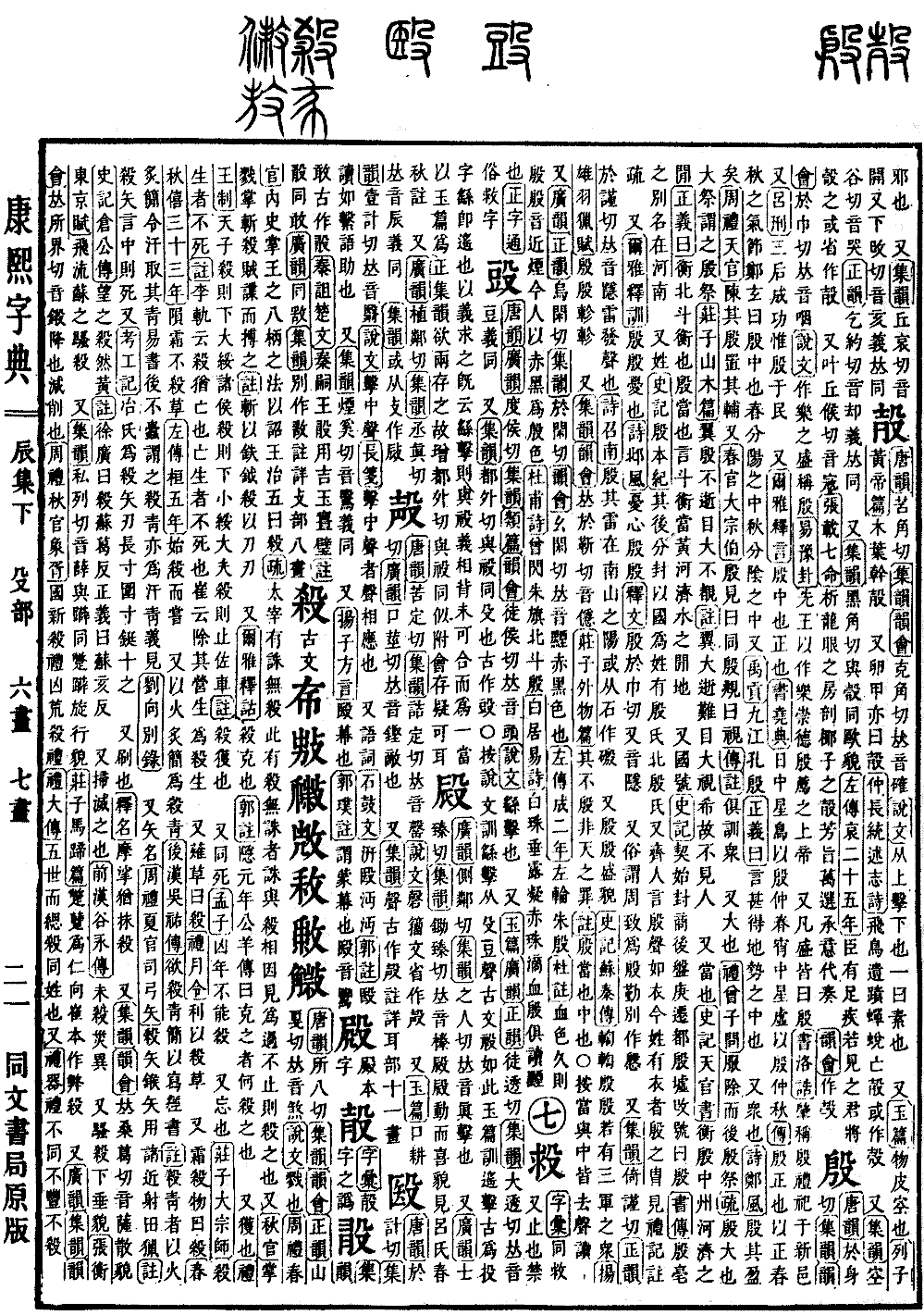
Chen Collection, Lower Volume
Radical: Weapon (shū)
Page 585, Entry 01
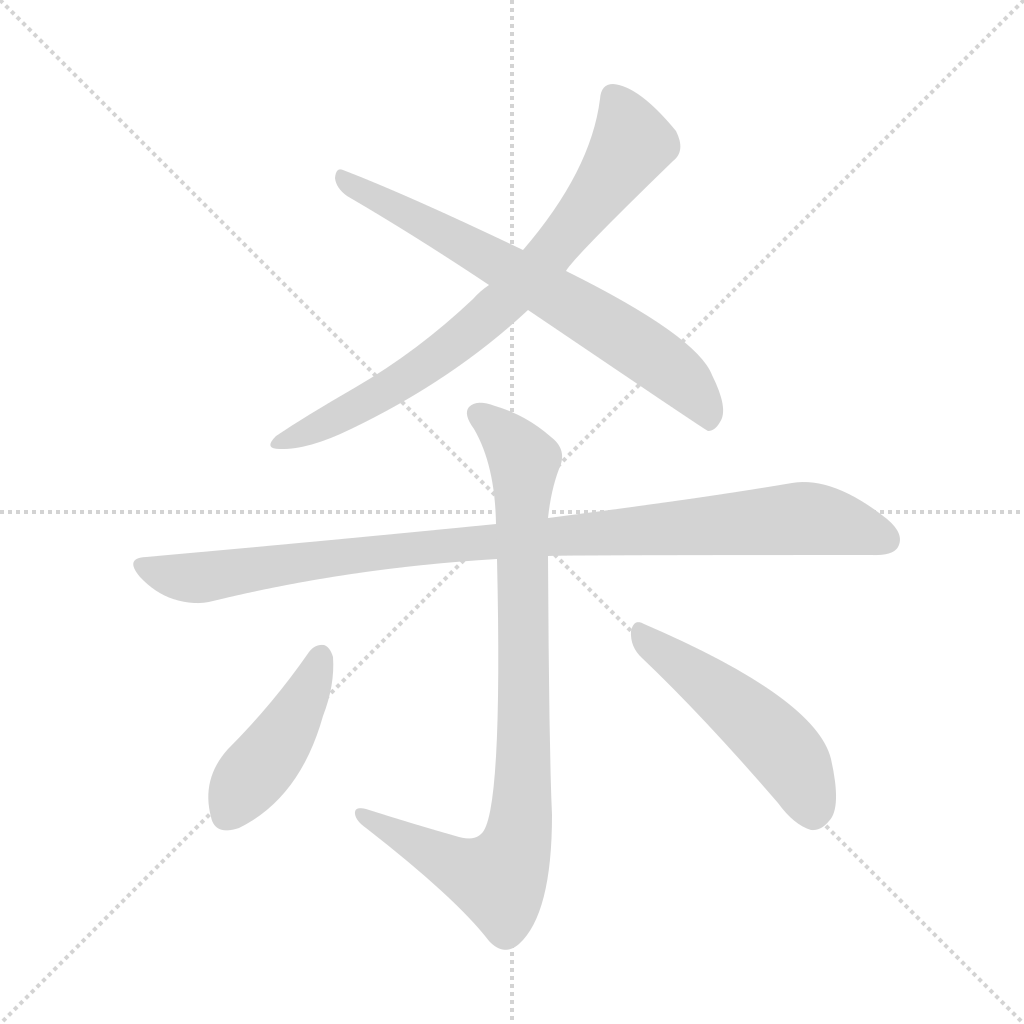
Ancient form. Pronounced sha.
Explaining characters (Shuowen Jiezi): To kill.
Rites of Zhou (Zhouli), Ministry of Spring: The Inner Archivist holds the method of the King's eight handles to advise the King on governance. The fifth is killing. Commentary: The Grand Preceptor has punishments but no killing. Here, there is killing but no punishment, as punishment and killing are mutually dependent; when a fault is seen and does not cease, one kills them.
Ministry of Autumn: The Minister of Executions manages the beheading, killing, and capturing of thieves and spies. Commentary: Beheading is done with a battle axe, killing is done with a blade.
Erya, Explanation of Words: To kill is to overcome. Guo commentary: Zuo Tradition (Zuo Zhuan), first year of Duke Yin, states: What does it mean to overcome? It means to kill.
Also means to capture. Book of Rites (Liji), Royal Regulations: When the Son of Heaven kills, he lowers the large streamer. When the princes kill, they lower the small streamer. When the ministers kill, they stop the accompanying carriage. Commentary: Killing is capturing.
Also means death. Mencius: In years of famine, one cannot kill.
Also means to lose. Zhuangzi, The Great and Venerable Teacher: Those who lose life do not die. Commentary: Li Gui says: Kill is like loss. Losing life, they do not die. Cui says: To remove the sustenance of life is killing life.
To mow grass is called killing. Book of Rites (Liji), Monthly Ordinances: It is advantageous to kill the grass.
Frost killing things is called killing. Spring and Autumn Annals (Chunqiu), 33rd year of Duke Xi: Frost fell but did not kill the grass. Zuo Tradition (Zuo Zhuan), 5th year of Duke Huan: It began to kill and was tasted.
Using fire to dry bamboo slips is called sha-qing (removing the green). History of the Later Han (Houhan Shu), Biography of Wu You: Wishing to sha-qing in order to write the classics. Commentary: Sha-qing means to use fire to sweat the bamboo, taking away its green color, making it easier to write upon and preventing worms; this is called sha-qing. Also known as han-qing (sweating green), the meaning is found in Liu Xiang's Separate Records (Bielu).
Also a type of arrow. Rites of Zhou (Zhouli), Ministry of Summer, Director of Bows and Arrows: Use killing arrows and whistling arrows for short-range shooting and hunting. Commentary: A killing arrow means if it hits, the target dies.
Also, Records of Trades (Kaogong Ji): The metalworkers make killing arrows; the blade is one inch long and one inch in circumference, and the tang is ten times that length.
Also means to brush. Explaining Names (Shiming): Mosa is like wiping away.
Pronounced sa. The appearance of being scattered. Records of the Grand Historian (Shiji), Biography of Physician Cang: Looking at it, it was yellow in a scattered manner. Commentary: Xu Guang says: Sha is pronounced su-ge. Correct Meaning says: Pronounced su-hai.
Also means to sweep away or extinguish. History of the Former Han (Qianhan Shu), Biography of Gu Yong: The disasters and anomalies were not yet extinguished.
Also sao-sha, the appearance of hanging down. Zhang Heng, Western Capital Rhapsody (Xijing Fu): The flying tassels hang down in a scattered manner.
Pronounced xue. Equivalent to another character. Bie-xie, the appearance of walking in a circling manner. Zhuangzi, Horse Hooves (Matie): Bie-xie is for benevolence. Xiang and Cui's original text reads bie-sha.
Pronounced sha. To descend or decrease. Rites of Zhou (Zhouli), Ministry of Autumn, Elephant Interpreters: When the state is new, adjust the rituals; during times of disaster, adjust the rituals. Book of Rites (Liji), The Great Transmission: After five generations, the mourning relationship ends and the surname is adjusted.
Also Book of Rites (Liji), Records of Rites: When rites differ, they are neither too lavish nor too sparse.
Pronounced shai. Same meaning as above.
Feathers and fur becoming worn is called killing. Book of Odes (Shijing), Odes of Bin: The feathers are worn. Commentary: Qiao-qiao means killing (worn).
Rites of Zhou (Zhouli), Ministry of Heaven, Surgeons: Prescriptions for scraping and killing. Commentary: Killing means using medicine to consume the gangrenous flesh.
Qiao-sha, a type of musical sound. Book of Rites (Liji), Record of Music: When the mourning heart is moved, its sound is thin and lacking richness (qiao) and reduced (sha). Commentary: Qiao means exhausted and lacking luster; sha means reduced and not grand.
Also to cut and sew. Analects (Lunyu): Unless it is the curtain-skirt, one must cut it. Also written with another character.
Also equipment for encasing a corpse; the upper part is called zhi, the lower part is called sha. Ceremonial and Rituals (Yili), 士喪禮: The sha covers the feet.
Also means rapid or fierce. Bai Juyi, Half-Opened Flower poem: The western sun shines lightly, do not let the east wind blow fiercely. Author's note: Sha, in the departing tone.
Correct Meaning Record (Zhengzitong): In contemporary opera, there is a distinction between yuan-sha and pang-sha. In the Yuan dynasty play The White Crane, the first sha and second sha are the remnants of this sound. The common pronunciation of sha in life and death is incorrect.
Also pronounced sha. To descend.
Pronounced shi. Same as to commit regicide. History of the Former Han (Qianhan Shu), Annals of Emperor Gao: Xiang Yu exiled and killed his lord. Commentary: Sha should be written as shi (regicide).
Ban Gu, Western Capital Rhapsody (Xijing Fu): Grabbing the swift and fierce, biting, breaking horns and smashing necks, fighting alone and killing them. Commentary: Sha also rhymes with shi.
Also rhymes with se. Liang Su, Military Admonition: Transmitting the beauty of shields and spears, changing the carriage with rules. The sages of old, divine martial power does not kill.
Also rhymes with she. Shu Xi, Leisurely Travels Rhapsody (Jinyou Fu): Wearing a lined jacket to resist the winter, and a sweat-shirt to withstand the heat. The cap pulls the seams of the four corners, the skirt is made with several strips of cloth. Sha is also written as another character.