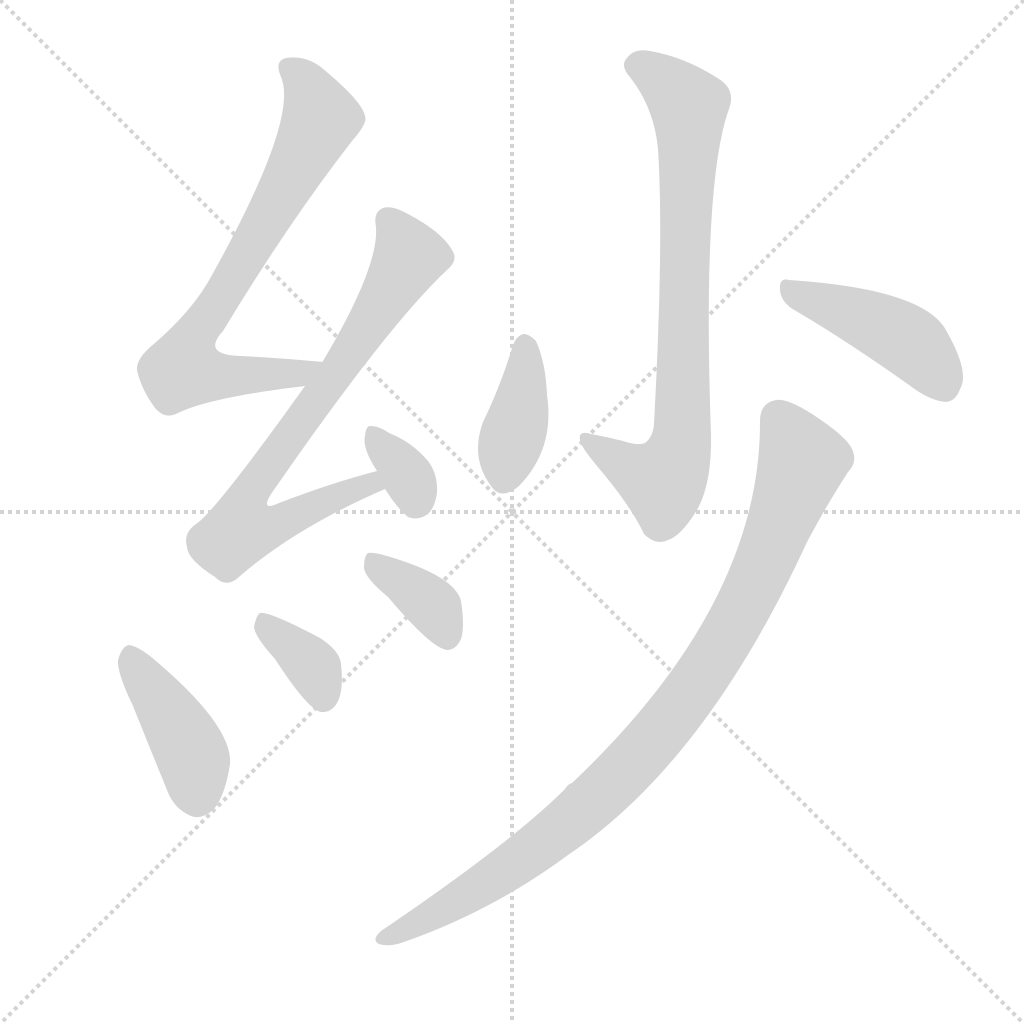
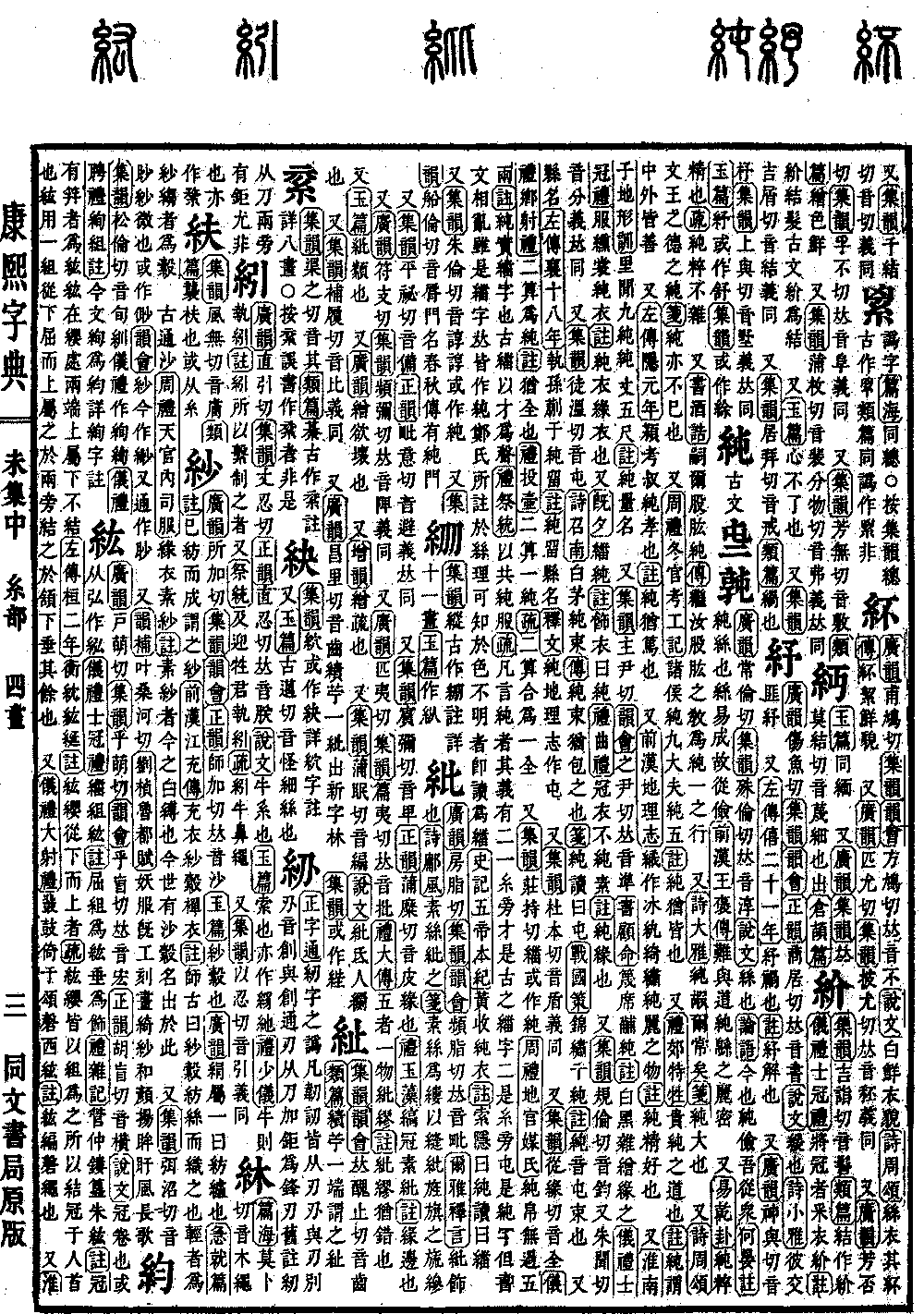
Wei Collection, Middle Volume
Radical: Silk (mì)
Kangxi Strokes: 10
Page 917, Entry 18
Broad Rhymes (Guangyun): Pronounced suo. Collected Rhymes (Jiyun), Rhyme Meetings (Yunhui), and Orthodox Rhymes (Zhengyun): Pronounced sha, pronounced the same as sha.
Jade Chapters (Yupian): Sha is a type of silk gauze (hu, a type of wrinkled gauze).
Broad Rhymes (Guangyun): Belongs to the silk category. One account suggests it refers to spun hemp.
Commentary on the Quick Literacy Treatise (Jijiu pian zhu): Fabric that has been spun and completed is called sha.
History of the Former Han (Qian Han shu), Biography of Jiang Chong: Jiang Chong wore unlined garments made of silk gauze. Commentary: Yan Shigu says, silk gauze is woven from silk thread; the light and thin fabric is called sha, while the wrinkled fabric is called hu. In ancient times, it was used interchangeably with sha.
Rites of Zhou (Zhou li), Celestial Offices, Inner Palace Attire: The edges of the garment are made of white sha. Commentary: White sha refers to what is now called white fu (a type of fine white cloth). What is now called silk gauze derives its name from this.
Also, Collected Rhymes (Jiyun): Pronounced miao, pronounced the same as miao. Sha denotes something minute or fine. Sometimes written in a variant form.
Rhyme Meetings (Yunhui): Sha is now written as miao, and also used interchangeably with miao.
Also, Rhyme Supplements (Yunbu): Rhyming variant pronounced sanghe. Liu Zhen, Rhapsody on the Capital of Lu (Lu du fu): The bewitching garments are already exquisite, carved with beautiful gauze patterns. With a pleasant countenance, she lifts her eyes, and amidst the breeze, sings a long song.
Textual Research: In ancient times, it was used interchangeably with sha. Rites of Zhou, Celestial Offices, Inner Palace Attire: The edges of the garment are made of white sha. Commentary: White sha refers to what is now called white fu. According to the original text, the two instances of the character sha have been changed to sha.