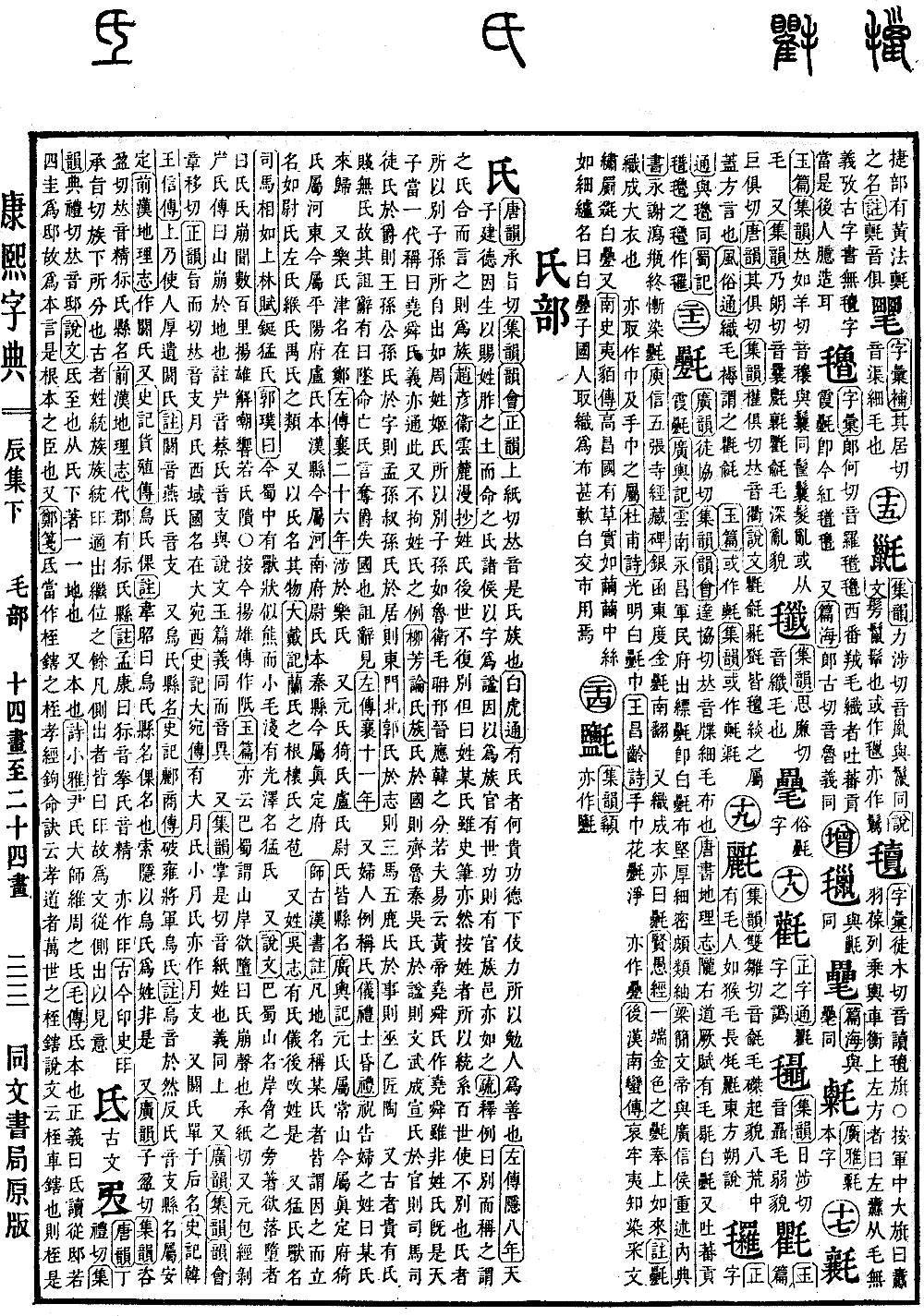
Chen Collection, Lower Volume
Radical: Clan (shì)
Page 597, Entry 18
Pronounced shi (rising tone). Refers to a clan or lineage.
White Tiger Comprehensive Discussion (Baihu Tong): Why is there the designation of clan? It is to honor those with merit and virtue and to demote those who only possess skill and labor, thereby encouraging people to do good.
Commentary on the Zuo Tradition (Zuo Zhuan), Eighth Year of Duke Yin: The Son of Heaven established those with virtue (as feudal lords), bestowed surnames based on their birthplace, and enfeoffed lands to designate their clans. Feudal lords used the courtesy name (zi) of their grandfather as a posthumous title, and used this as the clan name. When official positions held hereditary merit, the office title was sometimes used as the clan name; the same applies to names derived from fiefs.
Sub-commentary: The Book of Exemplifications (Shili) states: When mentioned separately, it is called a clan; when mentioned collectively, it is called a lineage.
Zhao Yanwei's Notes from the Cloud-Capped Mountains (Yunlu Manchao): Surnames and clan names were not distinguished in later ages; people only said "of a certain clan." Even the style of the official historians was like this. Note: The surname is used to organize generations and prevent them from separating. The clan name is used to distinguish which branch a descendant descends from. For example, the Zhou Dynasty used the surname Ji and used clan names to distinguish descendants, such as Lu, Wei, Mao, Dan, Yu, Jin, Ying, and Han. As for the Book of Changes (Yijing) saying, "The clans of the Yellow Emperor, Yao, and Shun arose," although Yao and Shun were not strictly surnames or clan names, because they were Sons of Heaven representing an era, calling them the Yao and Shun clans is also acceptable. This is a case of not being bound by the fixed conventions of surnames and clan names.
Liu Fang's Discussion on Clans: Those that took the name of the state as a clan include Qi, Lu, Qin, and Wu; those that took a posthumous title include Wen, Wu, Cheng, and Xuan; those that took an official title include Sima and Situ; those that took a title of nobility include Wangsun and Gongsun; those that took a courtesy name include Mengsun and Shusun; those that took a residence as a clan include Dongmen and Beiguo; those that took a profession include Sanma and Wulu; those that took a trade include Wu, Yi, Jiang, and Tao.
Furthermore, in ancient times, the noble had clan names while the humble did not. Thus, in their curses, it was said, "to lose one's life and lose one's clan name," meaning to be stripped of noble rank and lose one's fief. This curse is found in the Commentary on the Zuo Tradition (Zuo Zhuan), Eleventh Year of Duke Xiang.
Also, women are customarily addressed by their clan name. The Book of Ceremonial (Yili), Rites for Marriage of Officials: The priest announces the woman's surname, saying, "A woman of a certain clan has come to be married."
Also, Le-shi is the name of a ferry in the State of Zheng. Commentary on the Zuo Tradition (Zuo Zhuan), Twenty-sixth Year of Duke Xiang: "Crossed at Le-shi."
Also, Yuan-shi, Yi-shi, Lu-shi, and Wei-shi are all names of counties. The Comprehensive Geography of the World (Guangyu Ji): Yuan-shi belongs to Changshan Commandery, now part of Zhending Prefecture. Yi-shi belongs to Hedong Commandery, now part of Pingyang Prefecture. Lu-shi was originally a Han Dynasty county, now part of Henan Prefecture. Wei-shi was originally a Qin Dynasty county, now part of Zhending Prefecture. Yan Shigu's Commentary on the Book of Han (Hanshu Zhu): All place names that include a clan name indicate that the place was named after this person or event, such as Wei-shi, Zuo-shi, Gou-shi, and Yu-shi.
Also, using the term to name things. The Record of Rites by Dai the Elder (Da Dai Liji): "The root of the Lan-shi plant, the calyx of the Huai-shi plant."
Also, used as a surname. Records of Wu (Wu Zhi): There was a person named Shi Yi, who later changed his surname to Shi.
Also, Meng-shi is the name of a beast. Sima Xiangru's Rhapsody on the Shanglin Park (Shanglin Fu): "The fleet-footed Meng-shi." Guo Pu says: In the present-day Shu region, there is a wild beast shaped like a bear but smaller, with light, glossy fur, called the Meng-shi.
Also, from the Analytical Dictionary of Characters (Shuowen): In the Ba and Shu regions, the part of a cliffside that is attached and appears as if it is about to fall is called "shi." When it collapses, the sound can be heard for several hundred miles. Yang Xiong's Disillusionment (Jie Chao): "The echo is like a collapsing shi." Note: In the present-day Biography of Yang Xiong, it is written as "di." The Dictionary of Characters (Yupian) also says: In Ba and Shu, a cliff about to collapse is called shi, which is the sound of a collapse. Pronounced shi (rising tone).
Also, in the Classic of the Origin (Yuanbao Jing), "peeling away the ridge's shi." The commentary says: The mountain collapses onto the ground. Note: The character for ridge is pronounced cai, and shi is pronounced zhi. It has the same meaning as the Analytical Dictionary of Characters (Shuowen) and the Dictionary of Characters (Yupian) but a different pronunciation.
Also, pronounced zhi (rising tone). It is a surname. The meaning is the same.
Also, pronounced zhi. Yue-zhi is the name of a Western Region state, located west of Dayuan. Records of the Grand Historian (Shiji), Account of Dayuan: There is the Great Yue-zhi and the Lesser Yue-zhi. Also written as Yue-zhi.
Also, Yanzhi, the title of the Xiongnu Queen. Records of the Grand Historian (Shiji), Biography of Han Wang Xin: "The Emperor sent people to give generous gifts to the Yanzhi." Note: Yan is pronounced yan, and zhi is pronounced zhi.
Also, Wu-shi is the name of a county. Records of the Grand Historian (Shiji), Biography of Li Shang: "General Wu-shi, who broke the forces of Yong." Note: Wu is pronounced wu, and zhi is pronounced zhi; it is a county belonging to Anding Commandery. The Book of the Former Han (Qian Hanshu), Treatise on Geography: It is written as Yanzhi.
Also, Records of the Grand Historian (Shiji), Biographies of the Money-makers: "Wu-shi Luo." Note: Wei Zhao says: Wu-shi is a county name, and Luo is a person's name. The Suoyin commentary considers Wu-shi to be a surname, but this is incorrect.
Also, pronounced jing. Yishi is a county name. Book of the Former Han (Qian Hanshu), Treatise on Geography: Dai Commandery has Yishi County. Note: Meng Kang says: Yi is pronounced quan, and shi is pronounced jing. Also written as a variant form.
In the History of Ancient Seals (Gujin Yinshi), pronounced shi (rising tone), it refers to the branches separated from a lineage. In ancient times, the surname governed the lineage, and the lineage governed the clan. For all those born outside the line of the eldest legitimate son, all collateral branches are called a clan. Therefore, the character is created with a radical meaning "side-out" to reflect this meaning.
Textual Criticism: Zhao Yanwei's Notes from the Cloud-Capped Mountains (Yunlu Manchao): "Like the divisions of Lu, Wei, Mao, Dan, Yu, Jin, Ying, and Han." I respectfully note that in the original text, the character for Han should be changed to Yu. Records of the Grand Historian (Shiji), Biographies of the Money-makers: "Niao-shi Luo." I respectfully note that in the original text, the character for bird (niao) should be changed to wu (wu).