Chen Collection, Middle Volume
Radical: Tree (mù)
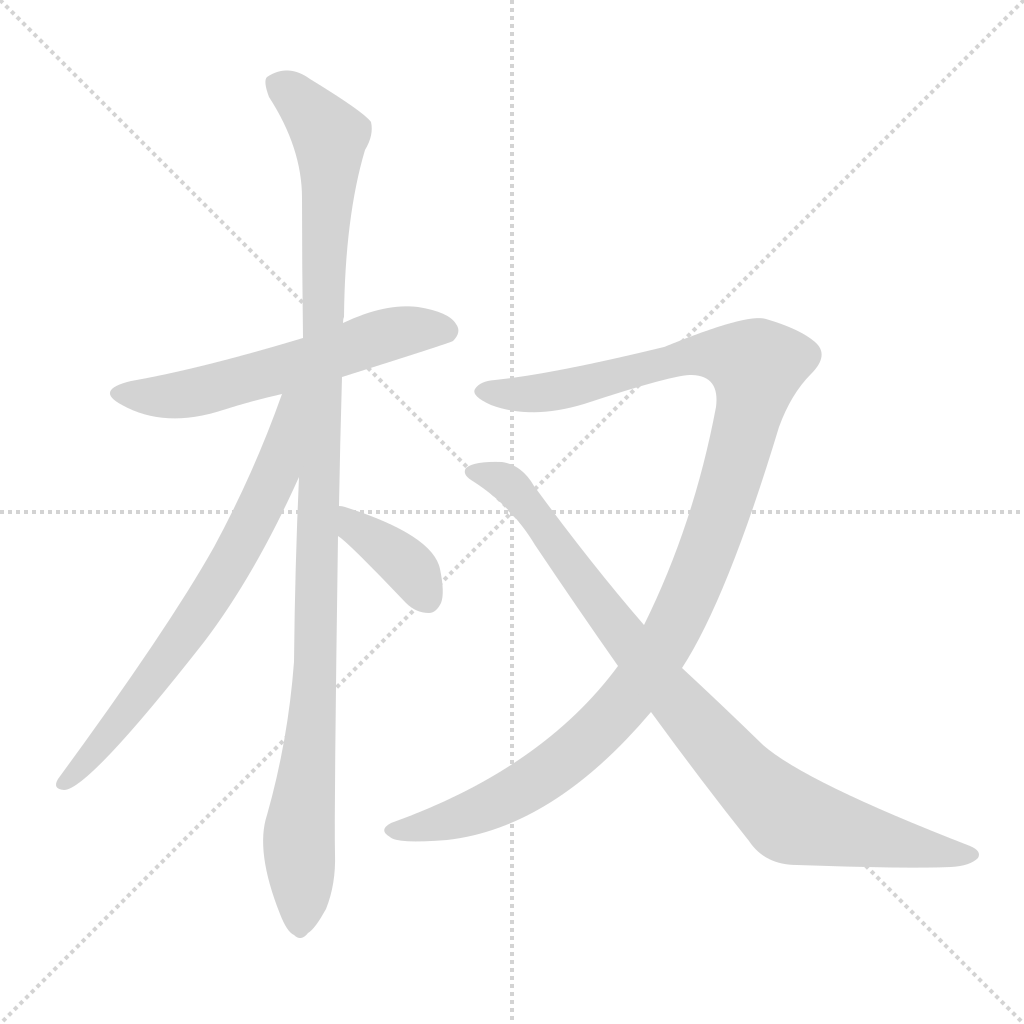
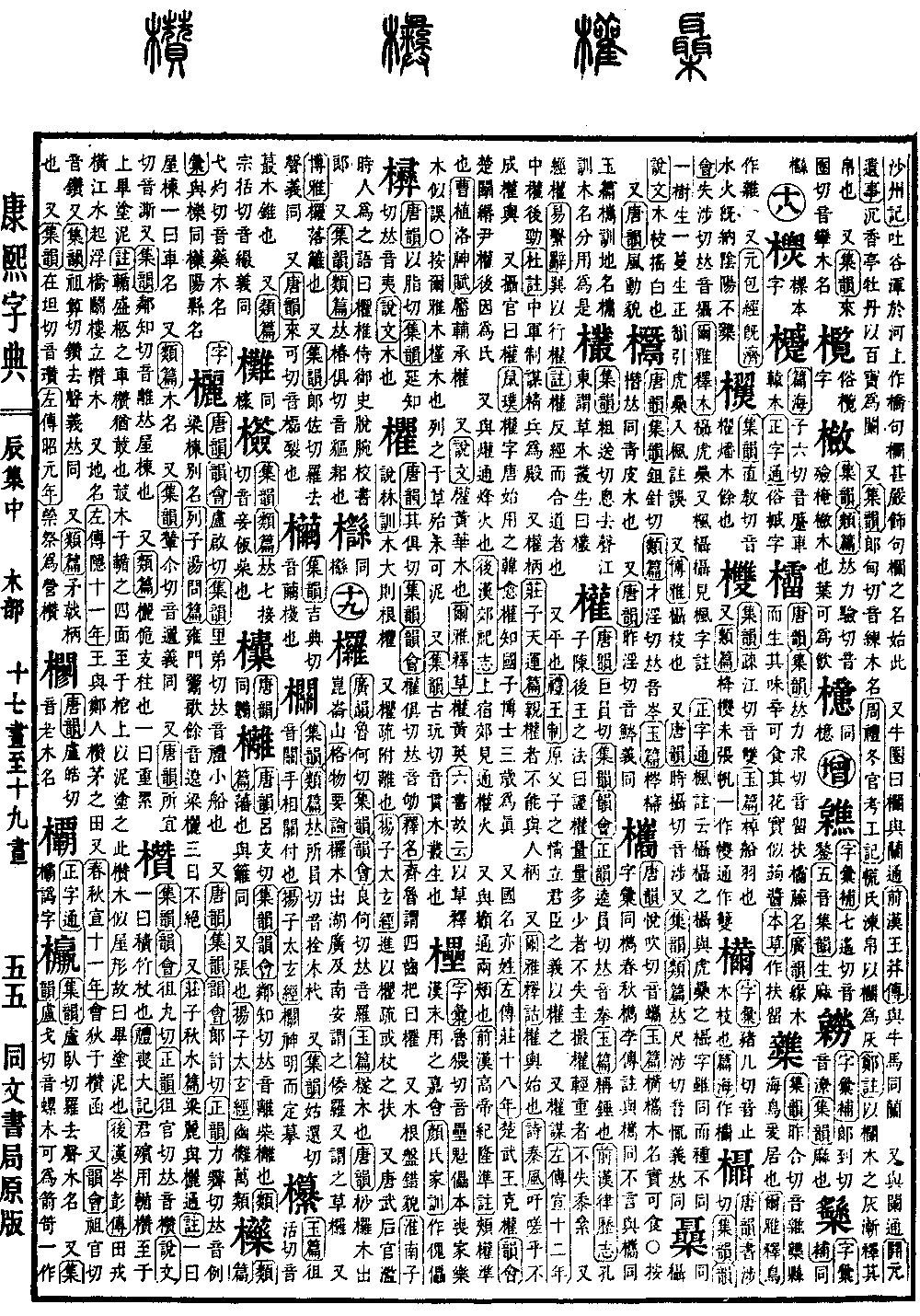
權; Kangxi stroke count: 22; Page 563
Pronounced quan
Yu pian (Jade Chapters): A balance weight.
Book of Han (Hanshu), Treatise on Harmonics and Calendars: Confucius described the principles to be followed by future rulers, saying, "Be cautious in standardizing weights and measures." Measurements of quantity should not differ by a grain, and the balancing of light and heavy weights should not differ by a millet seed.
Also refers to contingency.
Book of Changes (Yijing), Commentary on the Appended Statements: The Xun trigram is used to enact contingency.
Note: Contingency refers to an approach that seems to violate conventional norms but is in accordance with moral principles.
Also refers to balancing or judging.
Book of Rites (Liji), Royal Regulations: Examine the affection between father and son, establish the morality between ruler and subject, and use this as a standard to weigh and handle matters.
Also refers to strategy or artifice.
Zuo Tradition (Zuo Zhuan), 12th year of Duke Xuan: The central army is responsible for strategy, and the rear guard serves as elite troops.
Du Note: The central army is in charge of formulating strategy, while the elite troops serve as the rearguard.
Also refers to power or authority.
Zhuangzi, Chapter on Heavenly Revolutions: Those who value power will not hand over authority to others.
Also, Erya, Explanation of Words: Quanyu means beginning.
Book of Odes (Shijing), Qin Wind: Alas, unable to maintain the original splendor.
Also, temporarily holding an official post is called quan.
Shupu: The character quan began to be used this way during the Tang dynasty. Han Yu served as acting Doctor of the National University, and after three years, he was formally appointed.
Also, the name of a state. Also used as a surname.
Zuo Tradition (Zuo Zhuan), 18th year of Duke Zhuang: King Wu of Chu conquered the state of Quan.
Yunhui (Collection of Rhymes): Dou Min of the State of Chu served as the official in charge of the city of Quan; his descendants subsequently took Quan as their surname.
Also interchangeable with guan (beacon fire).
Book of Han (Hanshu), Treatise on Imperial Sacrifices: The Emperor stayed overnight in the suburbs and saw beacon fires lit everywhere.
Also interchangeable with quan, referring to the cheekbones.
Book of Han (Hanshu), Annals of Emperor Gaozu, Note on High-bridged Nose: The cheekbones and the bridge of the nose.
Cao Zhi, Rhapsody on the Luo River Goddess: Dimples supporting the cheekbones.
Also, Shuowen (Discussing Writing): Quan is a type of tree with yellow flowers.
Erya, Explanation of Plants: Quan, yellow flowers.
Liushu Gu (Refinement of the Six Writings): Explaining trees using plant categories seems incorrect. Note: In the Erya, the rose mallow is a tree but is listed in the plant category. It is likely not necessary to be overly rigid.
Also, pronounced guan. Trees growing in thickets.
Textual Corrections:
Book of Odes (Shijing), Qin Wind: Alas, unable to maintain the original splendor. Corrected the original character to the character for "at/in" and "maintain/sustain" based on the original text.
Book of Han (Hanshu), Treatise on Imperial Sacrifices: The Emperor stayed overnight in the suburbs and saw beacon fires lit everywhere. Note: The History of the Later Han does not contain a Treatise on Imperial Sacrifices. Changed Later Han to Book of Han.
Erya, Explanation of Plants: Quan, yellow flowers. Corrected flower to flower based on the original text.