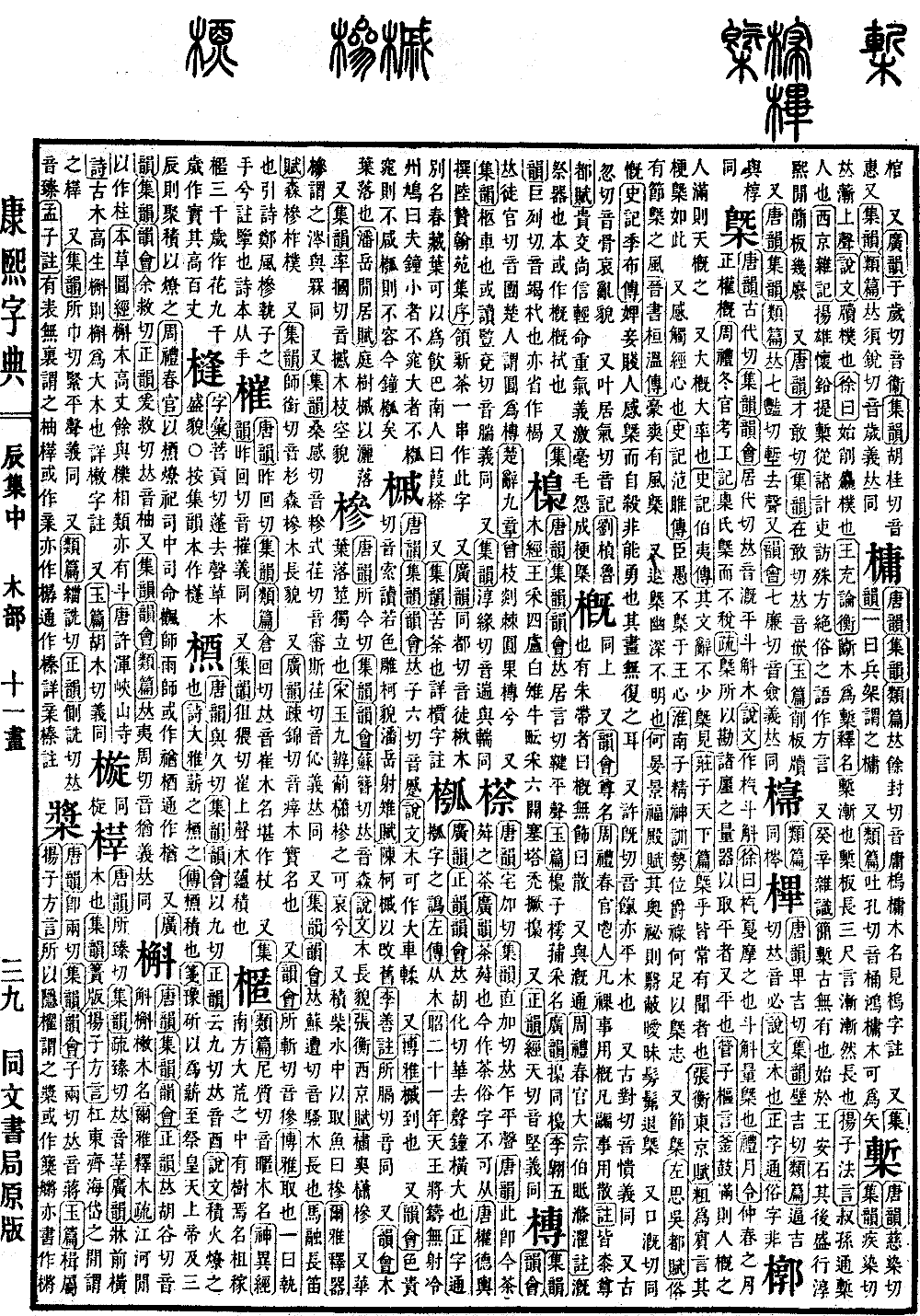
Chen Collection, Middle Volume
Radical: Tree (mù)
Page 547, Entry 13
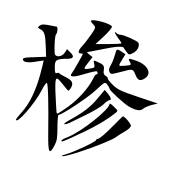
Pronounced sen. According to the Analytical Dictionary of Characters (Shuowen Jiezi), it describes the appearance of trees growing high and long. In the Western Metropolis Rhapsody (Xijing Fu) by Zhang Heng, it is written as tall and lofty. It also refers to the appearance of trunks standing alone after the flowers and leaves have fallen. In the Nine Arguments (Jiu Bian) by Song Yu, it is written as the swaying of trees that is sorrowful. It also refers to the act of piling firewood and timber in water to catch fish, which is called sam. This is noted in the Literary Expositor (Erya), where it is defined as a fish trap. It is the same as the character for a submerged fish trap (shen).
Also pronounced san. Also pronounced shen. Also pronounced xin. The meanings are the same.
Also pronounced sao. It refers to trees growing high and long. In the Long Flute Rhapsody (Changdi Fu) by Ma Rong, it describes the dense growth of oaks and other trees.
Also pronounced shan. Refers to the appearance of trees growing high and long.
Also pronounced shu. A name for a fruit of a tree.
Also pronounced zan. According to the Broad Anthology (Boya), it means to take or seize. One interpretation suggests it means to hold or grasp, citing the Classic of Poetry (Shijing), Zheng Odes, which uses this character for the phrase holding your hand. The commentary notes that it means to grasp. The original text of the Classic of Poetry uses the hand radical instead.