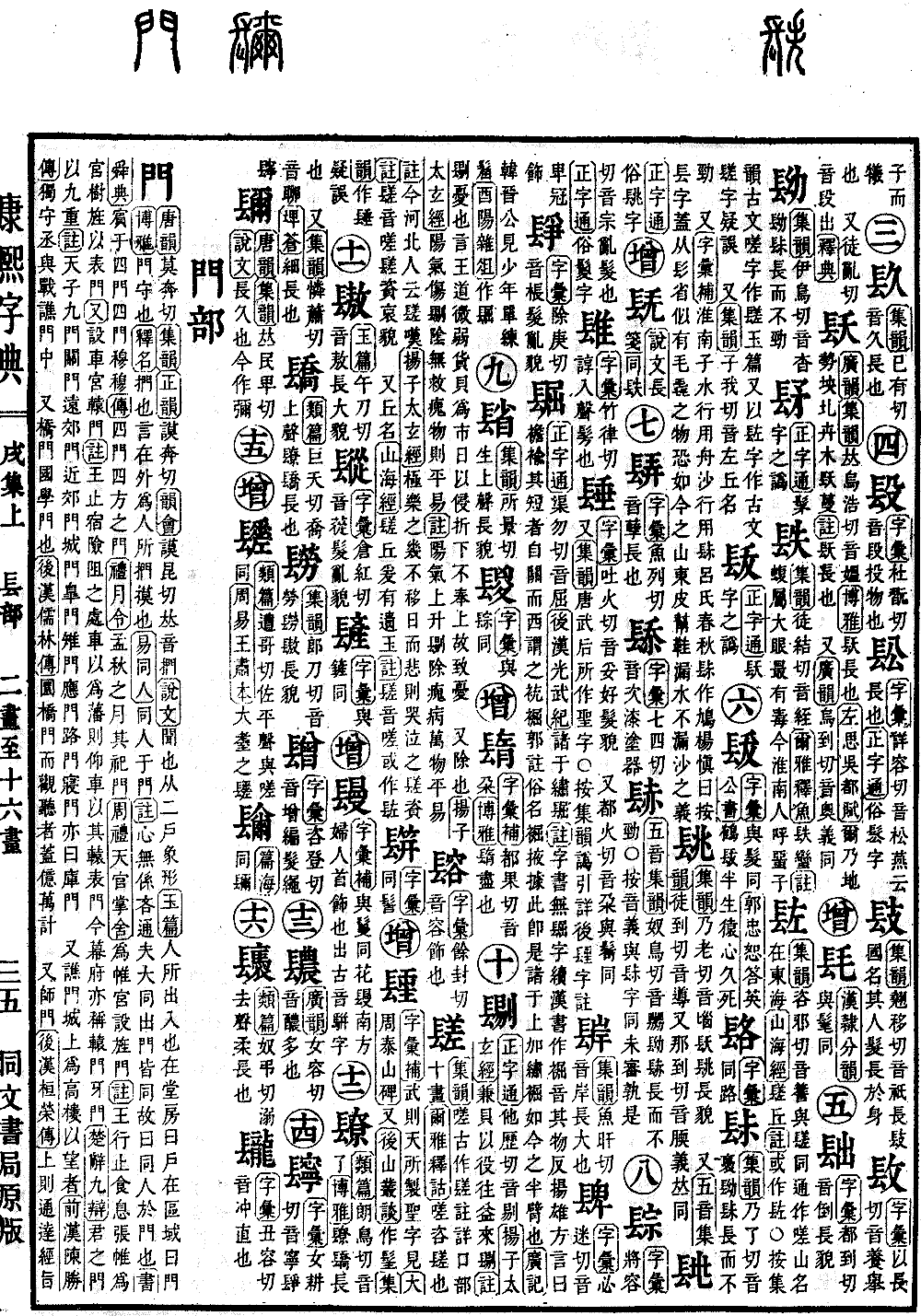
Xu Collection, Upper Volume. Radical: Gate (mén). 8 strokes. Page 1329, Entry 53.
Pronounced men. According to Tang Yun, Jiyun, Zhengyun, and Yunhui, it is pronounced the same as the character meaning to touch or feel (men).
According to the Shuowen Jiezi, it means to hear. The character form is composed of two door-leaf symbols and is a pictograph.
According to the Yupian, it is the place through which people enter and exit. Those within a building are called household doors (hu), while those at a boundary are called gates (men).
According to the Boya, a gate has the function of protection and defense.
According to the Shiming, it is synonymous with touching or feeling, implying that objects outside can be touched by others.
Book of Documents (Shujing), Shun Dian: Guests are at the four gates; the four gates are grand and solemn. Commentary: The four gates refer to the gates of the four cardinal directions.
Book of Rites (Liji), Yue Ling: In the month of mid-autumn, sacrifice to the gate spirits.
Rites of Zhou (Zhouli), Tian Guan: Set up curtains to create a palace, and erect banners to mark the gate. Commentary: When the Emperor rests or eats during a journey, curtains are set up to form a temporary palace, and banners are raised to mark the location of the gate. Also, set up chariots to enclose a palace, using the shafts to mark the gate. Commentary: When the Emperor stays in dangerous terrain, he uses war chariots as a barrier and raises the shafts to indicate the gate. Today, the offices of generals are also called the shaft gate or the tooth gate.
Chu Ci, Jiu Bian: The king's palace has nine gates. Commentary: The Emperor has nine gates: the Guan gate, the outer suburb gate, the inner suburb gate, the city gate, the Gao gate, the Zhi gate, the Ying gate, the Lu gate, and the Qin gate, which is also known as the storehouse gate.
There is also the Qiao gate, which refers to the watchtower built on top of a city wall. History of the Former Han (Qian Han Shu), Biography of Chen Sheng: Only the commandery assistant fought him within the Qiao gate.
There is the Qiao gate (bridge gate), which refers to the gate of the National Academy. History of the Later Han (Hou Han Shu), Biographies of Confucian Scholars: Those who gathered around the Qiao gate to watch and listen could be numbered in the hundreds of millions.
There is also the term Master's Gate. History of the Later Han, Biography of Huan Rong: Being able to understand the essence of the classics above, and leaving home but longing for one's hometown below, to go and offer thanks at the teacher's gate.
Comprehensive Mirror for Aid in Government (Tongjian): Di Renjie of the Tang dynasty once recommended dozens of people like Yao Yuanchong. Someone said to him: The peaches and plums of the world are all at your gate (a metaphor for one's students).
Zhengzitong: When a noble family is prominent, it is called a door of prestige. The memorial of Han Xianzong states that prestige is the achievement left by ancestors.
Generally, the crucial point of any matter is called a gate. Book of Changes (Yijing), Xici: This is the gate of morality. Commentary: Proper and appropriate matters all originate from the principles of the Changes, so it is called the gate of morality, meaning it is the entrance to the path of righteousness.
Laozi, Daodejing: It is the gateway to all mysteries.
Qimen refers to warriors. History of the Later Han, Biography of Qiao Xuan: The Emperor began to establish the Qimen, and often traveled in disguise. Commentary: According to the History of the Former Han, when Emperor Wu of Han traveled in disguise, he often met with attendants and skilled horsemen from noble families at the palace gate; thus, the title Qimen originated. Emperor Cheng of Han also traveled in disguise, hence the term "began."
Ban Gu, Western Metropolis Rhapsody: Warriors like the Qimen and Cifei arrayed their weapons and gathered their bows.
It is also an official title. Rites of Zhou, Di Guan: There is the office of the Gate Keeper, where sacrificial oxen are tethered and tended by the supervisor of the gate.
History of the Later Han, Records of Officials: The Yellow Gate Attendant, with a salary of six hundred shi, is responsible for attending the Emperor. Also, the Gate Grandee, with a salary of six hundred shi. Commentary: The Han Official Records state there are two Gate Grandees, selected from the subordinates of the four offices.
Rites of Zhou, Chun Guan: Those who are eldest sons are called gate sons. Commentary: These are the people who will take over their father's household in the future.
Zuo Zhuan, 11th Year of Duke Xiang: The ministers and the eldest sons of various departments must not be disobedient.
It is also a place name. Zuo Zhuan, 27th Year of Duke Xiang: Committed oneself to Mumen. Commentary: Mumen is a place name in the State of Jin.
Records of the Grand Historian (Shiji), Annals of Xiang Yu: An army of four hundred thousand at Hongmen in Xinfeng. Commentary: Seventeen li east of Xinfeng.
Annals of Qin: Defeated the armies of the three Jin states at Shimen. Yitongzhi: Located at the Bailing Ridge southeast of Xiezhou in Pingyang Prefecture, crossing the Zhongtiao Mountains, it is the road to Shanzhou. The mountain peaks are high, and the sides are like walls, with the path so narrow it cannot accommodate chariot tracks, hence the name Shimen (Stone Gate).
There is also Yanmen, a commandery name. See History of the Former Han, Treatise on Geography.
It is also a mountain name. Book of Documents, Yu Gong: Travel by boat from Jishi Mountain to Longmen. Commentary: Longmen Mountain is on the eastern side of the Yellow River.
History of the Later Han, Biographies of Recluses: Pang Gong took his wife and children to ascend Lumeng Mountain.
Zhengzitong: The mountain at the northern pole is called Hanmen (Cold Gate). History of the Later Han, Annals of Emperor Guangwu: Commentary by Shigu says: Today, Yegu is eighty li from Ganquan, and it is very cold even in the height of summer.
It is also a star name. Records of the Grand Historian, Treatise on Celestial Offices: The two large stars to its south are called Nanmen (Southern Gate). Commentary: The two Nanmen stars are at the outer gate of the storehouse, and if they are bright, the Qiang tribes will come to offer tribute.
Treatise on Astronomy: The four stars south of the Taiwei enclosure are the law-enforcement stars; the center is the Duan gate, and the sides are the Ye gates.
It is also a surname. Sons of ministers were educated in the six arts and called gate sons, which later became a surname. There was a Men Wen'ai in the Northern Wei.
There are also Dongmen, Ximen, Yongmen, and Mumen as compound surnames. Zuo Zhuan, 18th Year of Duke Xuan: Xiangzhong lived at the East Gate (Dongmen), so he was called the Dongmen clan.
It is also the name of a dance. Rites of Zhou, Chun Guan: Use music and dance to educate the noble youth; the dances include Yunmen, Da-juan, Da-xian, Da-shao, Da-xia, Da-hu, and Dawu. Commentary: These are the six generations of music preserved by the Zhou dynasty. The music from the time of the Yellow Emperor is called Yunmen.
It is also a person's name. Records of the Grand Historian, Annals of the First Emperor of Qin: Sent Lu Sheng to search for Xianmen and Gao Shi. Commentary: Xianmen is an ancient immortal.
History of the Former Han, Treatise on Literature: Two chapters of the Archery Method of Fengmen. Commentary: This refers to Fengmeng.
Xunzi, Zheng Lun: Yi and Fengmeng were the best archers in the world.
Zhengzitong: Buddhist monks are called Shamen or Sangmen. History of the Former Han, Treatise on Suburban Sacrifices: Shamen means, in Chinese, to rest the heart, shave the hair, cut off desires, and return to non-action.
Yunbu: Pronounced min. Chu Ci, Far-off Journey: Wait for it in emptiness and stillness; do not act before it. All things can be accomplished because they emerge from this gate of virtue.
Also pronounced min (rising tone). Book of Odes (Shijing), Bei Feng: I walked out through the North Gate. Rhymes with "poor" (pin) in the next line.
Xunzi, Cloud Rhapsody: Coming and going in darkness, communicating with the great gods. Entering and exiting very frequently, with no one knowing the gate.