Wu Collection, Lower Volume
Radical: Cave (xué)
Kangxi Strokes: 20
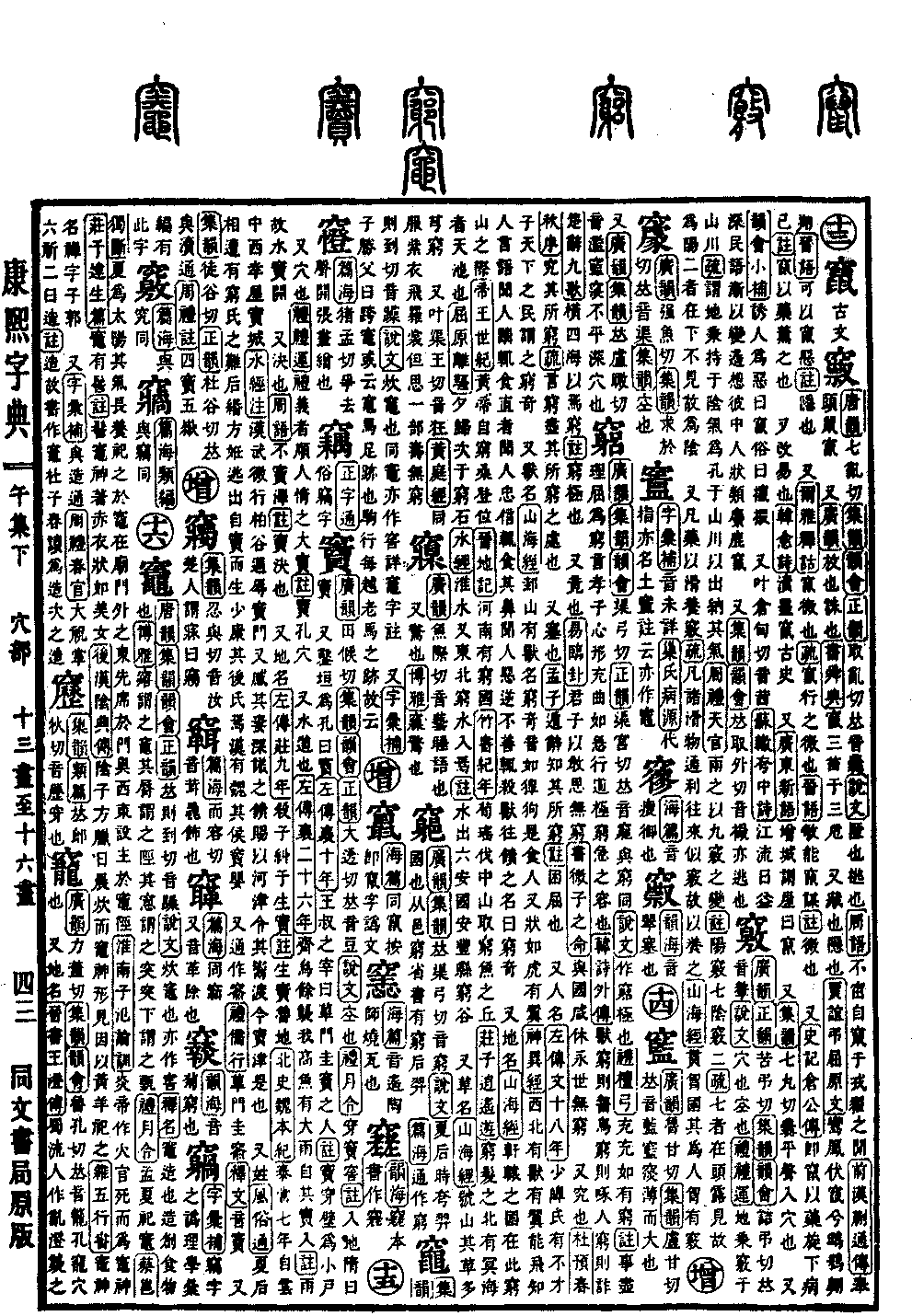
Page 869, Entry 01
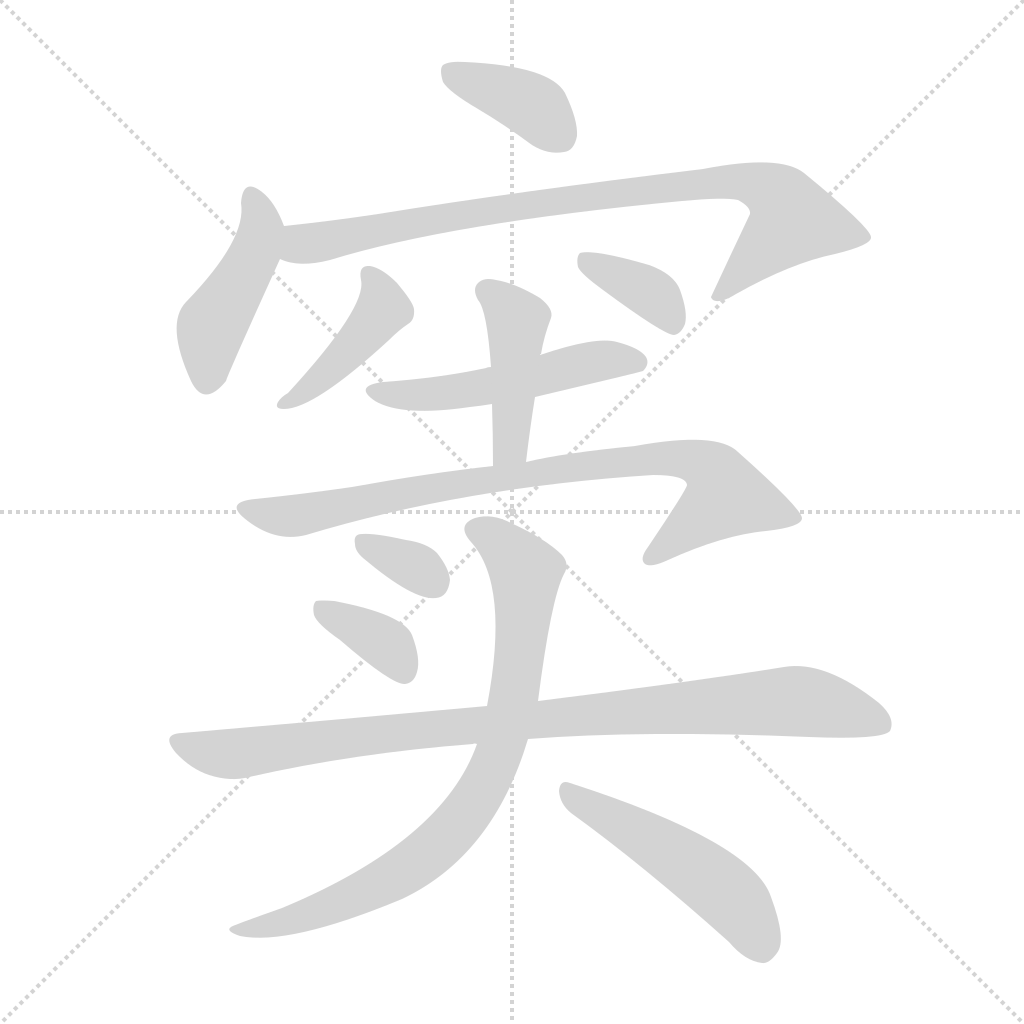
Pronounced dou.
As defined in the Analytical Dictionary of Characters (Shuowen Jiezi), it refers to a void or empty space.
In the Book of Rites (Liji), in the section Monthly Ordinances (Yueling), it says: Digging a cave or cellar. The commentary states: An entrance dug into the ground is called a dou. Also, to chisel a hole in a wall is called a dou.
In the Zuo Commentary (Zuozhuan), in the tenth year of Duke Xiang, it mentions: A person of the wicker gate and triangular-shaped small door. The commentary states: A dou is a small door created by piercing through a wall.
Also, it means a hole or aperture. In the Book of Rites (Liji), in the section Evolution of Rites (Liyun), it says: Ritual and righteousness are the great apertures that follow human nature. The commentary states: A dou is a hole or orifice.
Also, it refers to a water passage. In the Zuo Commentary (Zuozhuan), in the twenty-sixth year of Duke Xiang, it says: Qi Wuyu attacked us; Gao Yu encountered heavy rain, which entered from the water passage. The commentary states: Because of the heavy rain, the water aperture opened.
Also, it means to break through or drain. In the Discourses of the States (Guoyu), it says: Do not drain the marshes. The commentary states: A dou is to drain or break through.
Also, a place name. In the Zuo Commentary (Zuozhuan), in the ninth year of Duke Zhuang, it says: Killed Zijiu at Shengdou. The commentary states: Shengdou is a place in the state of Lu.
In the History of the Northern Dynasties (Beishi), in the Annals of the Wei, it records: In the seventh year of Taichang, he traveled west from Yunzhong to Wudou City.
In the Commentary on the Classic of Waterways (Shuijingzhu), it says: Emperor Wu of Han traveled incognito to Bogu and encountered an insult at the dou gate. He was moved by his wife’s deep understanding and rewarded her by appointing her husband as the Magistrate of Hejin. The ferry they operated is today known as Doujin.
Also, a surname. According to the Customs and Traditions (Fengsutong), when the Xia Dynasty ruler Xiang encountered the crisis of the Youqiong clan, his consort Min was pregnant and escaped through a hole and gave birth to Shaokang; her descendants took this as their surname. In the Han Dynasty, there was the Marquis of Weiqi, Dou Ying.
Also, it is commonly written as the variant form (yu).
In the Book of Rites (Liji), in the section Conduct of Scholars (Ruxing), it says: Wicker gate and triangular-shaped small door. The Explanation of Characters (Shiwen) states: Pronounced dou.
Also, pronounced du. It is interchangeable with the character for ditch or sluice (du). In the commentary to the Rites of Zhou (Zhouli), it mentions: The western sluices of the five sacred mountains.