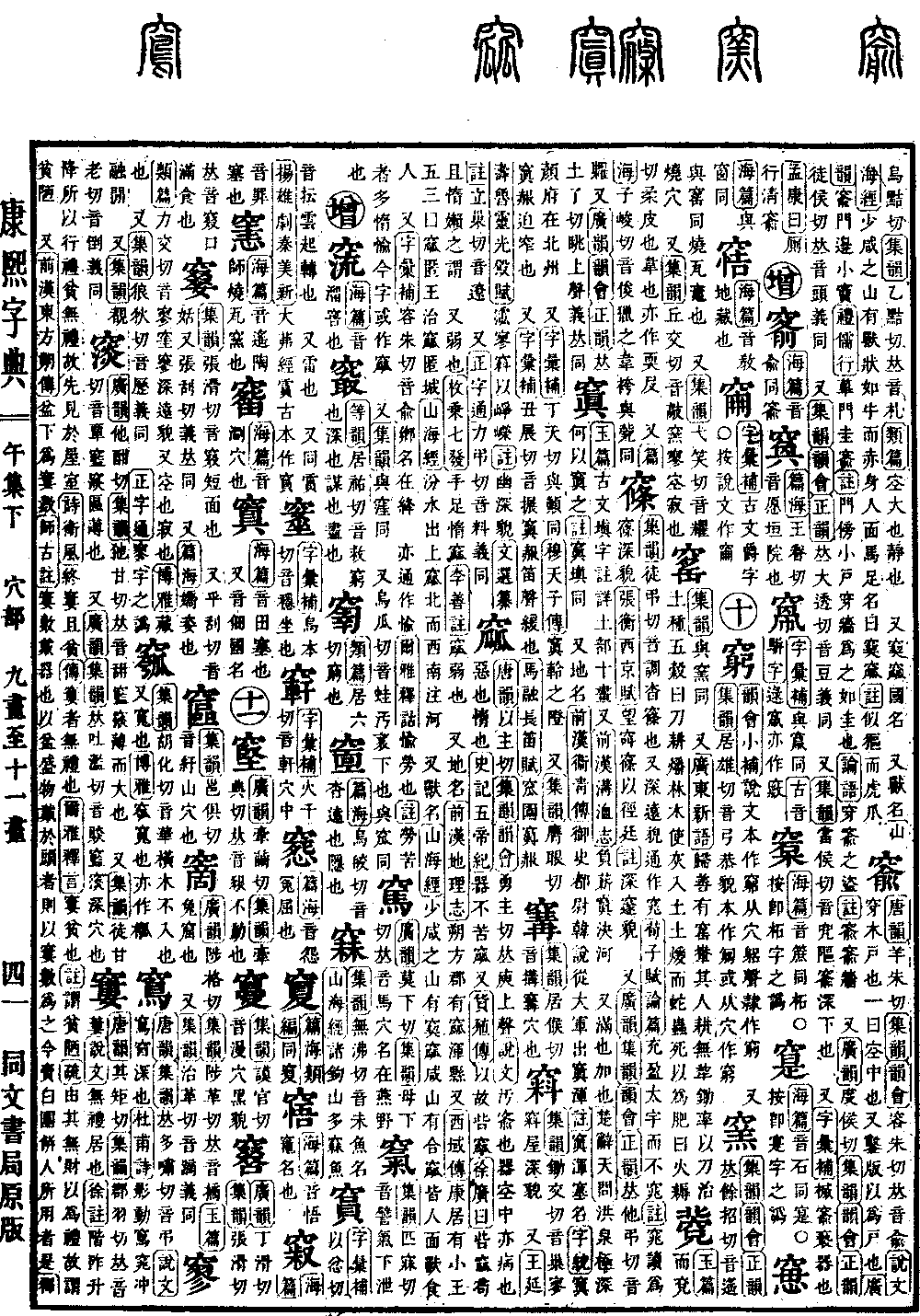
Wu Collection, Lower Volume
Radical: Cave (xué)
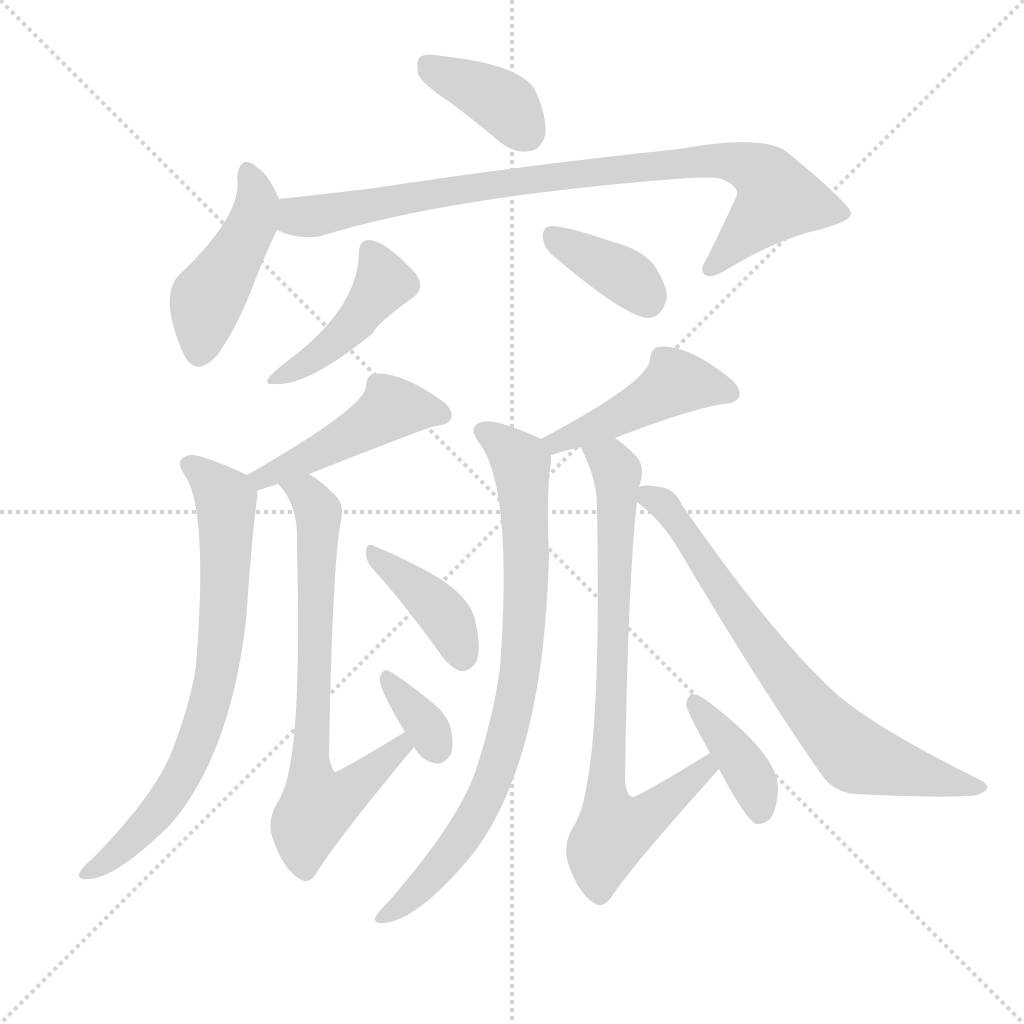
Yu
Kangxi Strokes: 15
Page 867, Entry 18
Pronounced yu (rising tone).
Explaining the character, it means filthy and low. It also refers to the hollow interior of a vessel. It further denotes illness, poor quality, and laziness.
Records of the Grand Historian (Shiji), Annals of the Five Emperors: Vessels that are not rough or inferior.
Also, Biographies of Money-makers (Huozhi Zhuan): Therefore, negligent and lazy.
Xu Guang says: Zi-yu refers to being negligent and lazy.
It also refers to being weak.
Mei Cheng, Seven Stimuli (Qifa): Limbs are lazy and weak.
Li Shan annotation: Yu means weak.
It is also a place name.
History of the Former Han (Qianhan Shu), Treatise on Geography: Shuofang Commandery contains Yuhun County.
Also, Treatise on the Western Regions: The Kingdom of Kangju has five minor kings, the third of whom is the King of Yuni, who governs Yuni City.
Classic of Mountains and Seas (Shanhaijing): The Fen River originates north of Shangyu and flows southwest into the Yellow River.
It is also the name of a beast.
Classic of Mountains and Seas (Shanhaijing): On Mount Shaoxian there is a Yazhu, and on Mount Xian there is a Heyu; both have human faces and animal bodies, and they eat people.
Also, Supplement to the Collection of Characters (Zihui Bu): Pronounced yu (level tone). It is the name of a village in the territory of Jiang.
It is also used interchangeably with yu.
Erya, Explanation of Glosses (Shigu): Yu means weary and laborious.
Annotation: Laborious people are mostly lazy and slack.
Modern characters are sometimes written as yu.
Also, Collected Rhymes (Jiyun): Identical to wa.
Also pronounced wa (level tone). It refers to being filthy, wicked, and low. It is identical to wa.