Hai Collection, Lower Volume
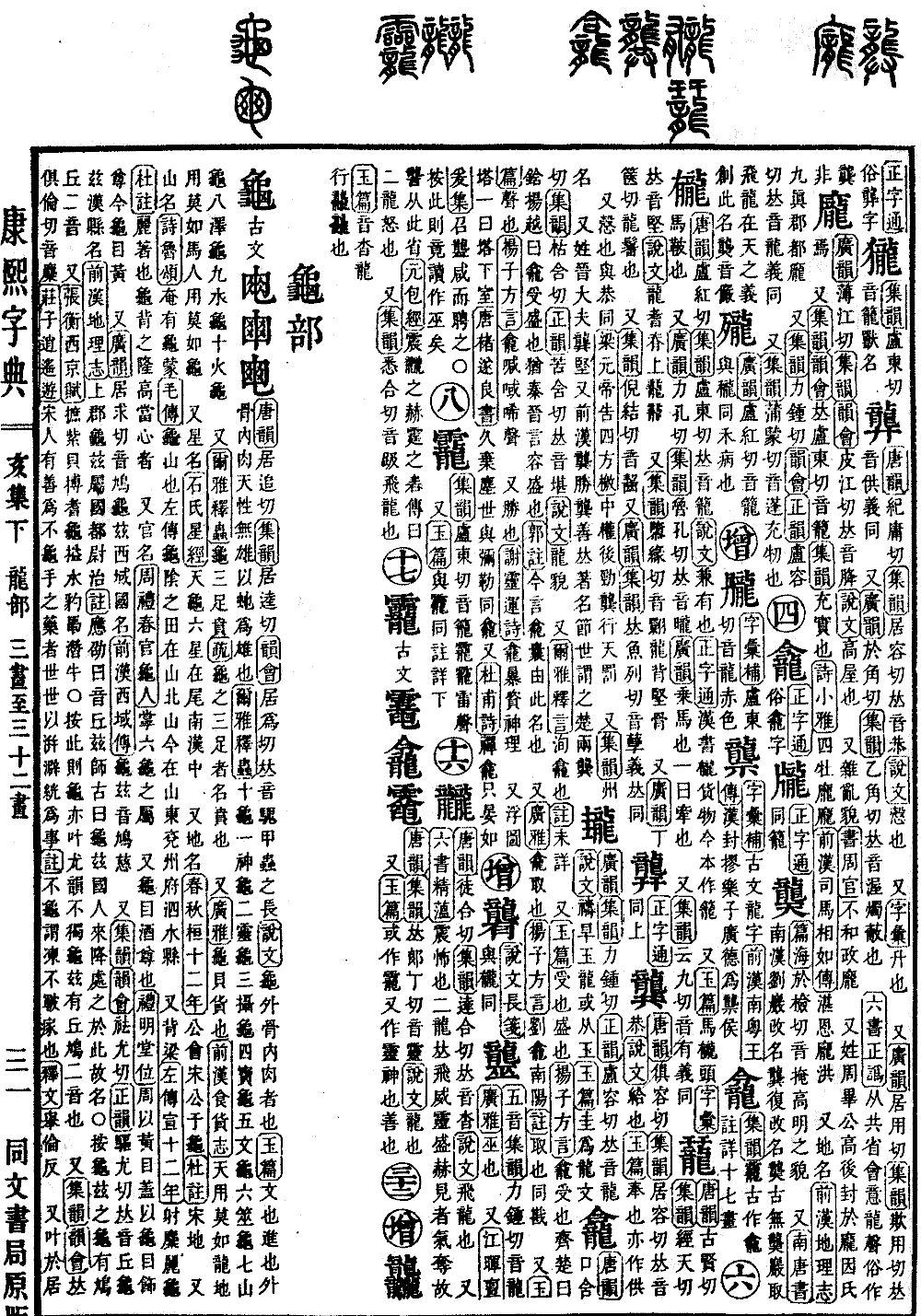
Radical: Dragon (lóng)
Kangxi Strokes: 22
Page 1537, Entry 25
Pronounced kan.
Shuowen Jiezi (Shuowen): The appearance of a dragon.
Er Ya (Erya): Explaining Words: Xun is kan. Commentary: Not yet detailed.
Yu Pian (Yupian): To hold, to contain, to store.
Yangzi Fangyan (Fangyan): Kan means to contain or store. In the regions of Qi and Chu it is called han, while in the regions of Yang and Yue it is called kan. It carries the meaning of containing or storing, similar to how the regions of Qin and Jin use the terms rong or sheng. Guo commentary: The modern term for a pouch or container (kannan) originates from this meaning.
Guangya: Kan means to attack and take.
Yangzi Fayan (Fayan): Liu conquered (kan) Nanyang. Commentary: It means to attack and take. It is the same character as kan (to overcome).
Yu Pian (Yupian): Sound.
Yangzi Fangyan (Fangyan): Kan refers to the sound of shouting or crying.
To overcome in battle. Xie Lingyun poem: To pacify violence and disorder relies upon divine reason.
Also refers to a Buddhist pagoda. It also refers to a chamber or grotto beneath a pagoda. Tang Dynasty Chu Suiliang writing: Long ago abandoned the mundane world to dwell in the same Buddhist shrine (kan) as the Maitreya Buddha.
Du Fu poem: Within the Buddhist shrine (kan), all is merely a scene of tranquility.
Research note: Regarding the citation Yangzi Fangyan: Liu conquered Nanyang, it has been corrected to Fayan according to the original text.