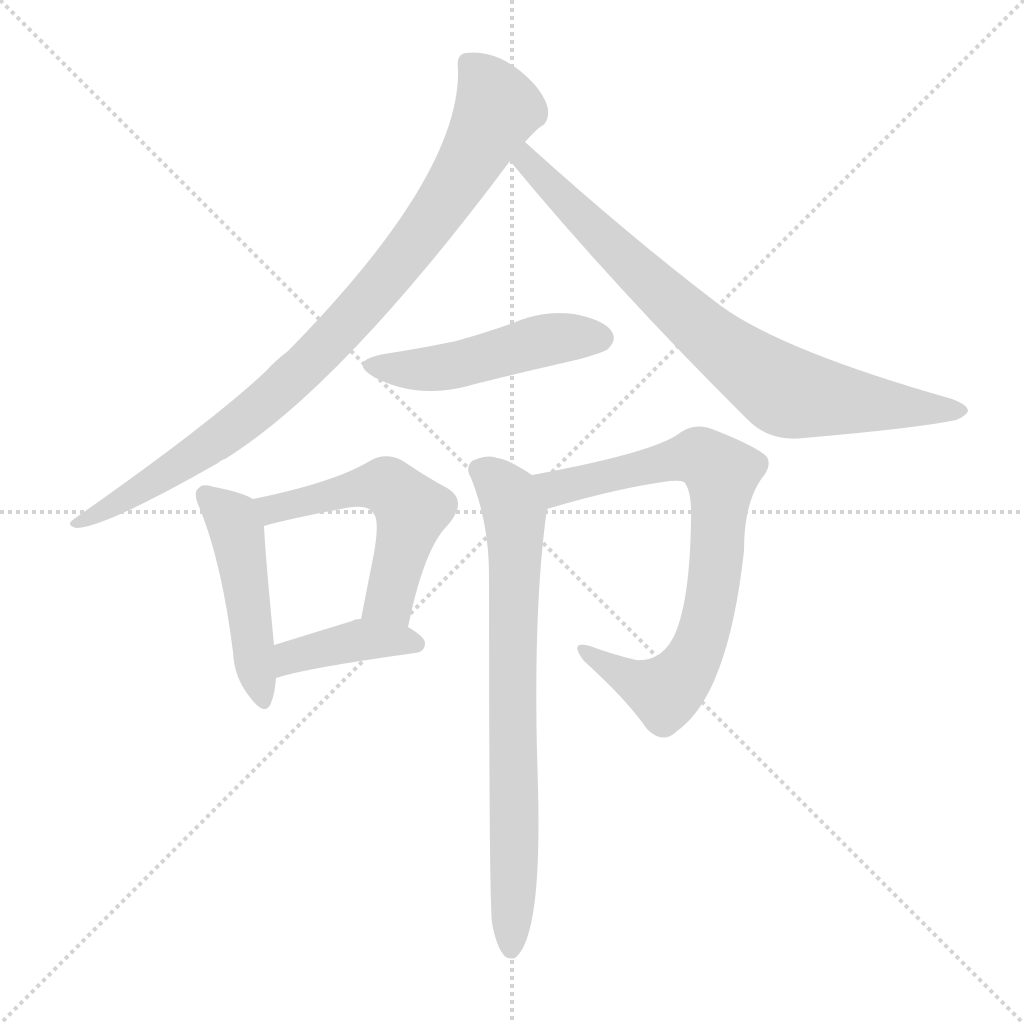
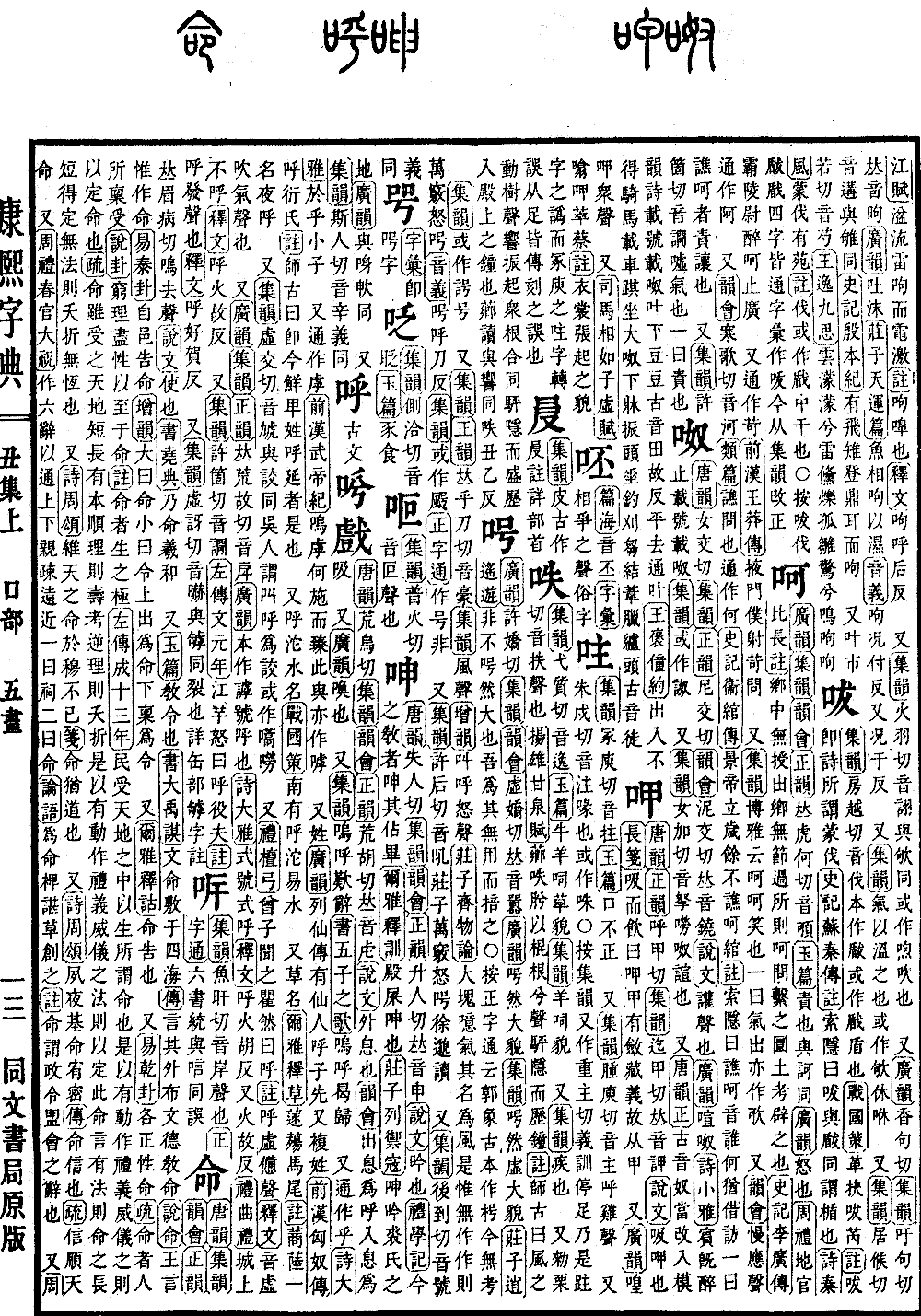
Chou Collection, Upper Volume
Radical: Mouth (kǒu)
Kangxi Strokes: 8
Page 183, Entry 18
Pronounced ming (falling tone).
Shuowen Jiezi (Explaining Single-Unit Characters and Analyzing Compound Characters): To cause or to send.
Book of Documents (Shujing), Canon of Yao: Then he ordered Xi and He.
Yu Pian (Jade Chapters): To instruct or command.
Book of Documents (Shujing), Counsels of the Great Yu: Civilizing mandates are spread across the four seas.
Commentary: This refers to the external propagation of civil virtue and governmental mandates.
Book of Documents (Shujing), Counsels of King Yao: The words of the king constitute a mandate.
Book of Changes (Yijing), Tai Hexagram: Proclaiming mandates from the capital.
Zeng Yun (Expanded Rhymes): Major commands are called ming, minor ones are called ling. What comes from above is ming, what is received from below is ling.
Erya (Approaching Elegance), Interpretation of Ancient Words: Ming means to inform.
Book of Changes (Yijing), Qian Hexagram: Each rectifies their nature and fate (ming).
Sub-commentary: Ming is that which a person receives [at birth].
Book of Changes (Yijing), Shuo Gua (Discussion of Trigrams): Investigate the principles to their utmost and exhaust one’s nature, thereby reaching the understanding of fate.
Annotation: Ming is the limit of life.
Zuo Commentary (Zuo Zhuan), 13th Year of Duke Cheng: The people receive the essence of Heaven and Earth to exist, which is what is called ming. Thus, there are rituals, righteousness, and majestic deportment to define this fate.
Sub-commentary: Although ming is received from Heaven and Earth, its length has an inherent root. Following reason leads to longevity, while opposing reason leads to premature death. Thus, there are rules of action, ritual, and righteousness to stabilize this fate; if there is a method, the length of life is stabilized; without a method, death is unstable.
Book of Odes (Shijing), Zhou Odes: The mandate of Heaven, how profound and unending.
Annotation: Ming is synonymous with the Way (dao).
Book of Odes (Shijing), Zhou Odes: From dawn to dusk, establish the mandate in peace and secrecy.
Commentary: Ming means trustworthiness.
Sub-commentary: This refers to believing in and following the mandate of Heaven.
Rites of Zhou (Zhouli), Spring Offices: Create the six types of declarations to communicate between the high and low, the intimate and the distant. The first is for sacrifices, the second is for mandates.
Analects (Lunyu): When drafting mandates, Pi Chen would compose the initial drafts.
Sub-commentary: Ming refers to the language of political decrees and diplomatic alliances.
Rites of Zhou (Zhouli), Spring Offices, Grand Minister of Rites: Statutes of rank.
Annotation: Ming refers to documents regarding the promotion or demotion of officials.
Also, the name of a star.
Rites of Zhou (Zhouli), Spring Offices, Grand Minister of Rites: The Director of Fate (Siming).
Annotation: The fourth star of Wenchang.
Discourses of the States (Guoyu): King Xiang bestowed a mandate upon Duke Hui of Jin.
Annotation: Ming refers to a mandate of tokens. When feudal lords ascended the throne, the Son of Heaven bestowed a jade token of mandate as a symbol of authority.
Discourses of the States (Guoyu): King Xiang bestowed... a mandate upon Duke Wen of Jin.
Annotation: Ming refers to the robes of mandate. Feudal lords were entitled to seven mandates, involving robes with seven levels of decoration.
History of the Former Han (Qian Hanshu), Biography of Zhang Er: Once, he was a fugitive avoiding the mandate (ming) while traveling in Waihuang.
Annotation: Shigu says: Ming refers to one's name. It means to escape from the name registers and live as a fugitive.
History of the Former Han (Qian Hanshu), Biography of Li Ling: His arrows hit the target (ming).
Annotation: Shigu says: It refers to hitting the exact spot indicated.
Guang Yun (Broad Rhymes): Calculation.
Guang Yun (Broad Rhymes): To summon.
Also rhymed as min (rising tone).
Book of Odes (Shijing), Odes of Yong: To be such a person, harboring hidden relations, possessing no trustworthiness, and not knowing fate.
Book of Odes (Shijing), Great Odes: Protecting and assisting him by mandate, bestowed anew by Heaven.
Note: Zhu Xi suggests all these should be rhymed as mi-bin; however, bin belongs to the geng rhyme group and is difficult to rhyme with the zhen rhyme group; it is suspected it should be mi-bin.
Also rhymed as mang (falling tone).
Guo Pu, Praise for the Land of Immortals in the Classic of Mountains and Seas (Shanhaijing): Someone lives there, atop the Yuan Hill, where red springs sustain the years and divine trees nourish life.
Book of Rites (Liji), Great Learning: When raised, one cannot precede the mandate.
Annotation: Ming is read as man (sluggish/slow), which is a mistake in pronunciation.
Explication of the Text: Ming is pronounced man, rhyming with wu and jian.