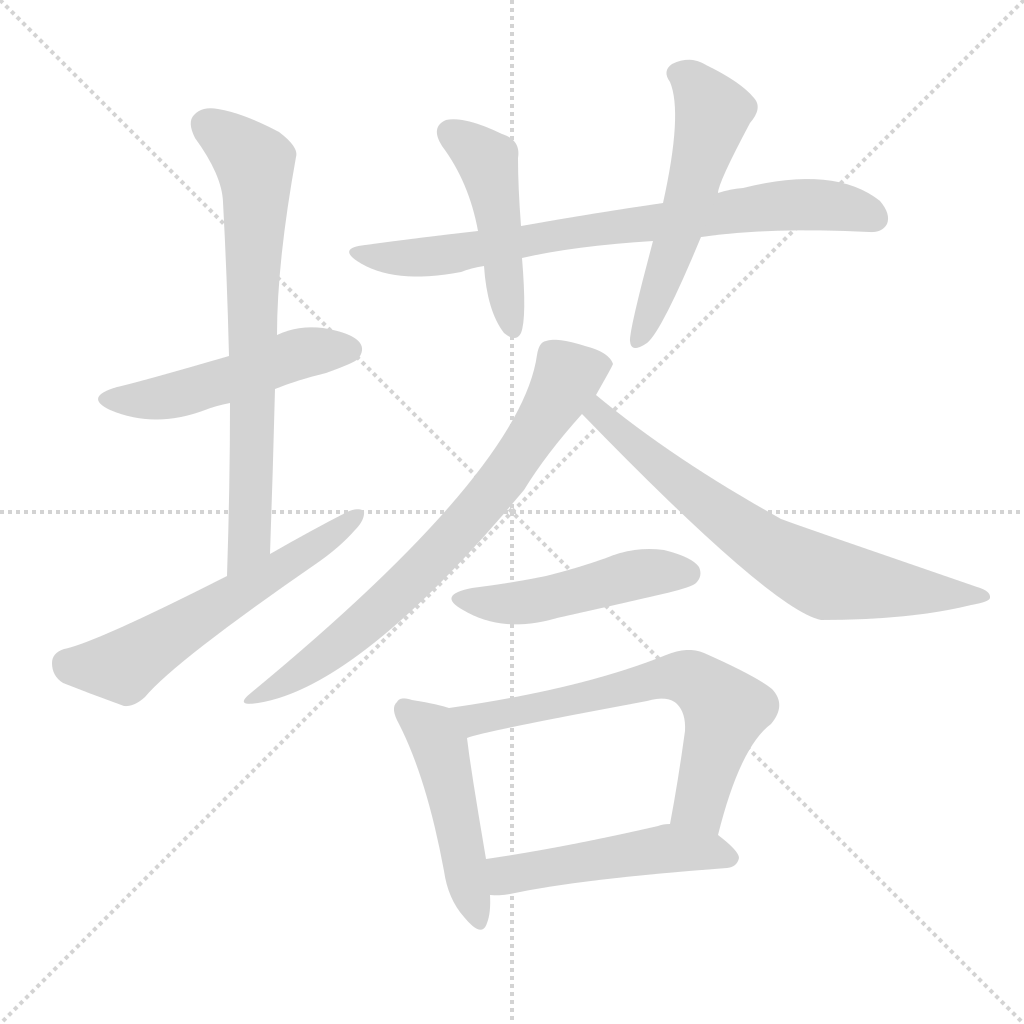
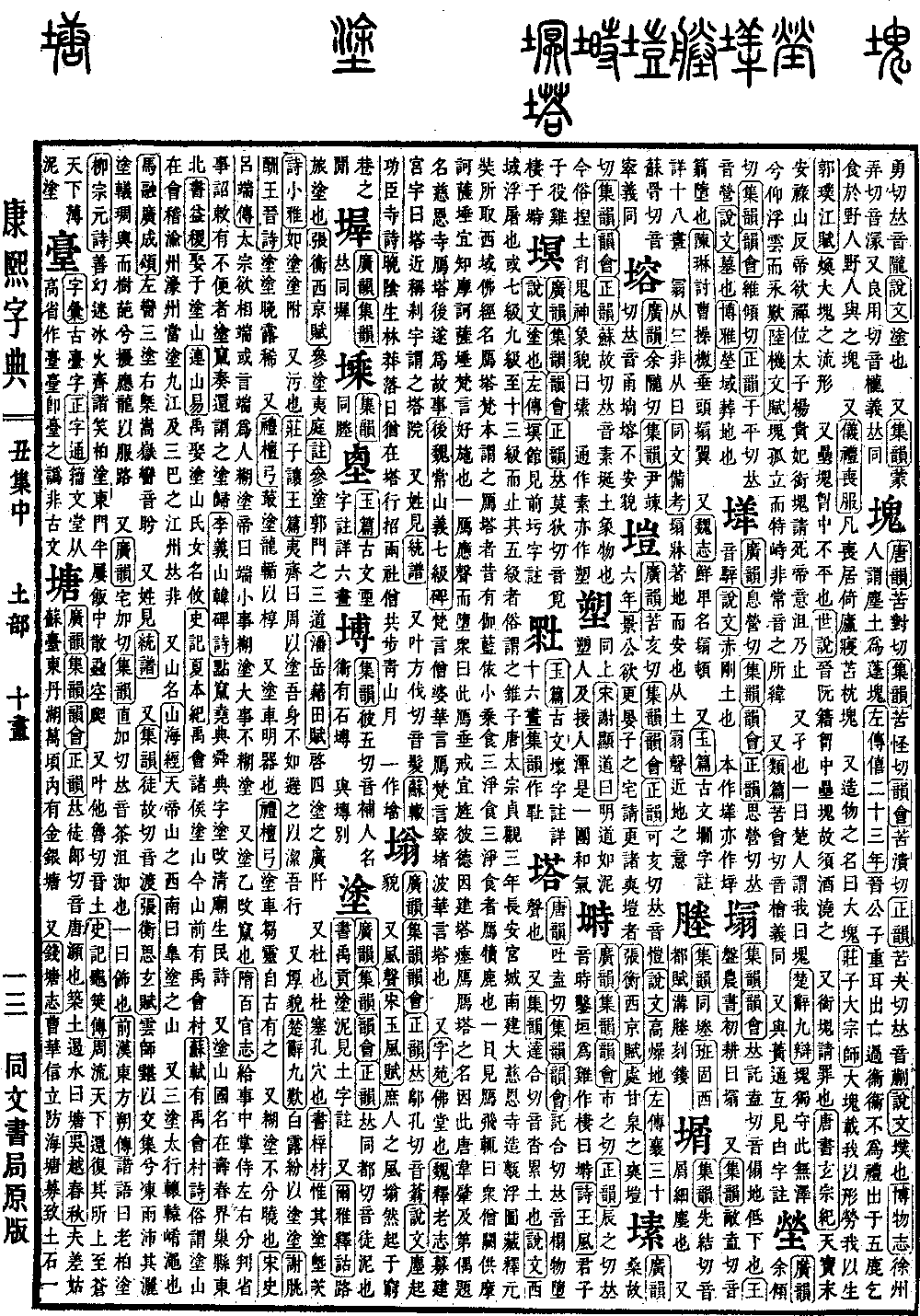
Chou Collection, Middle Volume. Radical: Earth (tǔ). Kangxi strokes: 13. Page 235, Entry 14.
Pronounced ta. Indicates the sound of an object falling.
Also, according to Jiyun, pronounced ta. Refers to piling up mud.
Explained in Explaining and Analyzing Characters (Shuowen Jiezi) as a Buddhist pagoda from the Western Regions, consisting of seven or nine stories, up to a maximum of thirteen stories. Those with five stories are colloquially called awls.
In the third year of the Zhenguan reign of Emperor Taizong of Tang, the Great Ci'en Temple was built south of the palace city in Chang'an, featuring a brick pagoda to house the Buddhist scriptures brought back from the Western Regions by the monk Xuanzang, known as the Wild Goose Pagoda (Yanta).
The origin of the Sanskrit name for the Wild Goose Pagoda is as follows: Long ago, there was a monastery that followed the Lesser Vehicle (Hinayana) precepts and consumed the three pure foods. The three pure foods refer to the meat of geese, calves, and deer. One day, the monks saw a flock of geese flying over and said, "The monks lack offerings for the Bodhisattva; the Bodhisattva should know our sincerity." A goose fell in response. The monks said, "This goose is providing a sign and a warning; we should honor its merit." Thus, they built a pagoda to bury the goose, and the name Wild Goose Pagoda originated from this.
After Wei Zhao of the Tang dynasty passed the imperial examination, he happened to write his name on the Wild Goose Pagoda at Ci'en Temple, which subsequently became a tradition.
In the Later Wei Dynasty record Changshan Yi Qiji, the Sanskrit term sengpo translates into Chinese as wild goose. The Sanskrit term stupa translates into Chinese as pagoda.
Also, according to Dictionary of Characters (Ziyuan), it refers to a Buddhist hall.
According to the Treatise on Buddhism and Taoism (Wei Shilao Zhi), palace buildings and halls constructed with collected funds were called pagodas; in modern times, temples are called pagoda compounds.
There is also a surname Ta, found in General Genealogy (Tongpu).
Also rhyming with fa.
In a poem by Su Zhe titled Gongchen Temple, the evening shade grows in the forest brush, the setting sun still touches the pagoda. Walking to invite the monks of the two societies, we step together under the moon of the green mountains.
Also written in a variant form.