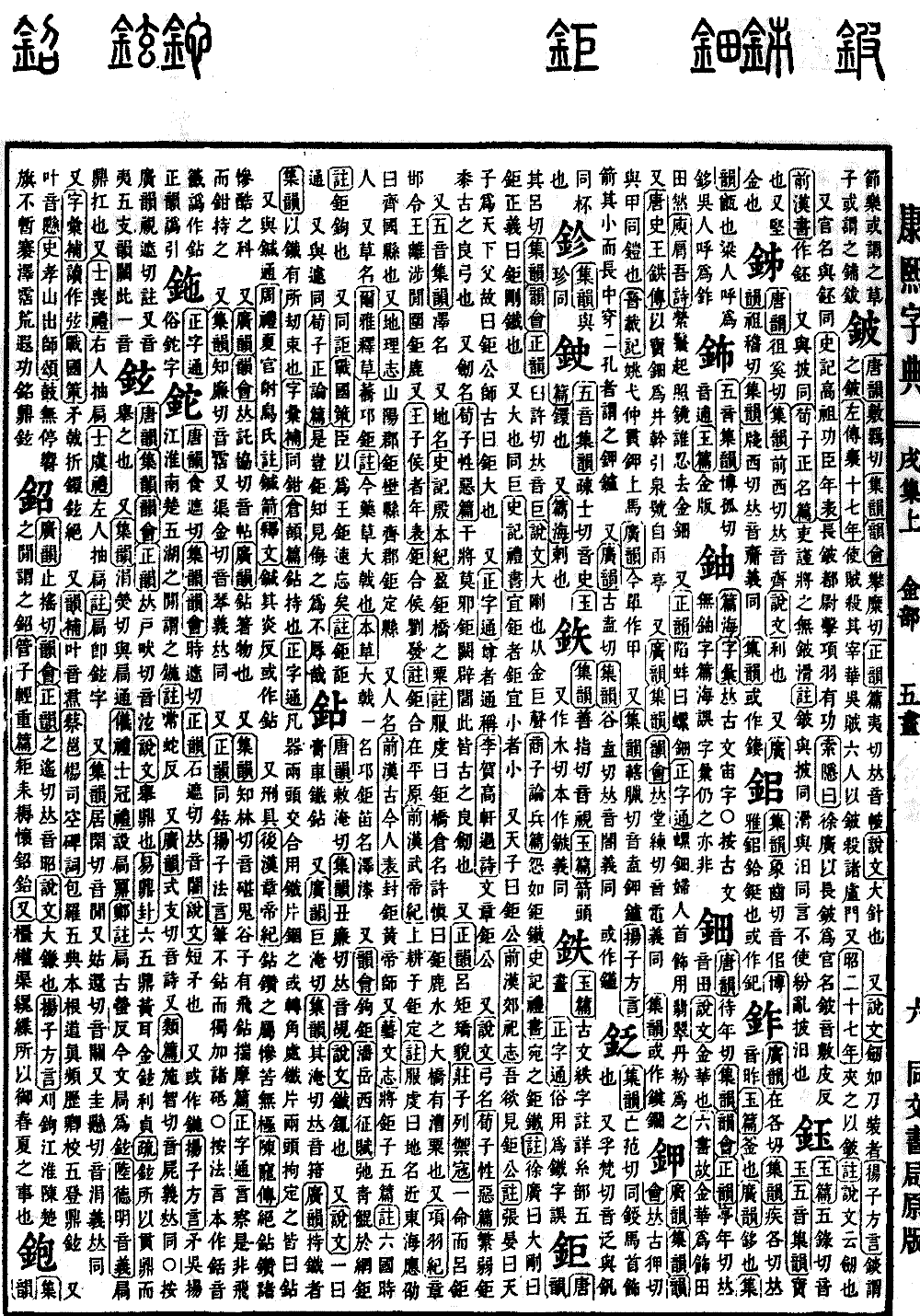
Xu Collection, Upper Volume
Radical: Metal (jīn)
Kangxi Strokes: 13
Page 1300, Entry 01
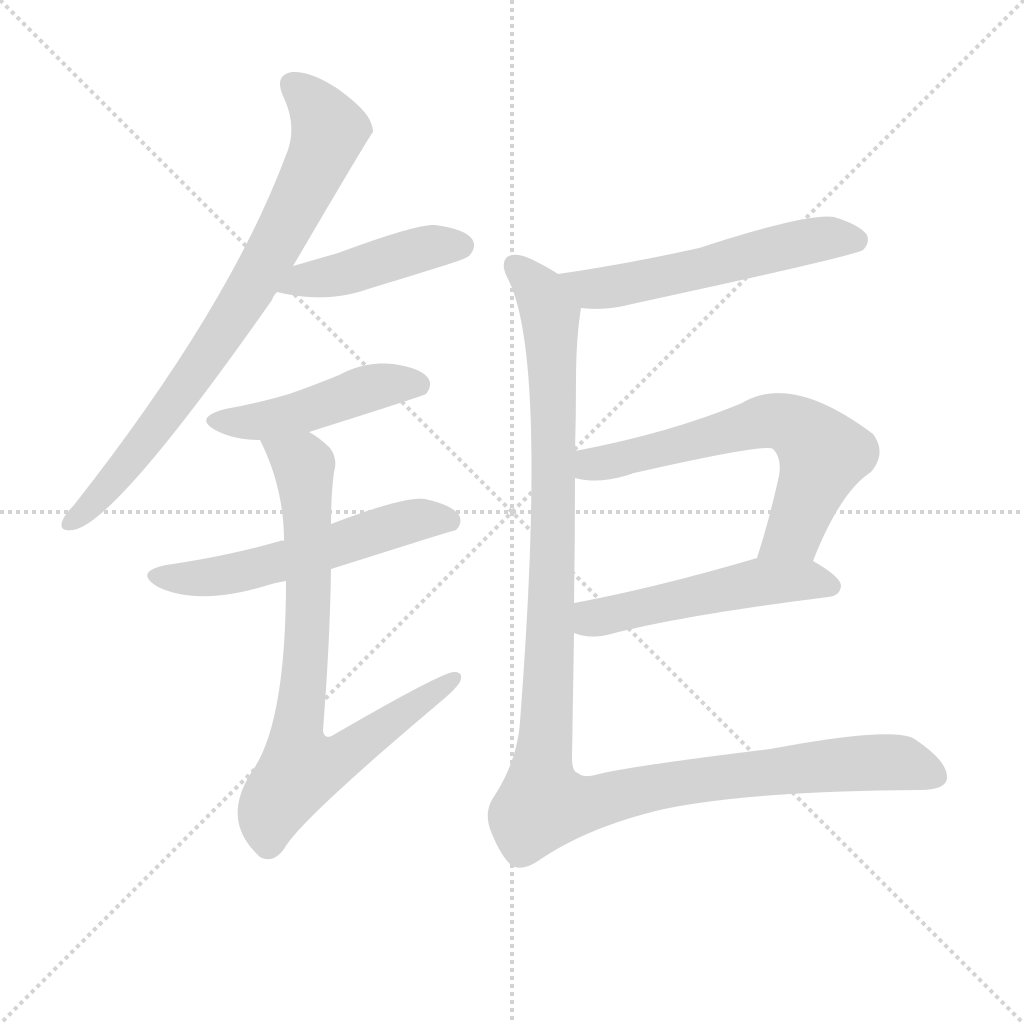
Pronounced ju. Pronounced ju, same sound as "ju".
Shuowen Jiezi (Explanation of Graphs and Analysis of Characters) states: Refers to very hard metal. The graph is formed with "metal" as the radical and "ju" as the phonetic component.
Book of Lord Shang (Shangjun Shu), Chapter on Discussing Warfare: Resentment is like hard iron.
Records of the Grand Historian (Shiji), Book on Rites: Hard ironware produced in the Wan region. Note: Xu Guang says: Very hard metal is called "ju". Zhengui says: "Ju" is hard iron.
Also indicates the meaning of "large". Same as "ju".
Records of the Grand Historian (Shiji), Book on Rites: What should be large is large, what should be small is small.
Also, the Son of Heaven is referred to as "Ju Gong" (Great Lord).
History of the Former Han (Hanshu), Treatise on Suburban Sacrifices: I wish to see the Son of Heaven. Note: Zhang Yan says: The Son of Heaven is the father of all people under heaven, thus called "Ju Gong". Shiguy says: Ju means large.
Also, according to Zhengzitong (Correction of Characters), it is a general term for honorable people.
Li He, Poem on High Carriages Passing By: Refers to masters of literature.
Also, according to Shuowen Jiezi (Explanation of Graphs and Analysis of Characters), it is the name of a bow.
Xunzi, Chapter on the Nature of Man is Evil: Fanruo and Jushu are fine bows of antiquity.
Also, the name of a sword.
Xunzi, Chapter on the Nature of Man is Evil: Ganjiang, Moye, Juque, and Bilu are all fine swords of antiquity.
Also, according to Zhengyun (Correct Rhymes), "Luju" describes the appearance of being arrogant and conceited.
Zhuangzi, Chapter on Lie Yukou: As soon as one is appointed, one becomes arrogant and conceited.
Also, according to Wuyin Jiyun (Collection of Rhymes of the Five Sounds), the name of a marsh.
Also, the name of a location.
Records of the Grand Historian (Shiji), Basic Annals of Yin: Filling the grain in the Juqiao granary. Note: Fu Qian says: Juqiao is the name of a granary. Xu Shen says: It is a granary for transshipping grain located at the large bridge on the Julu River.
Also, Basic Annals of Xiang Yu: Zhang Han ordered Wang Li and She Jian to besiege Julu.
Also, Table of Princes and Marquises: Marquis of Juhe, Liu Fa. Note: Juhe is in Pingyuan Commandery.
History of the Former Han (Hanshu), Annals of Emperor Wu: The Emperor plowed in Juding. Note: Fu Qian says: It is a place name, near the East Sea. Ying Shao says: It is a county in the state of Qi.
Also, Treatise on Geography: Shanyang Commandery has Juye County, and Qi Commandery has Juding County.
Also, the name of a person.
History of the Former Han (Hanshu), Table of Ancient and Modern People: Feng Ju was a teacher of the Yellow Emperor.
Also, Treatise on Arts and Literature: Contains five chapters of Jiang Juzi. Note: A person of the Warring States period.
Also, the name of a plant.
Erya, Interpretation of Grasses: "Qiao" is also called "Qiongju". Note: It is the current medicinal herb Euphorbia pekinensis. Bencao (Materia Medica) states: Euphorbia pekinensis is also called Qiongju, and its young sprouts are called Zeqi.
Also, according to Yunhui (Collection of Rhymes), refers to "gouju" (fishing hook).
Pan Yue, Western Expedition Rhapsody: Released the fishing hook from the blue kun fish in the net. Note: Ju is a hook.
Also, the same as "ju" (how, why).
Strategies of the Warring States (Zhan Guo Ce): I thought, how could Your Majesty have forgotten so quickly? Note: "Ju" is interchangeable with "ju".
Also, the same as "ju" (hurriedly, immediately).
Xunzi, Chapter on Correct Discussions: How could this be the reason for immediately understanding that being insulted is not a disgrace?