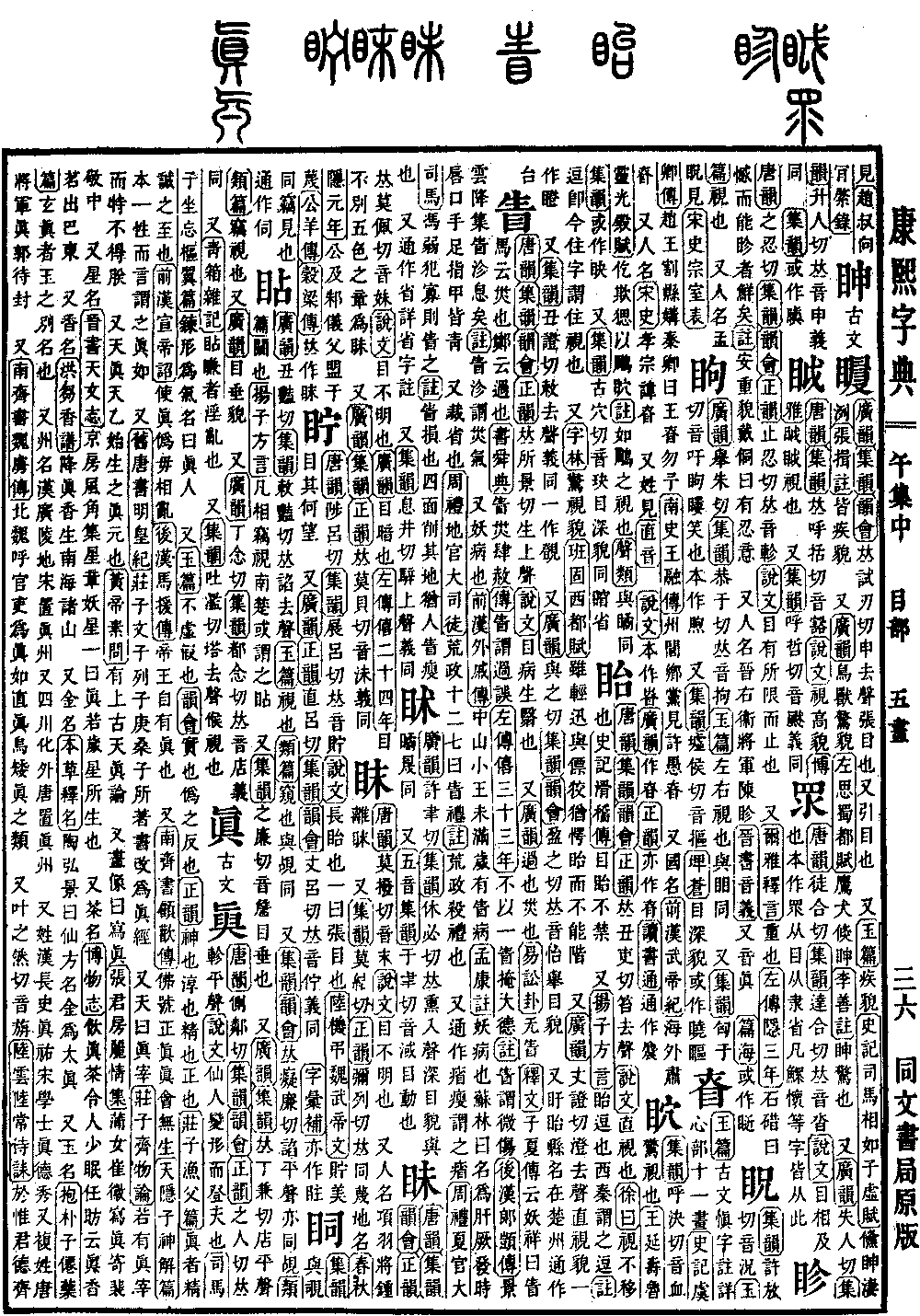
Wu Collection, Middle Volume
Radical: Eye (mù)
Pronounced zhen (rising tone)
Page 804, Entry 18
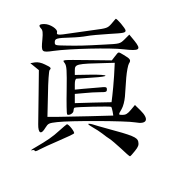
Ancient character. According to Tang Rhymes (Tang Yun), the pronunciation is zhen (rising tone). According to Collected Rhymes (Jiyun), Rhyme Treasury (Yunhui), and Orthodox Rhymes (Zhengyun), the pronunciation is zhen (rising tone). According to Explanation of Graphs and Analysis of Characters (Shuowen Jiezi), it refers to immortals who ascend to heaven through the transformation of their physical bodies. In the Sitting in Oblivion and Pivot Wings (Zuowang Shuyi Pian) by Sima Zi, it states that cultivating the physical form into vital energy is called a True Person (zhenren). Also, according to Jade Chapters (Yupian), it means not false. According to Rhyme Treasury (Yunhui), it means authentic. It is the opposite of hypocrisy. According to Orthodox Rhymes (Zhengyun), it refers to the miraculous, simple, refined, and pure. In the Fisherman (Yufu Pian) of the Zhuangzi, it states that truth is the highest state of sincerity. In the Edict of Emperor Xuan of the Former Han Dynasty, it states to not let truth and falsehood be confused. In the Biography of Ma Yuan in the History of the Later Han Dynasty, it states that emperors have their own truth. Also, in the Biography of Gu Huan in the Book of Southern Qi, the Buddha is called Correct Truth (zhengzhen), and the Ultimate Truth (zhendi) lies in the realization of non-arising. In the Divine Understanding (Shengjie Pian) of Tianyinzi, in terms of original nature, it is called Thusness (zhenru). Also, in the Old Book of Tang, Annals of Emperor Xuanzong, the books written by Zhuangzi, Wenzi, Liezi, and Gengsangzi were renamed True Classics (zhenjing). Also, heaven is called the True Sovereign (zhenzai). In the Zhuangzi, Discussion on the Equality of Things (Qiwulun), it states that there seems to be a true master, yet one cannot find its traces. Also, heavenly truth (tianzhen) refers to Tianyi, the primordial vital energy of initial life. The Yellow Emperor's Inner Canon (Huangdi Suwen) contains the Discourse on Ancient Heavenly Truth (Shanggu Tianzhen Lun). Also, portraits are called realistic depictions (xiezhen). In the Record of Beautiful Feelings (Liqing Ji) by Zhang Junfang, a woman named Cui Hui from Pudi painted her own portrait and sent it to Pei Jingzhong. Also, the name of a star. The History of Jin, Treatise on Astronomy, records in the Chapters on Stars from the Wind Horn Collection (Fengjiao Jixing Zhang) by Jing Fang that there is a demon star called Zhenruo, which is born from Jupiter. Also, a type of tea. In the Treatise on Diverse Things (Bowuzhi), it states that drinking true tea can reduce sleep. Ren Fang says: Zhen is a type of fragrant tea produced in Badong. Also, a type of spice. In the Fragrance Manual (Xiangpu) by Hong Chu, the Jiangzhen fragrance grows in the mountains of the South Sea. Also, a type of metal. In the Materia Medica (Bencao), Shiming, Tao Hongjing says: In immortal prescriptions, gold is called Great Truth (taizhen). Also, a type of jade. In the Baopuzi, Chapter on Immortal Medicine, Zhen is an alias for jade. Also, the name of a prefecture. In the Han Dynasty, it was the Guangling region, and in the Song Dynasty, Zhen Prefecture was established. Also, a place beyond the reaches of Chinese civilization in Sichuan; the Tang Dynasty established Zhen Prefecture. Also, a surname. In the Han Dynasty, there was a senior official named Zhen You, and in the Song Dynasty, a scholar named Zhen Dexiu. Also, a compound surname. In the Tang Dynasty, there was a general named Zhen Guo Daifeng. Also, in the Book of Southern Qi, Biography of the Wei Captives, Northern Wei called officials Zhen, such as Zhizhen or Wuaizhen. Also, a rhyming sound related to zhan. In the Eulogy for Chamberlains (Lu Changshi Lei) by Lu Yun, it says regarding your virtues: sagely, vast, and profound. Many talented people admire and follow, gradually becoming influenced and becoming pure and true (chunzhen). According to Six Categories of Writing Corrected (Liushu Zheng'e), when a person is born, they receive primordial energy; the eyes are the first to form, as they are where the spirit gathers, and there is nothing untrue about them. Therefore, the character is composed of Eye and Dagger. Dagger indicates transformation. Adding the element for the beginning indicates the state of primordial energy. It is an associative compound character. Sun Jizhao says: There is no character for Zhen in the Six Classics. It is the ancient form of the character. Zhen and this character are the same. It is a common, non-standard form.