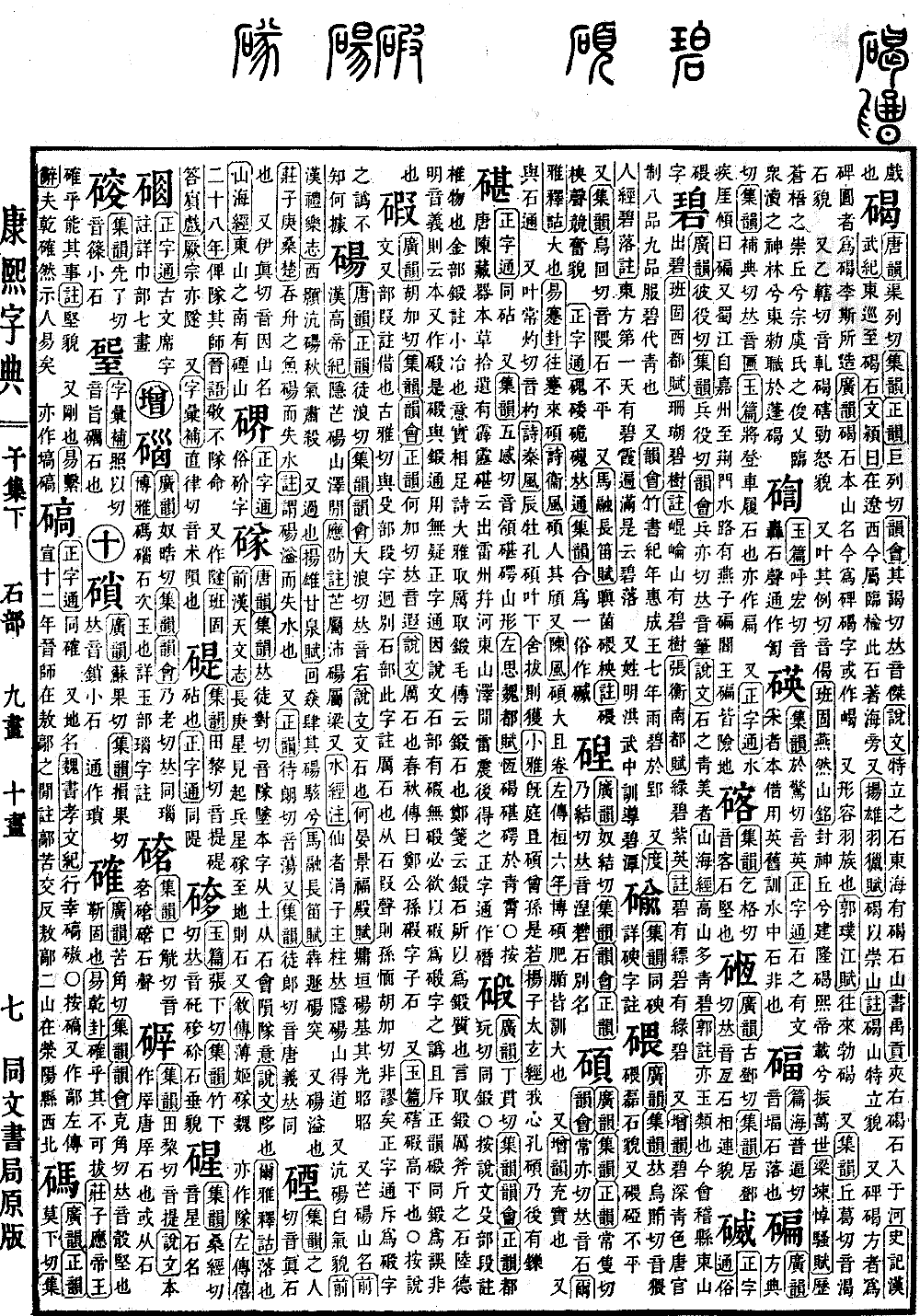
Wu Collection, Lower Volume
Radical: Stone (shí)
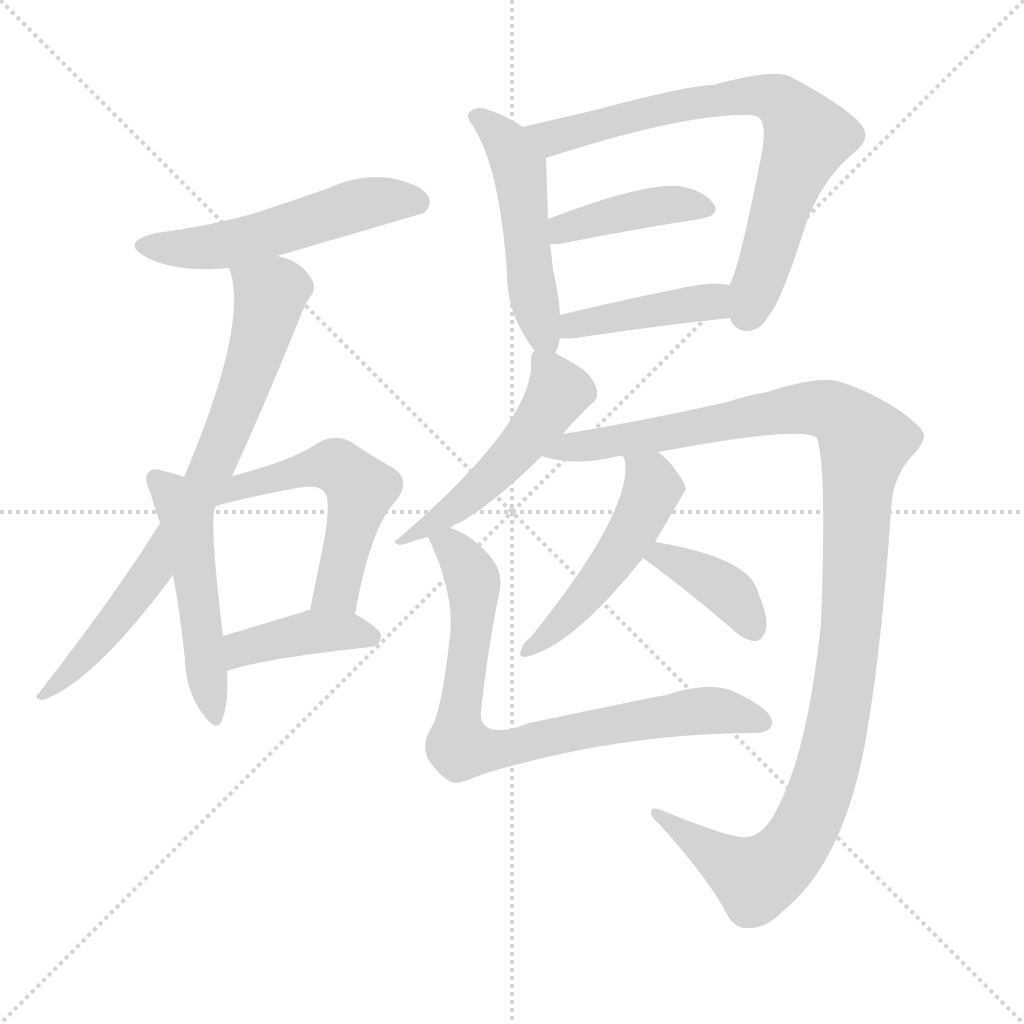
Jie
Kangxi Strokes: 14
Page 833, Entry 01
Pronounced jie.
According to the Shuo Wen Jie Zi (Explaining Graphs and Analyzing Characters), a stone standing alone. There is Mount Jieshi in the East Sea.
Classic of History (Shangshu), Tribute of Yu chapter: Flanking the right, Mount Jieshi enters the Yellow River.
Records of the Grand Historian (Shiji), Annals of Emperor Wu of Han: Traveled east to Mount Jieshi. Wen Ying commented: It is in Liaoxi, now part of Linyu, and this stone stands by the sea.
Also, in Yang Xiong, Feather Hunt Rhapsody (Yulie Fu): Standing like a high mountain. The commentary notes: Jie describes a mountain standing alone.
Also, regarding the term jie: A square shape is called a stele, and a round shape is called a jie; this was established by Li Si.
Guang Yun (Wide Rhyme): Jieshi is originally a mountain name. It is now written as the character jie, and sometimes written in a variant form (ke).
Also, describing feathered creatures. In Guo Pu, River Rhapsody (Jiang Fu): Coming and going, rushing and surging.
Also, pronounced ke. The appearance of a stone.
Also, pronounced zha. Jie-xi, the appearance of being powerful and angry.
Also, rhymes with the sound jie. In Ban Gu, Yanran Mountain Inscription: Sealing the sacred mound to build a lofty stele, glorifying the Emperor's deeds to shake ten thousand generations.
In Liang Song, Lamenting the Li Sao (Dao Sao Fu): Passing the high mounds of Cangwu, honoring the talented ones of the Yu clan. Approaching the sacred forests of the many rivers, eastwards ordering duties at Peng-Jie.