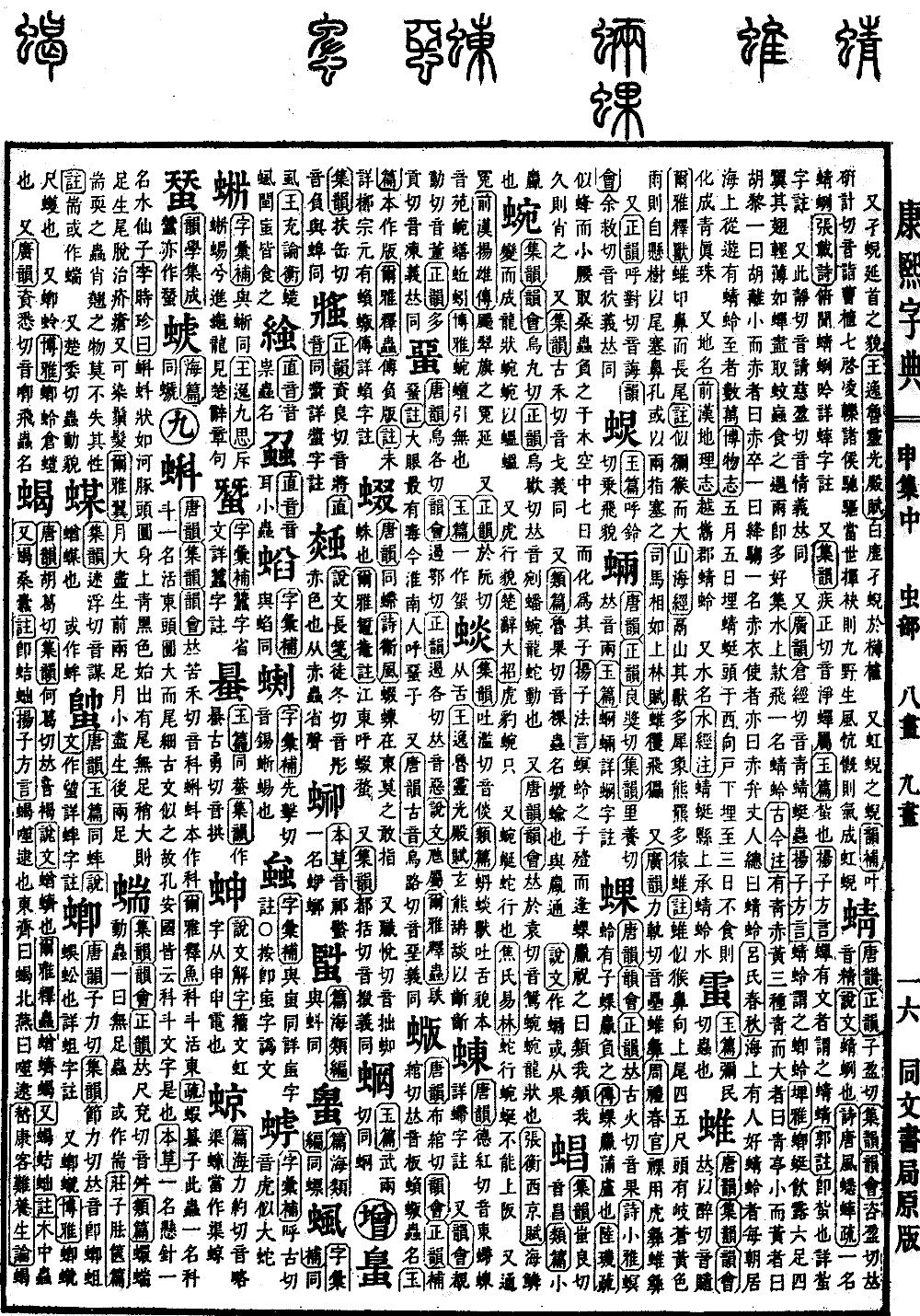
Shen Collection, Middle Volume
Radical: Insect (chóng)
蝎
Kangxi stroke count: 19
Page 1088, Entry 40
Pronounced he.
Pronounced he.
Pronounced he (same as the word for brown/coarse cloth).
Explaining the term as the grub of a beetle (qiutui).
The term refers to the grub of a beetle.
Also known as jia.
Refers to a wood-boring insect.
Also known as sangdu (mulberry borer).
Refers to the same as jia.
If parasitic insects are abundant, the tree will rot — Ji Kang (Jikang), Response to Difficulties in Nourishing Life (Da Nan Yangsheng Lun).
There was a gardener using a light chisel and long hook to remove wood-boring insects from a tree. He asked, do you not know that there are also such insects in the world? The reply was, are the Sanmiao and Gonggong not the wood-boring insects of the era of Emperor Yao? — Cao Zhi (Caozhi), Discussion on the Fields (Jietian Lun).
When people have desires, it is like a tree having wood-boring insects — Liu Xie (Liuxie), New Treatise (Xin Lun).
The term signifies biting or reaching. In the eastern Qi region it is called xie, while in northern Yan it is called shi.
A type of pastry.
Pastries include the xie biscuit — Explanation of Names (Shiming), Explanation of Food and Drink (Shi Yinshi).
Pronounced hong.
An ancient seal script form of the character for rainbow (hong).
Examination of textual evidence:
Regarding the citation from the Erya, Explaining Insects, the entry for xie jia refers to an insect inside wood. The entry for xie sangdu refers to the same as jia. It is noted that the original text character jia has been corrected. The character for borer has been added under the reference to wood-boring insects.
Regarding the citation from the Fangyan, the entry concerning biting and reaching is an explanation of ancient meanings, distinct from the insect definitions above. This segment has been moved to follow the mention of a tree having wood-boring insects, with the prefix also added to distinguish it. It is noted that in the original text of the Fangyan, the phrase referring to northern Yan and the phrase referring to general language are separate and should not be read as one; the word for reach has been omitted here.
Regarding the citation from Ji Kang, Response to Difficulties in Nourishing Life, it is noted that the original character guest has been corrected to response.