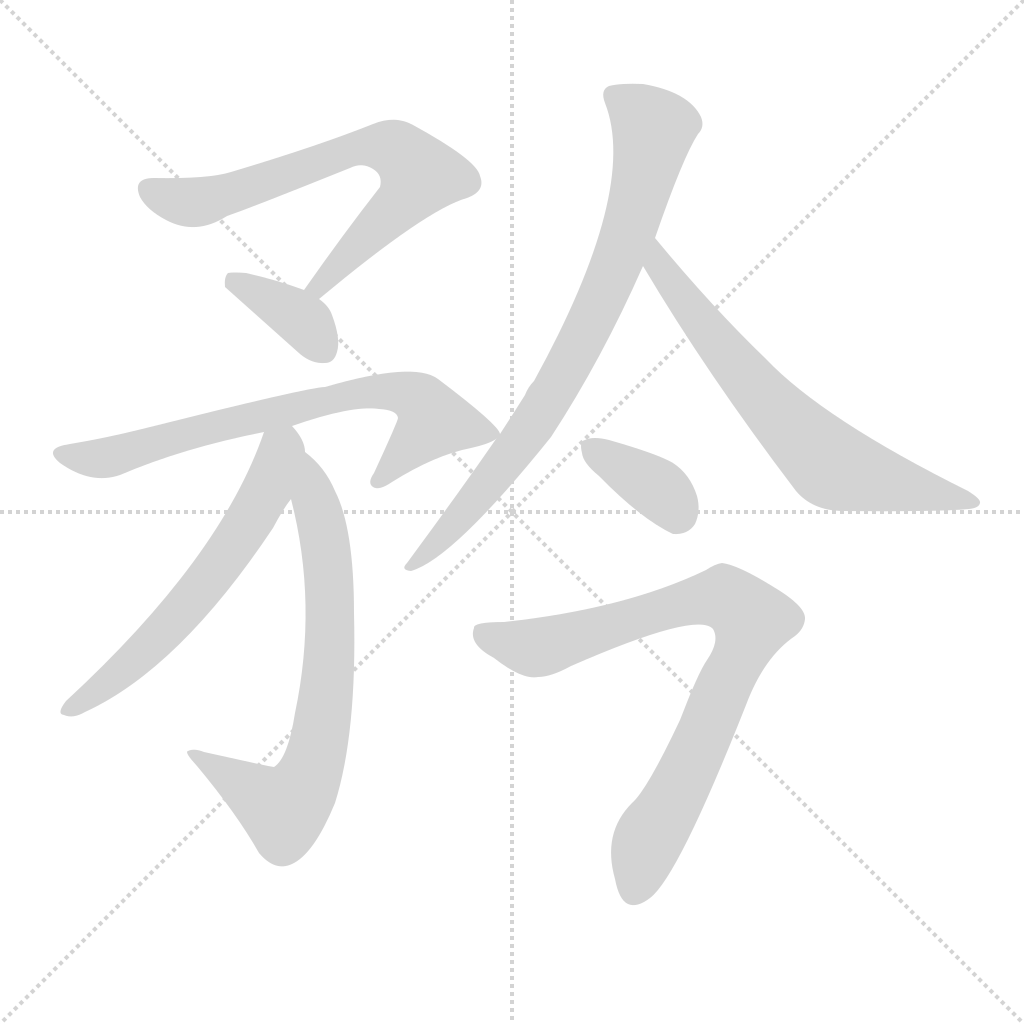
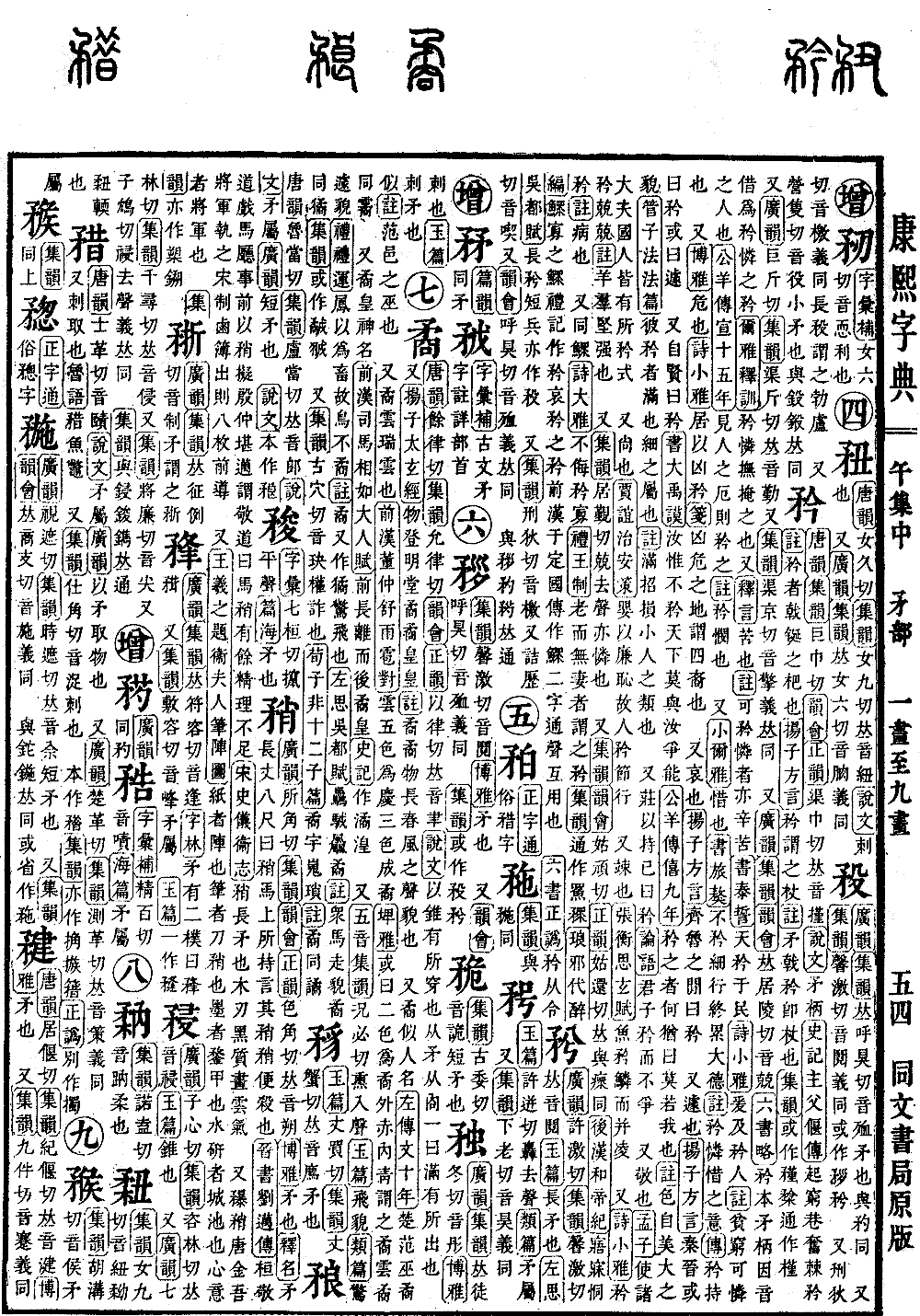
Wu Collection, Middle Volume
Radical: Spear (máo)
Kangxi Strokes: 9
Page 822, Entry 04
Pronounced jin
Pronounced jin
Pronounced qin
Pronounced qing
Pronounced jing
Pronounced jing (falling tone)
Pronounced guan
The handle of a spear.
Records of the Grand Historian (Shiji), Biography of Zhufu Yan: Rising from a narrow alley, surging forth from the bramble handles. Commentary: A handle for weapons such as halberds or spears.
Fangyan (Local Dialects) by Yangzi: Called a staff. Commentary: For spears and halberds, the handle is the staff.
Also written in a variant form (jǐn), interchangeable with the hibiscus character (jǐn).
Meaning the same as above.
Originally referred to the handle of a spear; because of phonetic borrowing, it is used to express pity.
Erya, Explanation of Teachings: To pity is to soothe or cover.
Explanation of Words: To suffer. Commentary: That which is worthy of pity is also bitter.
Book of Documents (Shushangshu): Heaven pities the people.
Book of Odes (Shijing), Lesser Odes of the Kingdom: Bestow favor upon the pitiable. Commentary: Poor and pitiable people.
Gongyang Commentary (Gongyang Zhuan), 15th Year of Duke Xuan: To pity those in danger. Commentary: To pity.
Meaning to regret or lament.
Book of Documents (Shushangshu), Hound of Zhou (Liao): If one does not value minor conduct, it will eventually damage great virtue. Commentary: To pity or cherish. Commentary: To hold fast.
Meaning dangerous.
Book of Odes (Shijing), Lesser Odes of the Kingdom: Dwelling in a place of danger. Commentary: Dangerous places refer to the remote regions of the four borders.
In the regions of Qi and Lu, it is called by this name.
In the regions of Qin and Jin, it is sometimes called by this name, and sometimes called ju.
To consider oneself worthy or capable.
Book of Documents (Shushangshu), Counsels of the Great Yu: If you do not boast, no one in the world can compete with your ability.
Gongyang Commentary (Gongyang Zhuan), 9th Year of Duke Xi: What does it mean to be arrogant? It is like saying no one can compare to me. Commentary: An appearance of self-boasting and arrogance.
Guanzi, Methods of Law: Those who are self-satisfied are arrogant and belong to a petty category. Commentary: Self-satisfaction invites loss; it is the way of a small person.
To carry oneself with solemnity.
Analects (Lunyu): The superior person is solemn but does not contend with others.
Meaning to respect.
Mencius (Mengzi): So that all officials and citizens have a model to respect and emulate.
Meaning to hold in high regard.
Jia Yi, Discourse on Peace and Order (Zhi'an Ce): Educate with a sense of shame, so people will value integrity.
Meaning to stand erect or bristle.
Zhang Heng, Rhapsody on Contemplating the Mystery (Sixuan Fu): Fish bristle their scales and leap together.
Book of Odes (Shijing), Lesser Odes of the Kingdom: Sturdy and cautious. Commentary: Describes the strength of a flock of sheep.
Meaning pain or illness.
Book of the Later Han (Hou Hanshu), Annals of Emperor He: Suffering and feeling pity day and night. Commentary: Illness and pain.
Interchangeable with the character for a widower (guan).
Book of Odes (Shijing), Greater Odes of the Kingdom: Do not bully the widowed.
Book of Rites (Liji), Royal Regulations: An old man without a wife is called a widower (jin).
Langya Daizui Bian: The character for widower (guan) is written as jin in the Book of Rites (Liji). The jin meaning to pity is written as guan in the History of the Former Han (Qian Hanshu), Biography of Yu Dingguo. These two characters are borrowed for each other because their pronunciations are the same.
Sixian Zheng'e: The character follows the component for command (ling).