Xu Collection, Upper Volume; Radical: Gate (mén); guān; Kangxi strokes: 19; Page 1341
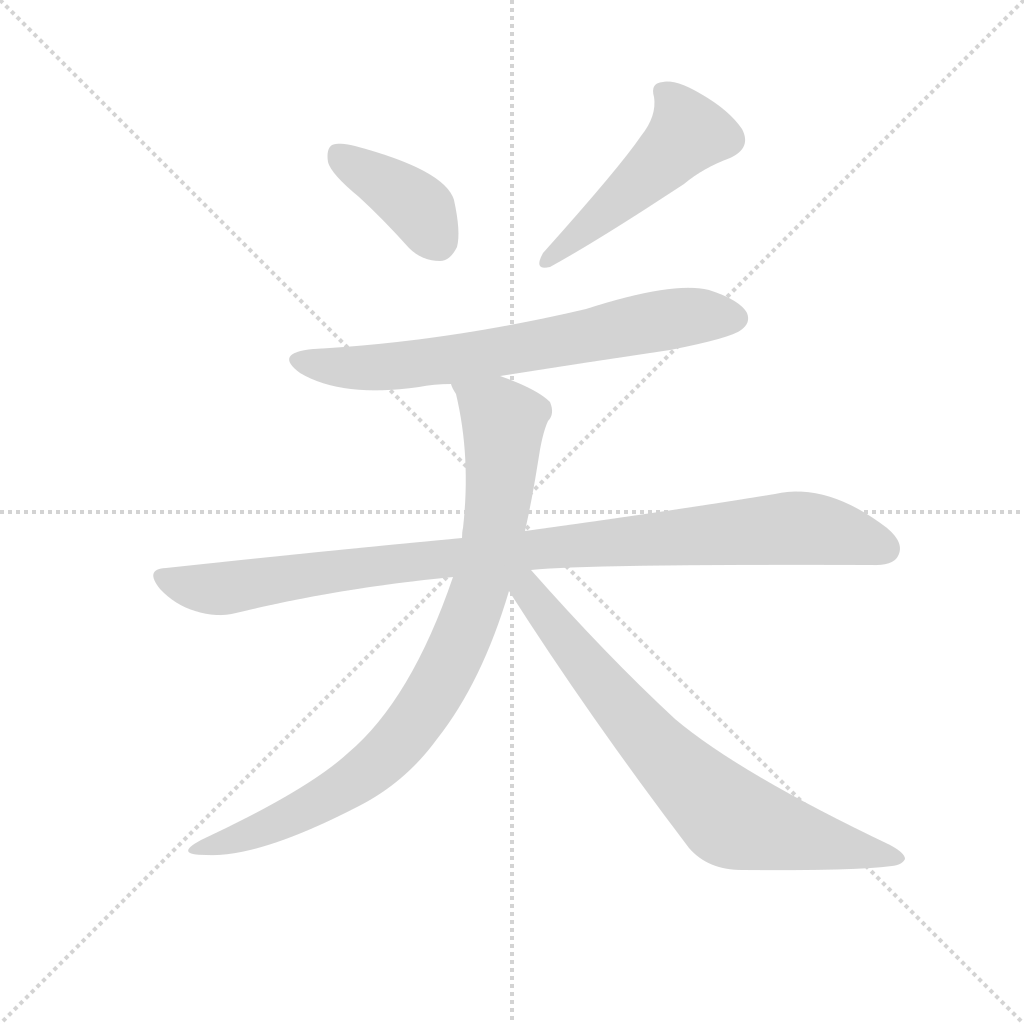
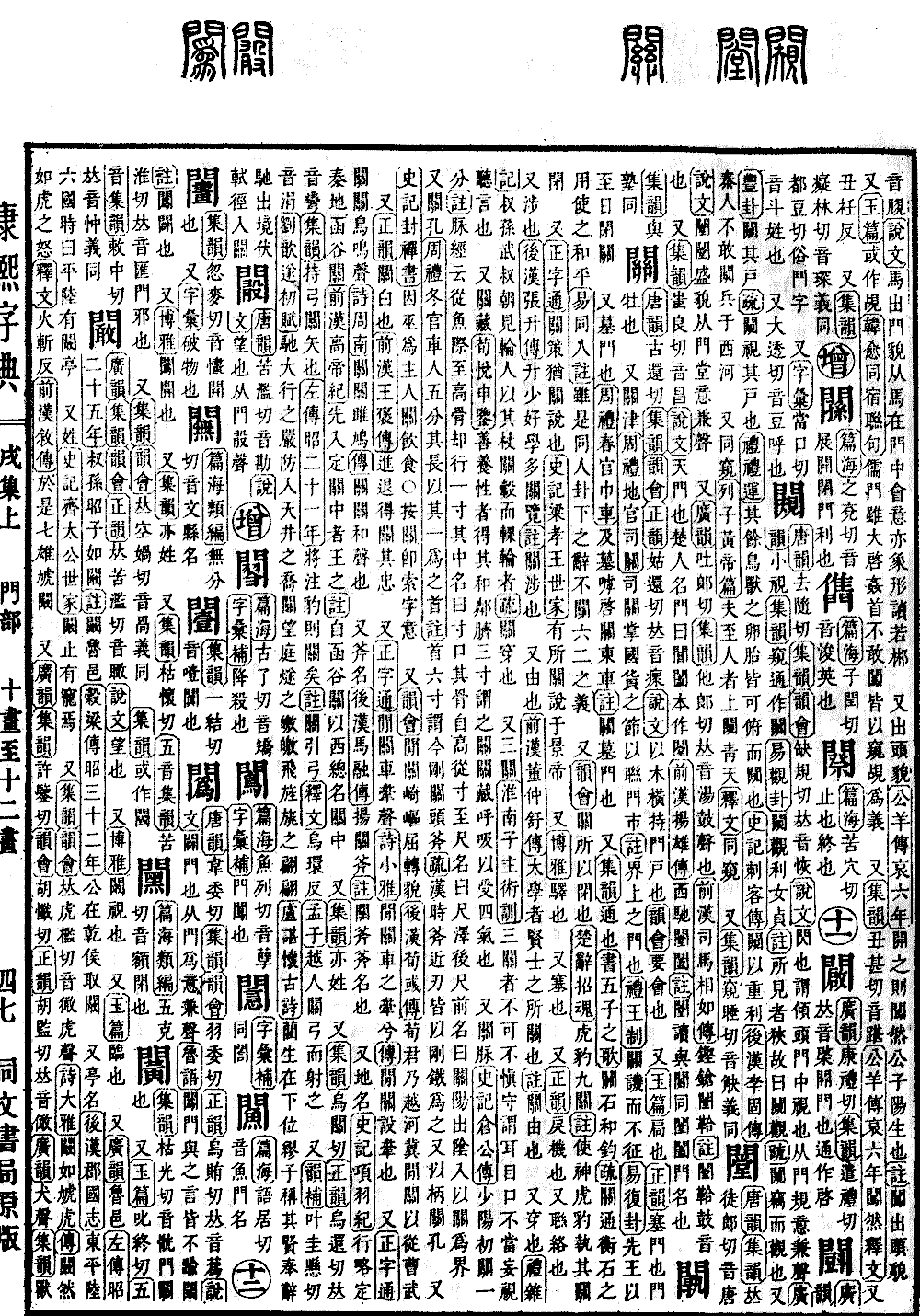
Tang rhyme: gǔ huán qiè. Jiyun, Yunhui, Zhengyun: gū huán qiè. Pronounced guān. Shuowen: To use a wooden bar horizontally to secure a gate or door. Yunhui: A vital or crucial place. Also, Yupian: A door bolt. Zhengyun: A bolt for blocking city gates; a door bolt. Also refers to a pass or a ferry crossing. In Rites of Zhou (Zhouli), Officers of Earth (Dìguān), Director of Passes (Sīguān): The Director of Passes manages the credentials for goods entering and exiting the state. It is used to connect city gates and markets. Commentary: Gates at the national border. In Book of Rites (Lǐjì), Royal Regulations (Wángzhì): Passes only inspect and do not levy taxes. In Book of Changes (Yìjīng), Fù Hexagram: The former kings closed the passes on the winter solstice. Also refers to a tomb gate. In Rites of Zhou (Zhouli), Officers of Spring (Chūnguān), Chariots (Jīnchē): Upon reaching the tomb, one calls out to open the tomb gate and display the chariots. Commentary: guān, a tomb gate. Also, Jiyun: To penetrate, to connect. In Book of Documents (Shūjīng), Song of the Five Sons (Wǔzǐ zhī Gē): Unifying *shi* and *jun* weights. Commentary (Shu): To standardize the use of weights and measures, making them uniform. Commentary on Hexagram Tóngrén in the Book of Changes (Yìjīng): Although these are the words below the Tóngrén hexagram, they are unrelated to the meaning of the second yin line. Also, Yunhui: guān, something used to close. In Songs of Chu (Chǔcí), Summoning the Soul (Zhāohún): Tigers and leopards at the nine passes. Commentary: Let the divine tigers and leopards guard those closed places. Also, Zhengzitong: *guāncè*, similar to *guānshuō* (to pull strings, to intercede). In Records of the Grand Historian (Shǐjì), Hereditary House of King Xiao of Liang (Liáng Xiàowáng Shìjiā): Interceded with Emperor Jing. Also, Boya: A postal relay station. Also, to obstruct. Also, Zhengyun: A mechanism, a pivot. Also, to connect, to link. Also, to involve, to relate to. In Book of the Later Han (Hòuhànshū), Biography of Zhang Sheng (Zhāng Shēng Zhuàn): Zhang Sheng was fond of learning in his youth and widely read. Commentary: guān, to involve. Also, to pass through, via. In Book of Han (Hànshū), Biography of Dong Zhongshu (Dǒng Zhòngshū Zhuàn): The Imperial Academy is the necessary path for worthy scholars. Commentary: guān, to pass through. Also, to pierce through. In Book of Rites (Lǐjì), Miscellaneous Records (Zájì): When Shusun Wushu went to court, a wheelwright used his staff to pass through the hub and turn the wheel. Commentary (Shu): guān, to pierce through. Also, the three passes (sānguān). In Huainanzi (Huáinánzǐ), Chapter on the Art of Rulership (Zhǔshù Xùn): The three passes, which must be guarded with caution, refer to the ears, eyes, and mouth, which should not indiscriminately see, hear, or speak. Also, *guāncáng* (dāntián, the cinnabar field). In Xun Yue's Shenjian: Those skilled in cultivating their nature achieve harmony of body and mind; the place three inches from the navel is called *guān*. *Guān* stores the breath and receives the qi of the four seasons. Also, *guānmài* (a specific pulse position). In Records of the Grand Historian (Shǐjì), Biography of Cang Gong (Cānggōng Zhuàn): The shaoyang pulse begins at one *fen* from *guān*. Commentary: The Pulse Classic states: From the thenar eminence to the high bone, moving back one *cun*, is called the *cùnkǒu*. The bone from the high point from *cun* to *chi* is called *chǐzé*; the area behind *chǐzé* and in front of *chi* is called *guān*. Yang emerges and yin enters, with *guān* as the boundary. Also, the hole of an axe. In Rites of Zhou (Zhouli), Officers of Winter (Dōngguān), Wheelwrights (Chē Rén), "Dividing its length into five parts, one part for its head" commentary: The head is six *cun* long; this refers to the modern "newly *guān*-headed axe" (an axe with a newly fitted handle). Commentary (Shu): In the Han dynasty, the part of an axe near the blade was all made of hard iron. Also, to pass a handle through a hole. Also, in Records of the Grand Historian (Shǐjì), Treatise on the Feng and Shan Sacrifices (Fēngshàn Shū): To request food and drink through a shaman as the host. According to this, "guān" means to solicit or demand. Also, Yunhui: *xiánguān*, describing a rugged and circuitous path. In Book of the Later Han (Hòuhànshū), Biography of Xun Yu (Xún Yù Zhuàn): Lord Xun then crossed the Yellow River and Jizhou, traversing rugged and winding paths to follow Cao Wu. Also, Zhengyun: To report, to inform. In Book of Han (Hànshū), Biography of Wang Bao (Wáng Bāo Zhuàn): His advances and retreats could be reported as evidence of his loyalty. Also, Zhengzitong: *xiánguān*, the sound of a carriage. In Book of Odes (Shijing), Minor Odes (Xiǎoyǎ): *xiánguān*, the sound of the axle-ends of a carriage. Commentary: *xiánguān*, the sound of fitting (the axle-ends). Also, Zhengzitong: *guānguān*, the sound of birds chirping. In Book of Odes (Shijing), Odes of Zhou and the South (Zhōunán): *Guānguān* cry the ospreys. Commentary: *guānguān*, harmonious chirping. Also, a type of axe. In Book of the Later Han (Hòuhànshū), Biography of Ma Rong (Mǎ Róng Zhuàn): Raised a *guān* axe. Commentary: *guān* axe, the name of an axe. Also, a place name. In Records of the Grand Historian (Shǐjì), Annals of Xiang Yu (Xiàng Yǔ Jì): He traversed, attacked, and pacified the Qin territory of Hangu Pass (Hángǔ Guān). In Book of Han (Hànshū), Annals of Emperor Gao (Gāo Dì Jì): The one who first enters and pacifies Guanzhong (Guānzhōng) will be king there. Commentary: The area west of Hangu Pass (Hángǔ Guān) is generally called Guanzhong (Guānzhōng). Also, Jiyun: Also a surname. Also, Jiyun: wū guān qiè. Zhengyun: wū huán qiè. Pronounced wān. Jiyun: To draw a bow to its full extent and nock an arrow. In Zuo Commentary (Zuǒzhuàn), Duke Zhao, Year 21: Just as he was about to aim, the leopard had already drawn his bow to the full. Commentary: guān, to draw a bow. Shìwén: wū huán fǎn. In Mencius (Mèngzǐ): The people of Yue drew their bows to shoot him. Also, Yunbu: xié guī xuán qiè. Pronounced juān. In Liu Xin's Fu on Succeeding in the Beginning: Galloping along the strict defensive lines of Mount Taihang, entering the towering pass of Tianjing. Gazing upon the bright border beacons, with fluttering banners dancing gracefully. In Lu Chen's Poem on Recalling Antiquity: Lin Xiangru was in a humble position, and Miao Xian praised his worthiness. He was ordered to gallop out of the border, leaning on the chariot rail, and directly entered Hangu Pass.
Correction: In Rites of Zhou (Zhouli), Officers of Spring (Chūnguān), Chariots (Jīnchē): "Upon reaching the tomb, one calls out to open the tomb gate and display the chariots." The original text "東車" (east chariots) should be corrected to "陳車" (display chariots).