Yin Collection, Upper Volume
Radical: Roof (mián)
Kangxi stroke count: 8
Page 283, Entry 15
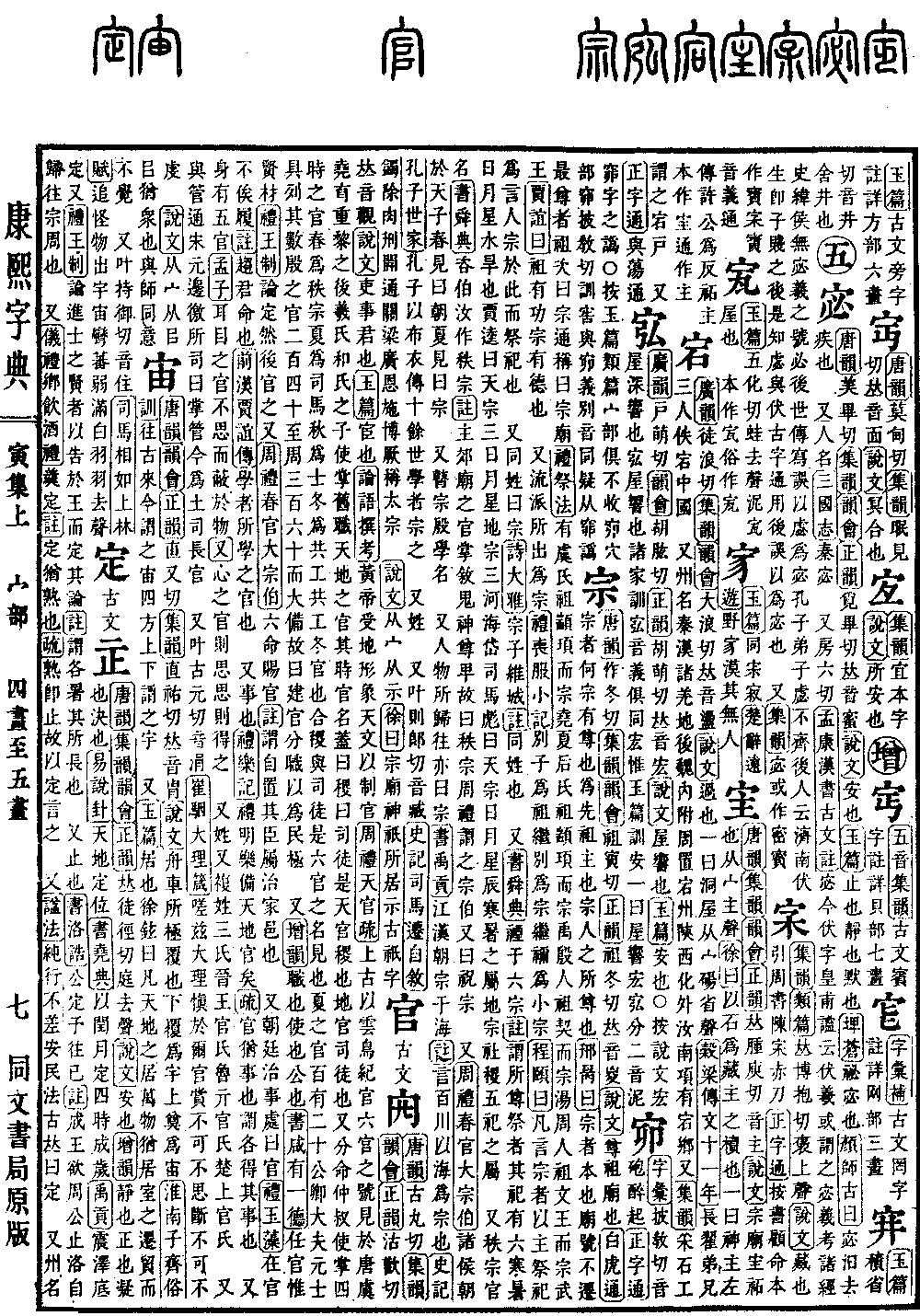
Ancient form. Pronounced guan. According to the Explanation of Words and Phrases (Shuowen Jiezi), it refers to an official serving a ruler. According to the Jade Chapters (Yupian), it means to hold office. According to the Analects of Confucius: Verified Record (Lunyu Zhuankao), the Yellow Emperor observed the topography and the phenomena of the heavens to establish official positions. According to the Commentary on the Heaven Officials in the Rites of Zhou (Zhouli), in ancient times, clouds and birds were used to designate official positions; the names of the six categories of officials appeared during the eras of Tang and Yu. Yao raised the descendants of Zhong and Li, the sons of the Xi and He clans, to manage the ancient duties of celestial and terrestrial offices. At that time, the official titles were known as Ji and Situ; Ji was the celestial official, and Situ was the terrestrial official. Later, he ordered Zhong and Shu to manage the offices of the four seasons: in spring, the Zhezong; in summer, the Sima; in autumn, the Shi; and in winter, the Gonggong. Gonggong was the official of winter. Together with Ji and Situ, the names of the six categories of officials were established. In the Xia dynasty, there were one hundred and twenty official posts, with the number of dukes, ministers, grand masters, and minor officials fully listed; in the Yin dynasty, there were two hundred and forty, reaching three hundred and sixty by the Zhou dynasty, which was considered the complete perfection. Hence the saying: Establish offices and divide duties to serve as the standard for the people. According to the Expanded Rhymes (Zengyun), it also means duty, mission, or public. According to the Book of Documents (Shujing): Appoint officials based only on talent and ability. According to the Book of Rites (Liji): After the investigation is concluded, then appoint them to office. According to the Rites of Zhou: The six ranks are granted an official position. The commentary notes that this refers to appointing one's own retainers to manage a family estate. It also refers to the place where the imperial court conducts its affairs. According to the Book of Rites: When in the government office, do not wait to put on sandals. The commentary notes this refers to hastening to fulfill the ruler's command. According to the History of the Former Han (Qianhan): Scholars are the officials they learn to become. It also means affairs. According to the Book of Rites: When rites and music are clearly provided, the affairs of heaven and earth are in order. The commentary notes that official here means affair, indicating that each thing has its proper place. It also refers to the five faculties of the body. According to Mencius: The faculties of the ears and eyes do not think and are obscured by external things. Also: The faculty of the heart is to think; by thinking, one acquires knowledge. It is also a surname. It is also a compound surname. There are three clans: the Wangguan clan of the Jin state, the Qiguan clan of the Lu state, and the Shangguan clan of the Chu state. It is also interchangeable with the character meaning to manage; the authorities in the border regions during the Song and Yuan dynasties were called changguan, which now refers to the head of a native office. It is also rhymed as juan. According to the Cui Yin Admonition to the Grand Justice: Alas, O Grand Justice, be cautious in your office. Rewards must be contemplated, and judgments must be rendered with sincerity. The Explanation of Words and Phrases states: Formed from the radical for roof and the character for mass; it implies a multitude, consistent with the meaning of the character for army. Textual research: According to the Commentary on the Heaven Officials in the Rites of Zhou: Hence the saying, establish offices and divide duties to serve as the standard for the people. We have corrected the word build to establish based on the original text. According to the Book of Rites: When in the government office, do not wait to put on sandals. We have corrected the character for shoes to the character for sandals based on the original text. According to the Book of Rites: When rites and music are clearly provided. We have corrected the text to read when rites and music are clearly provided.