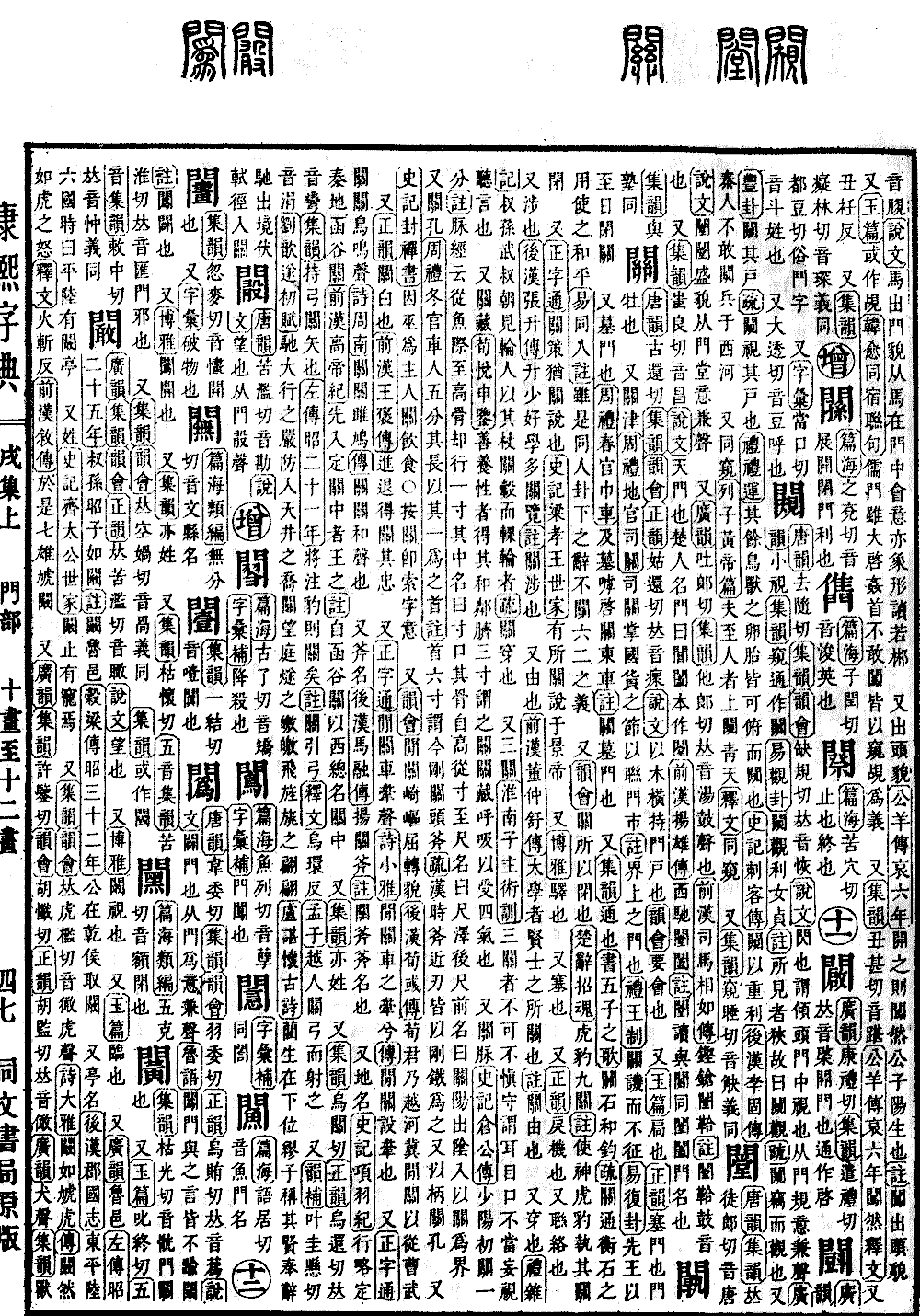
Xu Collection, Upper Volume
Radical: Gate (mén)
Page 1341, Entry 09
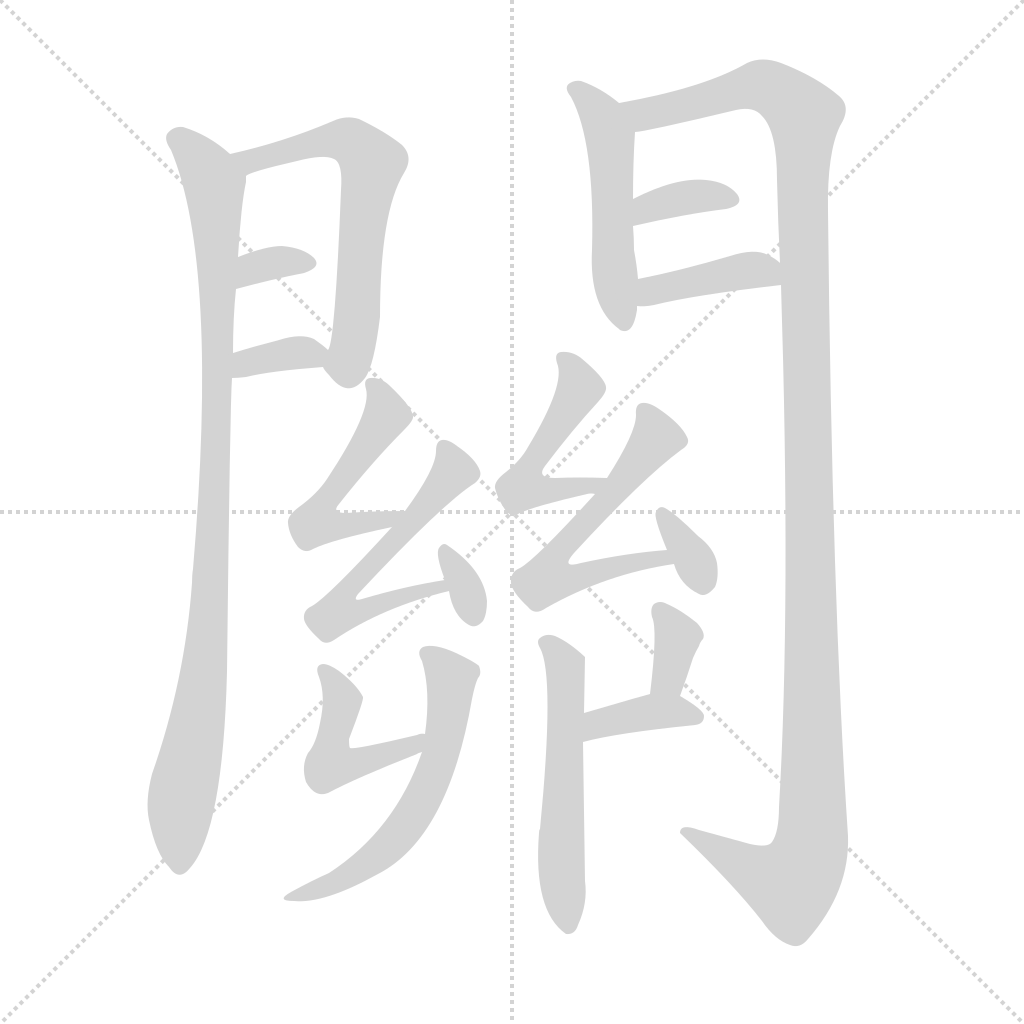
Pronounced guan.
Shuowen Jiezi (Shuowen): To use wood to crosswise support a gate or door.
Rhyme Collection (Yunhui): Refers to a pivot, hinge, or key component.
Jade Chapters (Yupian): Refers to a door bolt or latch.
Orthography Corrected (Zheng yun): Refers to an object that blocks a door; a door latch. Also refers to a mountain pass or a ferry crossing.
Rites of Zhou (Zhouli), Earth Officials, Officer of the Pass: The Officer of the Pass manages the credentials for national goods and oversees the connections between city gates and markets.
Commentary: Refers to a gate located at a border.
Rites (Liji), Royal Regulations: At a pass, officials inspect but do not levy taxes.
Book of Changes (Yijing), Return Hexagram: In ancient times, the kings closed the passes on the day of the winter solstice.
Also refers to a tomb gate.
Rites of Zhou (Zhouli), Spring Officials, Carriage Officer: Upon arriving at the cemetery, one calls for the opening of the tomb gates to display the carriages.
Commentary: Pass refers to the tomb gate.
Also in Rhyme Collection (Jiyun): Has the meaning of connecting or interlinking.
Book of Documents (Shujing), Song of the Five Sons: Harmonize the stones and the balance.
Sub-commentary: Refers to the standards for weights and measures, ensuring they are equitable.
Book of Changes (Yijing), Fellow Humans Commentary: Although this is the text under the Fellow Humans hexagram, it has no relation to the meaning of the second line of the six-line hexagram.
Also in Rhyme Collection (Yunhui): A pass is an object used for shutting or closing.
Songs of Chu (Chuchu), Summoning the Soul: The tiger and leopard stand at the nine gates.
Commentary: Let the divine tiger and leopard guard those passes.
Also in Compendium of Correct Characters (Zhengzitong): To petition or intercede, similar to speaking on behalf of someone to influence a decision.
Records of the Grand Historian (Shiji), House of Prince Xiao of Liang: Someone spoke on behalf of others to the Emperor Jing.
Also in Encyclopedia of Antiquities (Boya): Refers to a courier station.
Also refers to a fortress.
Also in Orthography Corrected (Zheng yun): Refers to a central mechanism or pivot.
Also refers to establishing a connection.
Also refers to involvement or association.
History of the Later Han (Hou Hanshu), Biography of Zhang Sheng: When Zhang Sheng was young, he was fond of learning and studied broadly.
Commentary: Pass refers to involvement or relevance.
Also refers to passing through or traversing.
History of the Former Han (Qian Hanshu), Biography of Dong Zhongshu: The Imperial Academy is a path that talented scholars must traverse.
Commentary: Pass refers to passing through.
Also refers to penetrating or passing through.
Rites (Liji), Miscellaneous Records: When Shusun Wushu went to court, the wheelwright used his cane to pass through the hub to turn the wheel.
Sub-commentary: Pass refers to passing through.
Also refers to the three passes.
Huainanzi, Principles of Sovereignty: One must be cautious in guarding the three passes, which refer to the ears, eyes, and mouth; one should not listen, look, or speak inappropriately.
Also refers to the vital storage point (dantian).
Xun Yue, Shenjian (Extended Reflections): Those who are skilled in nurturing their nature can maintain peace; the point three inches below the navel is called the pass. This point stores the breath and is used to receive the energy of the four seasons.
Also refers to the pulse at the wrist (in Chinese medicine).
Records of the Grand Historian (Shiji), Biography of Cang Gong: In the Lesser Yang, the first pass is one part.
Commentary: The Pulse Classic states: From the fish-border to the high bone, moving back one inch, this space is called the inch-mouth. The bone from the height of the inch to the cubit is called the cubit; the area after the cubit-marsh and before the cubit-section is called the pass. Yang exits and Yin enters, using the pass as the boundary.
Also refers to the hole in an axe head.
Rites of Zhou (Zhouli), Winter Officials, Carriage Maker: Divide the length into five parts and use one for the head.
Commentary: The head is six inches long, referring to the iron-headed axe of the present (Han dynasty).
Sub-commentary: In the Han dynasty, the part of the axe near the blade was made of hard iron, and the handle was inserted through the hole.
Also in Records of the Grand Historian (Shiji), Treatise on the Feng and Shan Sacrifices: Through the medium of a shaman, they acted as hosts and demanded food and drink. Note: Here, pass has the meaning of to solicit or demand.
Also in Rhyme Collection (Yunhui): The phrase jianguan describes a road that is rugged and winding.
History of the Later Han (Hou Hanshu), Biography of Xun Yu: Lord Xun crossed the Yellow River and Jizhou, traveling through rugged paths to follow Cao Cao.
Also in Orthography Corrected (Zheng yun): Refers to a formal report or notification.
History of the Former Han (Qian Hanshu), Biography of Wang Bao: In advance and retreat, he was able to report his loyalty.
Also in Compendium of Correct Characters (Zhengzitong): The phrase jianguan describes the sound of carriages.
Book of Odes (Shijing), Lesser Odes: The jianguan sound is the decoration on the end of a carriage axle.
Commentary: Jianguan refers to the set axle-end fittings.
Also in Compendium of Correct Characters (Zhengzitong): The phrase guanguan describes the chirping sound of birds.
Book of Odes (Shijing), Zhou South: The guanguan sound of the ospreys.
Commentary: Guanguan refers to a harmonious sound.
Also refers to the name of an axe.
History of the Later Han (Hou Hanshu), Biography of Ma Rong: Raising the guan axe.
Commentary: Guan axe is the name of an axe.
Also refers to a place name.
Records of the Grand Historian (Shiji), Annals of Xiang Yu: He patrolled and pacified the Hangu Pass in Qin territory.
History of the Former Han (Qian Hanshu), Annals of Emperor Gao: The first to enter and pacify the Guanzhong region shall be king.
Commentary: The region west of Hangu Pass is collectively called Guanzhong.
Also in Rhyme Collection (Jiyun): It is also a surname.
Also in Rhyme Collection (Jiyun): Pronounced wan.
Rhyme Collection (Jiyun): Refers to drawing a bow fully and nocking an arrow.
Zuo Tradition (Zuozhuan), Twenty-first Year of Duke Zhao: About to aim at the leopard, he drew the bow fully.
Commentary: Guan refers to drawing a bow.
Explanation of Characters: Pronounced wan.
Mencius: The people of the Yue state drew their bows to shoot him.
Also in Rhyme Supplement: Rhyming with gui and xuan, pronounced juan.
Liu Xin, Sui Chu Fu (Rhapsody on Following Initial Intentions): Galloping through the dangerous passes of the Taihang Mountains, entering the lofty gateways of Tianjing. Gazing at the bright beacons on the border, the banners flutter and dance.
Lu Chen, Huai Gu Shi (Poetry on Remembering the Past): Lin Xiangru remained in a lowly position, but Miao Xian praised his virtue. He was ordered to gallop out of the border, leaning over the carriage bar to drive straight into Hangu Pass.