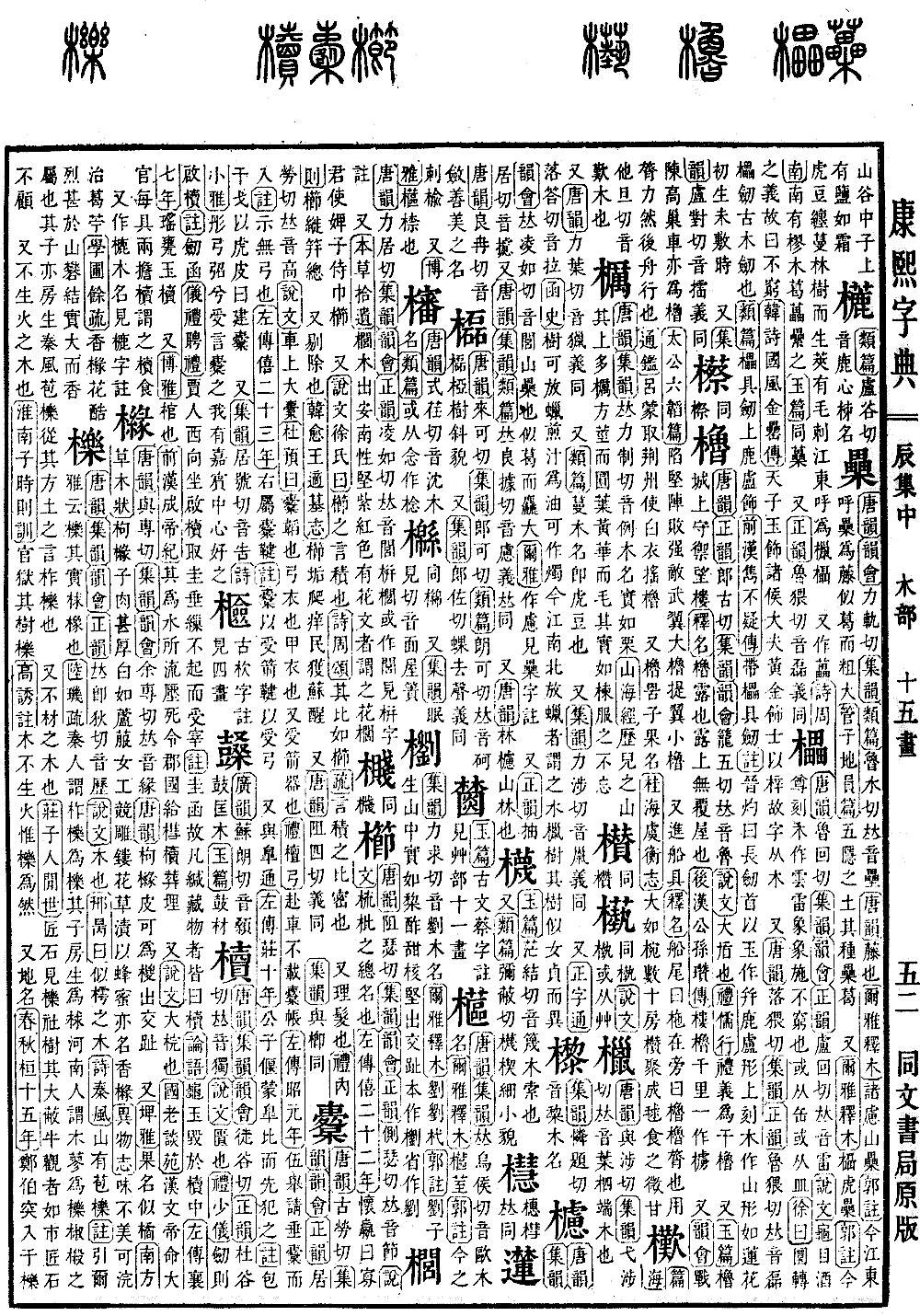
Chen Collection, Middle Volume
Radical: Wood (mù)
櫓
Kangxi strokes: 19
Page 560, Entry 01
Pronounced lu (third tone).
According to the Explanation of Simple and Compound Characters (Shuowen): A large shield.
According to the Book of Rites (Liji), specifically the chapter on the conduct of a scholar: Using ritual and righteousness as a shield.
Also, according to the Jade Chapters (Yupian): A watchtower for defense on top of a city wall.
According to the Explanation of Names (Shiming): It is called lu because it is exposed (lu), being a structure on top without a roof cover.
According to the History of the Later Han (Houhan shu), biography of Gongsun Zan: Watchtowers extended for a thousand miles. A variant form is also used.
Also, according to the Compendium of Rhymes (Yunhui): A tall nesting cart used in battle formations is also called a lu.
According to the Six Secret Teachings of Taigong (Liutao): To penetrate a firm formation or defeat a strong enemy, use the martial-wing large lu and the raised-wing small lu.
Also, a tool for propelling boats.
According to the Explanation of Names (Shiming): The stern of a boat is called the rudder, and that which is at the side is called the lu. The lu is related to the spine (lü), as one must use the strength of the spine to make the boat travel.
According to the Comprehensive Mirror (Tongjian): When Lü Meng took Jingzhou, he ordered men in white clothing to row the boats.
Also, the lu-zi, name of a fruit.
According to the Records of the Southern Territories (Guihai yuheng zhi): It is as large as a bowl, with several dozen segments clustered into a sphere, with a slightly sweet taste when eaten.
Textual research:
According to the Book of Rites (Liji), chapter on the conduct of a scholar: Using ritual and righteousness as a shield. The character yi has been added after the character li in accordance with the original text.