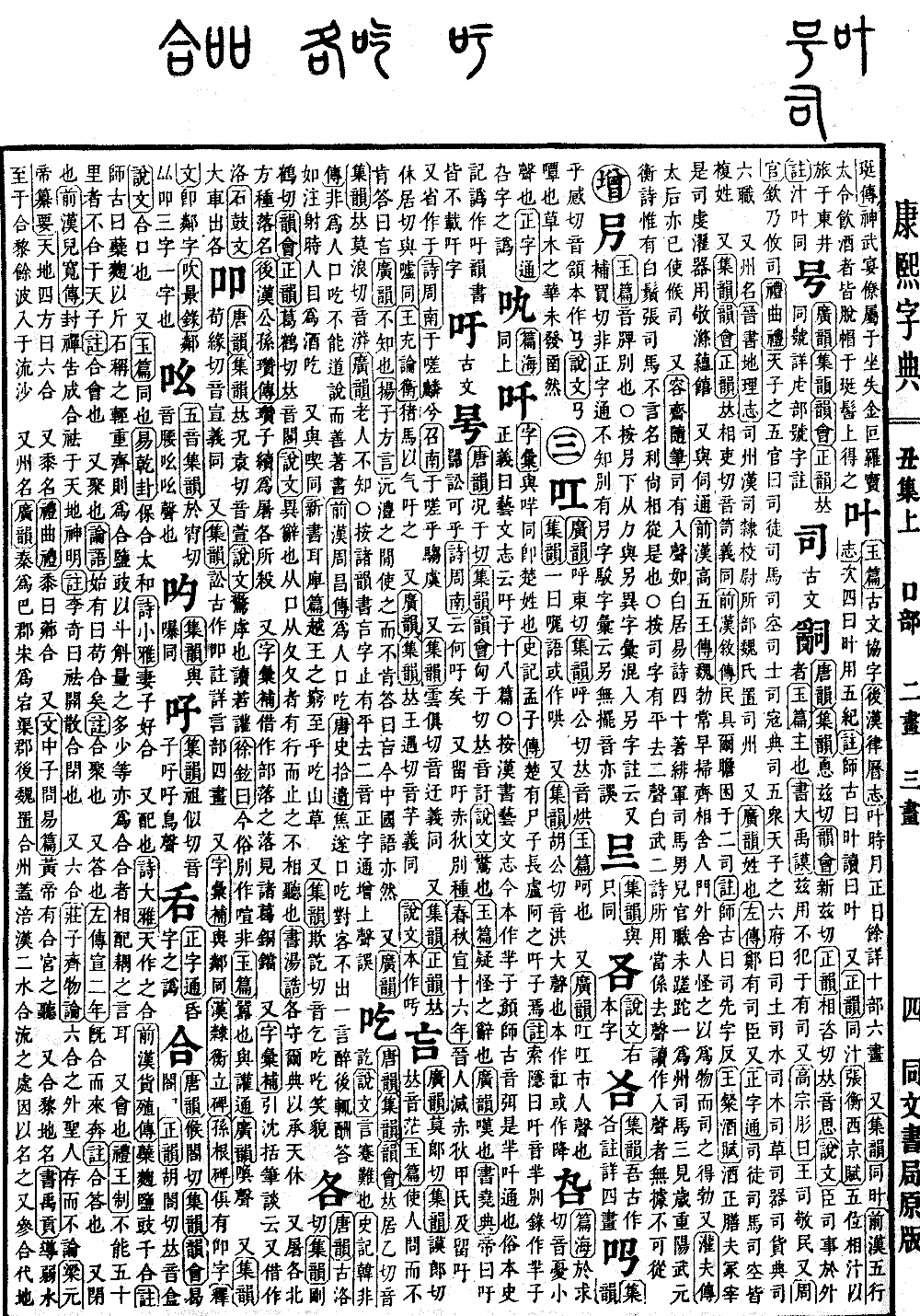
Chou Collection, Upper Volume. Radical: Mouth (kǒu). Kangxi Stroke Count: 6. Page 174, Entry 24.
According to the Tang Rhyme (Tangyun), the pronunciation of the character is ge (entered tone). According to the Collected Rhymes (Jiyun) and the Rhyme Compendium (Yunhui), the pronunciation is he (entered tone). The Orthography of Rhymes (Zhengyun) records it as hu-ge, with a pronunciation similar to he.
The Explaining Graphs and Analyzing Characters (Shuowen Jiezi) defines its primary meaning as closing the mouth.
It also means identical or same, as noted in the Jade Chapter (Yupian).
In the Book of Changes (Yijing), in the Qian Hexagram, it is used to mean maintaining a state of harmony and integration. In the Book of Odes (Shijing), it refers to a harmonious relationship between husband and wife.
It also means to match or coordinate. In the Book of Odes (Shijing), it refers to a marriage matched by Heaven. In the History of the Former Han (Qianhan Shu), in the Biographies of Merchants (Huozhi Zhuan), it refers to units of measure; Yan Shigu notes that for brewing, grains are measured by weight, and when equal, it is called he; salt and beans are measured by volume, and when equal, it is called he. This term signifies matching and pairing.
It also means to meet or encounter. In the Book of Rites (Liji), in the Royal Regulations (Wangzhi), it refers to an audience or meeting.
It also means to gather. In the Analects (Lunyu), it is used to describe the gathering of people.
It also means to answer or respond. In the Zuo Tradition (Zuo Zhuan), it is used to mean responding to a call.
It also means to close or shut. In the History of the Former Han (Qianhan Shu), in the Biography of Er Kuan, Li Qi notes that he signifies closing.
It refers to the Six Directions (Liuhe), indicating Heaven, Earth, and the four cardinal directions. In the Zhuangzi, in the Discourse on Making All Things Equal (Qiwulun), it refers to the world beyond the six directions. According to the Compendium of Essentials (Zuanyao) by Emperor Yuan of Liang, the six directions represent the universe and the four cardinal points.
It is a name for a type of millet, referred to as xianghe in the Book of Rites (Liji), in the Biographies of the Rites (Quli).
In the Inquiry into the Changes (Wen Zhongzi: Wenyi Pian), it refers to the He Palace, used by the Yellow Emperor to hear counsel.
He-li is a geographical name. In the Book of Documents (Shujing), in the Tribute of Yu (Yugong), it refers to the destination of the flow of the Ruo River.
It is a name of a prefecture. According to the Expanded Rhymes (Guangyun), it was Ba Commandery in the Qin dynasty, Dangqu Commandery in the Song dynasty, and established as He Prefecture in the Later Wei dynasty, likely named for the confluence of the Fu and Han rivers.
Canhe is a location in the Dai region, as mentioned in the Records of the Grand Historian (Shiji), in the Biography of Han Xin, King of Han.
Juhe was in Pingyuan Commandery, and Heji was in Gaocheng County, both being marquisates during the Han dynasty, as seen in the Records of the Grand Historian (Shiji), in the Chronological Table of Princes and Marquises since the Jianyuan Era.
Chonghe County belonged to Bohai Commandery, and Hexiang County belonged to Donghai Commandery.
He Pu is the name of a commandery, seen in the History of the Former Han (Qianhan Shu), in the Treatise on Geography (Dili Zhi).
According to the Expanded Rhymes (Guangyun), it refers to the name of a vessel. The Orthography of Rhymes (Zhengyun) defines hezi as a container.
According to the Expanded Rhymes (Guangyun), it is a surname. The Zuo Tradition (Zuo Zhuan) records a high official in the State of Song named He Zuoshi.
Zi-he is the name of a Western Region state. According to the History of the Former Han (Qianhan Shu), in the Account of the Western Regions, the king of Xiye was titled King of Zi-he. The History of the Later Han (Houhan Shu), in the Account of the Western Regions, states that Zi-he was one thousand li from Shule.
It is also used interchangeably with the character he (to close). In the Strategies of the Warring States (Zhan Guo Ce), it is used in a context implying agreement with the king's heart.
It is also used interchangeably with the character he (He River). In the Records of the Grand Historian (Shiji), in the House of Wei, it refers to the construction of fortifications at Heyang, north of the He River. Additionally, in the Table of Merit and Nobility of Emperor Gaozu, the emperor's elder brother Liu Zhong was titled Marquis of Heyang after being demoted.
According to the Tang Rhyme (Tangyun) and the Orthography of Rhymes (Zhengyun), it is pronounced ge (entered tone). According to the Collected Rhymes (Jiyun) and the Rhyme Compendium (Yunhui), it is pronounced he (entered tone). According to the Expanded Rhymes (Guangyun), it signifies collecting or gathering.
According to the Collected Rhymes (Jiyun), the capacity of two yue is one he. In the History of the Former Han (Qianhan Shu), in the Treatise on Harmonics and Calendars (Lüli Zhi), it mentions units of capacity including yue, he, sheng, dou, and hu. One he equals the capacity of one yue, and ten he make one sheng.
It is also pronounced xi (entering tone) when used in a rhyming context. In the Rhapsody on Thinking of the Hidden (Si-xuan Fu) by Zhang Heng, it refers to the difficulty of a virtuous person finding a compatible match.
Note: In the citation from the Strategies of the Warring States (Zhan Guo Ce), the character "yu" has been added following the character "he" to conform to the original text.