Yin Collection, Middle Volume
Radical: Turban (jīn)
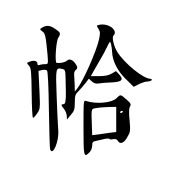
Qia
Kangxi strokes: 9
Page 331, Entry 05
Pronounced qia
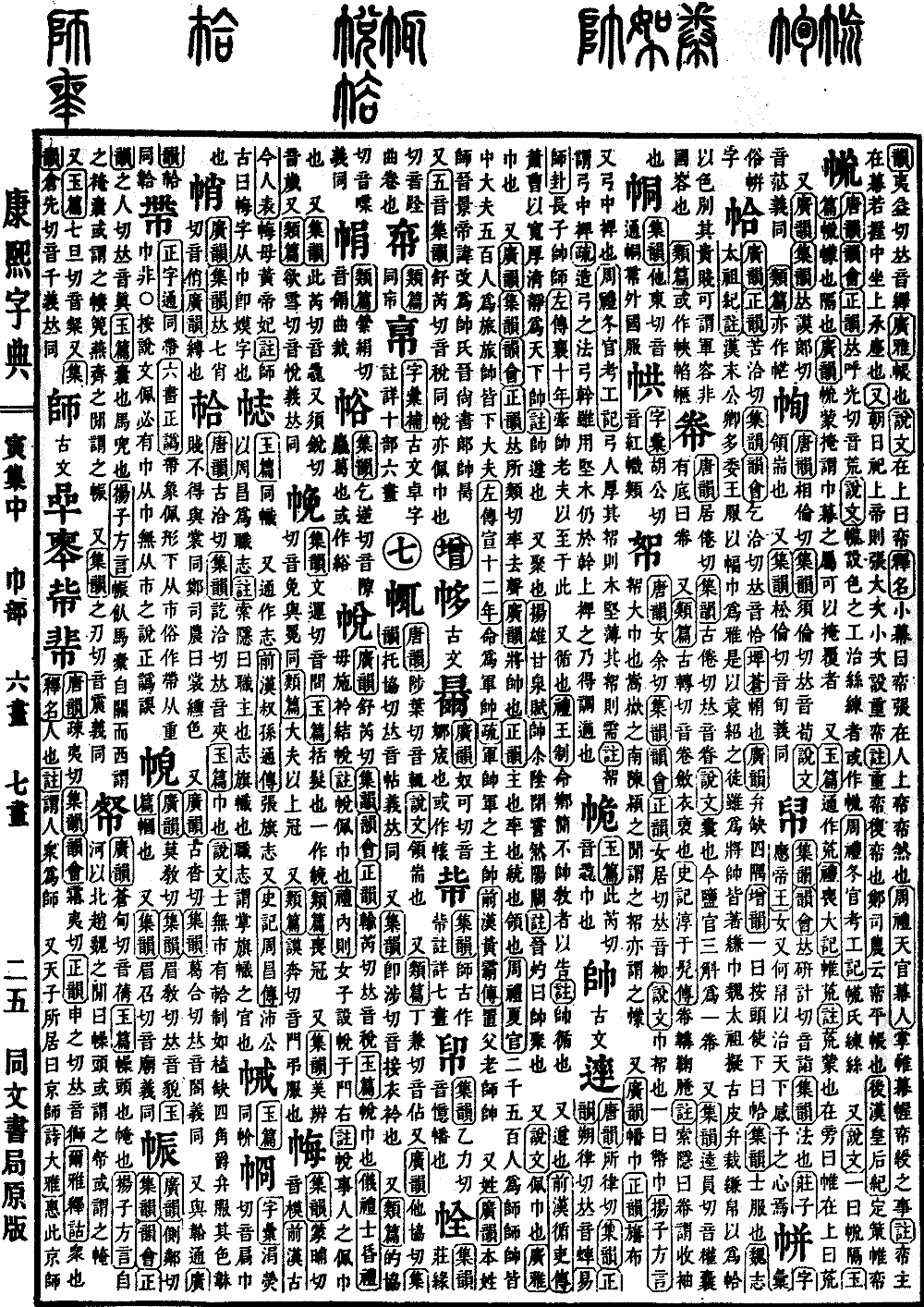
Broad Rhymes (Guangyun), Correct Rhymes (Zhengyun): combined pronunciation of ku and qia. Collected Rhymes (Jiyun), Rhyme Anthology (Yunhui): combined pronunciation of qi and qia.
Picang: A type of hat.
Broad Rhymes (Guangyun): A type of ceremonial cap with the four corners missing.
Expanded Rhymes (Zengyun): One theory states that a hat worn close to the head so that it droops is called a qia.
Collected Rhymes (Jiyun): A hat worn by scholars.
Records of the Three Kingdoms (Sanguozhi), Biography of Emperor Wu, Commentary: At the end of the Han dynasty, dukes and ministers mostly abandoned the attire of kings and nobles, considering headscarves made from a single piece of cloth more elegant. Thus, figures like Yuan Shao, although serving as generals, all wore silk headscarves. Emperor Wu of Wei imitated the style of the ancient leather ceremonial cap, cutting silk to create the qia hat, using color to distinguish rank. This was considered military attire, not formal state attire.
Categorized Chapters (Leipian): Sometimes also written in a variant form (zhuàn).