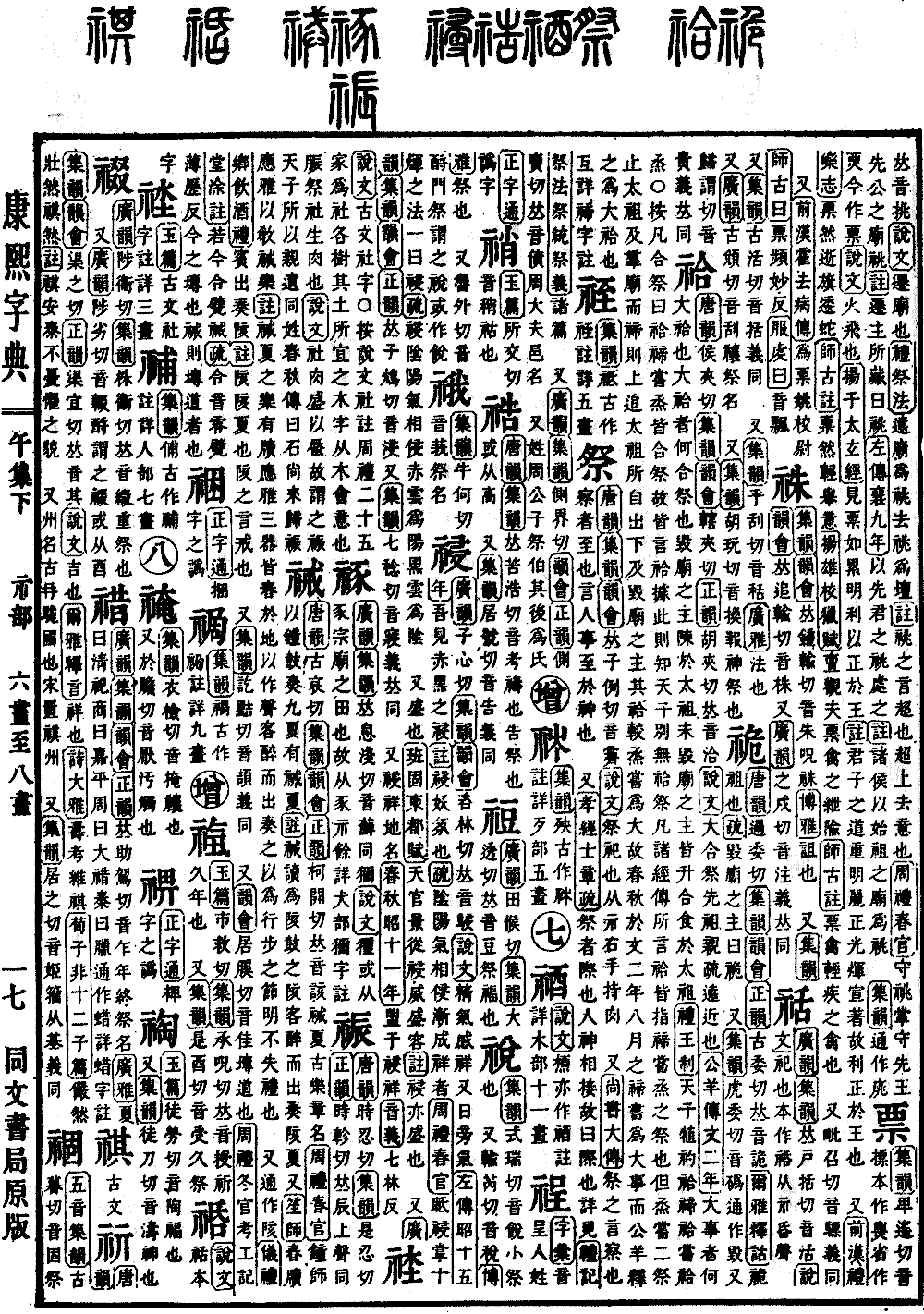
Wu Collection, Lower Volume
Radical: Spirit (shì)
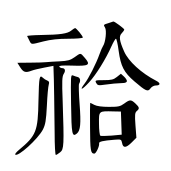
Character: Xia
Kangxi strokes: 11
Page 843, Entry 05
Pronounced xia.
According to the Shuo Wen Jiezi (Explaining Graphs and Analyzing Characters), it refers to a large-scale joint sacrifice to ancestors, where all are sacrificed to together, regardless of whether they are near or distant kin.
Commentary on the Gongyang Zhuan (Gongyang Commentary), Year 2 of Duke Wen: What does great affair refer to? It is the great xia. What is the great xia? It is the joint sacrifice. The spirit tablets of temples that have been moved and destroyed are brought into the Grand Ancestor's temple, and together with the spirit tablets of temples not yet destroyed, they are all elevated to the Grand Ancestor's temple to be sacrificed to together.
Book of Rites (Liji), Regulations of the King: It is recorded that the Son of Heaven performs the yue sacrifice alone in the spring, but performs joint sacrifices during the di, chang, and zheng sacrifices. Note: Whenever a joint sacrifice occurs, it is called xia; the di, chang, and zheng sacrifices are all joint sacrifices, which is why they are all referred to as xia. From this, one knows that the Son of Heaven does not have a separate xia sacrifice. All instances of xia mentioned in the various classics and commentaries refer to these di, chang, and zheng sacrifices. However, the zheng and chang sacrifices only include the Grand Ancestor and the various ancestral temples, while the di sacrifice reaches upward to the progenitor of the Grand Ancestor and downward to include the spirit tablets of temples that have been destroyed. Its scale of joint sacrifice is greater than that of the zheng and chang sacrifices; therefore, the Spring and Autumn Annals (Chunqiu) records the di sacrifice of the eighth month of the second year of Duke Wen as a great affair, and the Gongyang Commentary interprets this as the great xia. Refer also to the entry for the character di.