Wu Collection, Upper Volume
Radical: Jade (yù)
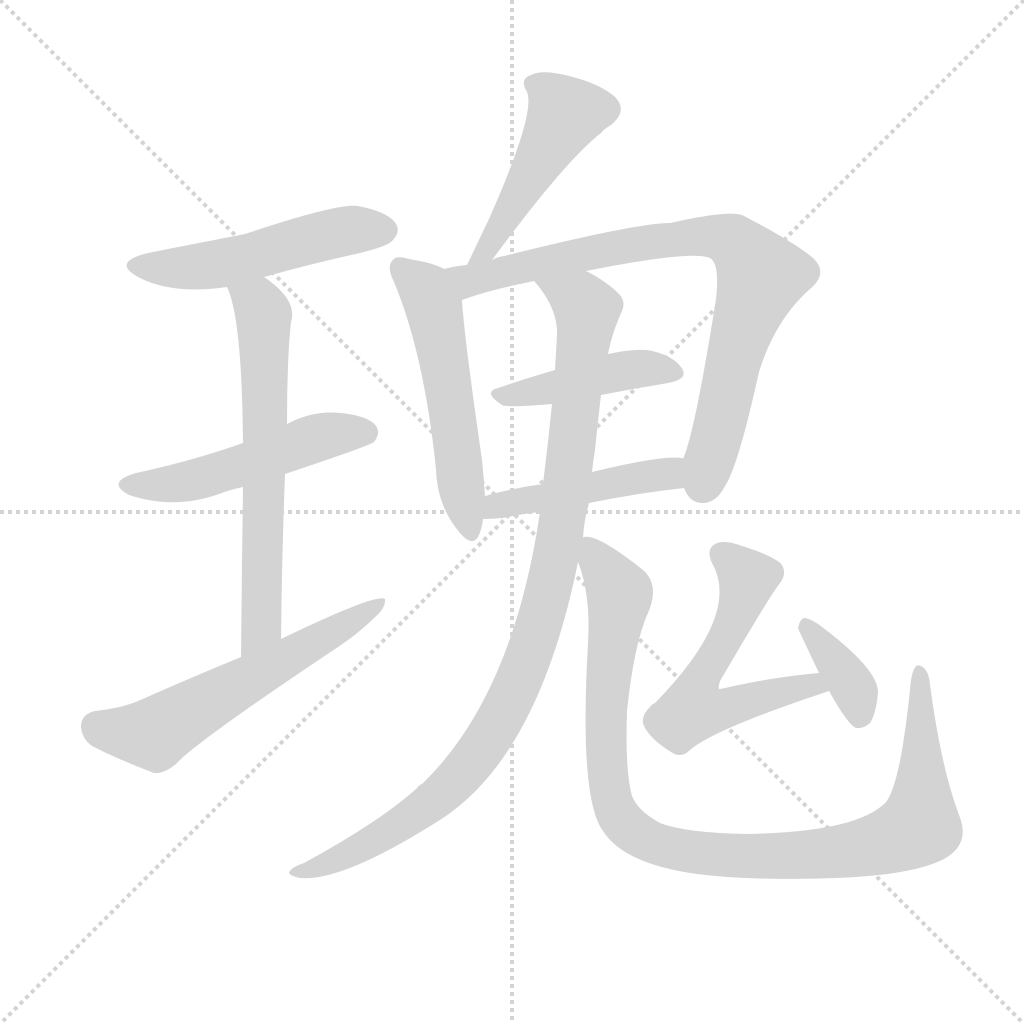
Gui
Kangxi Strokes: 15
Page 739, Entry 16
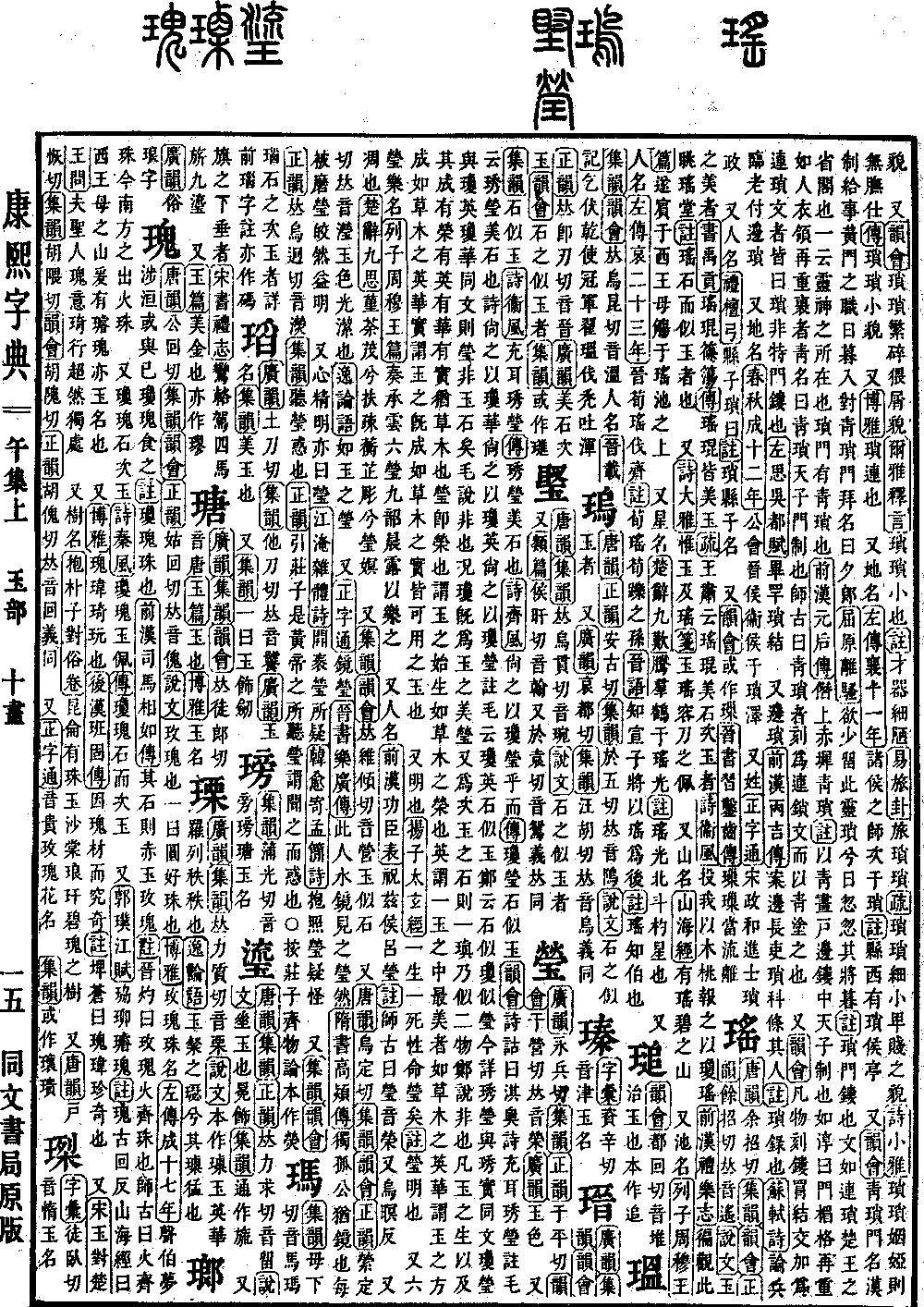
Pronounced gui. In the Shuo Wen Jie Zi (Explaining Graphs and Analyzing Characters), it refers to a rose. Another definition states it is a round and beautiful pearl. In the Guang Ya (Expanded Glossaries), it is defined as a type of pearl. In the Zuo Zhuan (Chronicle of Zuo), entry for the 17th year of Duke Cheng, it is written: Sheng Bo dreamt of crossing the Huan River, where someone gave him precious stones to eat. The commentary notes that these are pearls. In the History of the Former Han (Hanshu), Biography of Sima Xiangru, it states: Its stones are red jade and roses. Jin Zhuo comments: A rose is a fire-polished pearl. Yan Shigu adds: The fire-polished pearl is what is known today as the fire pearl from the south. Furthermore, these stones are of a quality secondary to jade. In the Book of Odes (Shijing), Qin Wind section, it mentions jade pendants made of these stones. The commentary states they are stones secondary to jade. Also, in the River Rhapsody (Jiang Fu) by Guo Pu, it mentions various gems. The commentary notes that it is pronounced gui. The Classic of Mountains and Seas (Shanhaijing) states: In the mountains of the Queen Mother of the West, there are mysterious gems, which are also a type of jade. In the Guang Ya, it is noted that the term signifies something extraordinary and precious. In the History of the Later Han (Hou Hanshu), Biography of Ban Gu, it states: Making use of extraordinary materials to investigate wonders. The commentary notes that it refers to precious and rare things. In the Questions of the King of Chu (Dui Chu Wang Wen) by Song Yu, it states: The sage possesses extraordinary intentions and conducts himself with excellence, standing transcendent and solitary. It is also the name of a tree. In the Baopuzi (Master Who Embraces Simplicity), section on responding to common customs, it states: Kunlun has pearls, jade, satang trees, langgan, and green rose trees.
Additionally, pronounced hui. The meaning is the same. According to the Zhengzitong (Correction of Character Meaning), it is also pronounced gui, referring to the flower name rose. In the Jiyun (Collected Rhymes), it is sometimes written in the variant forms gui or gui.