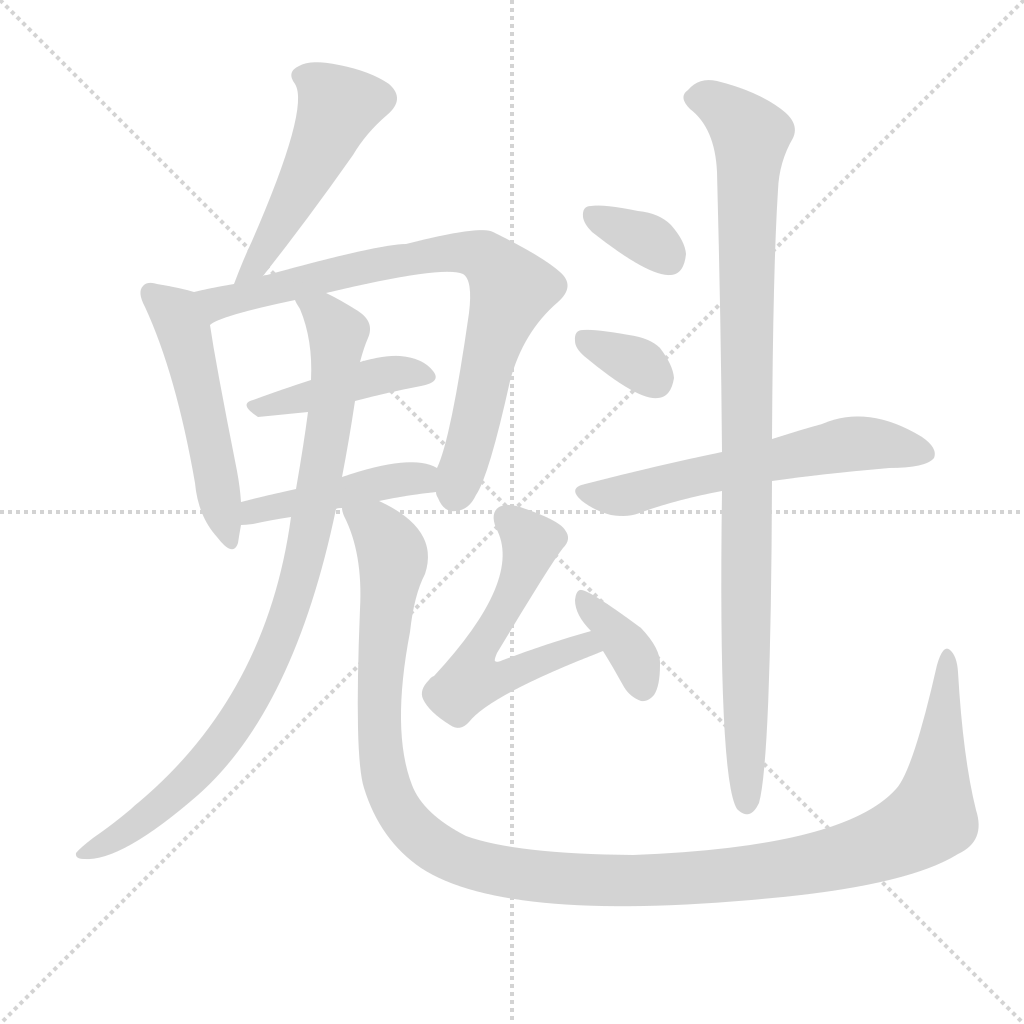
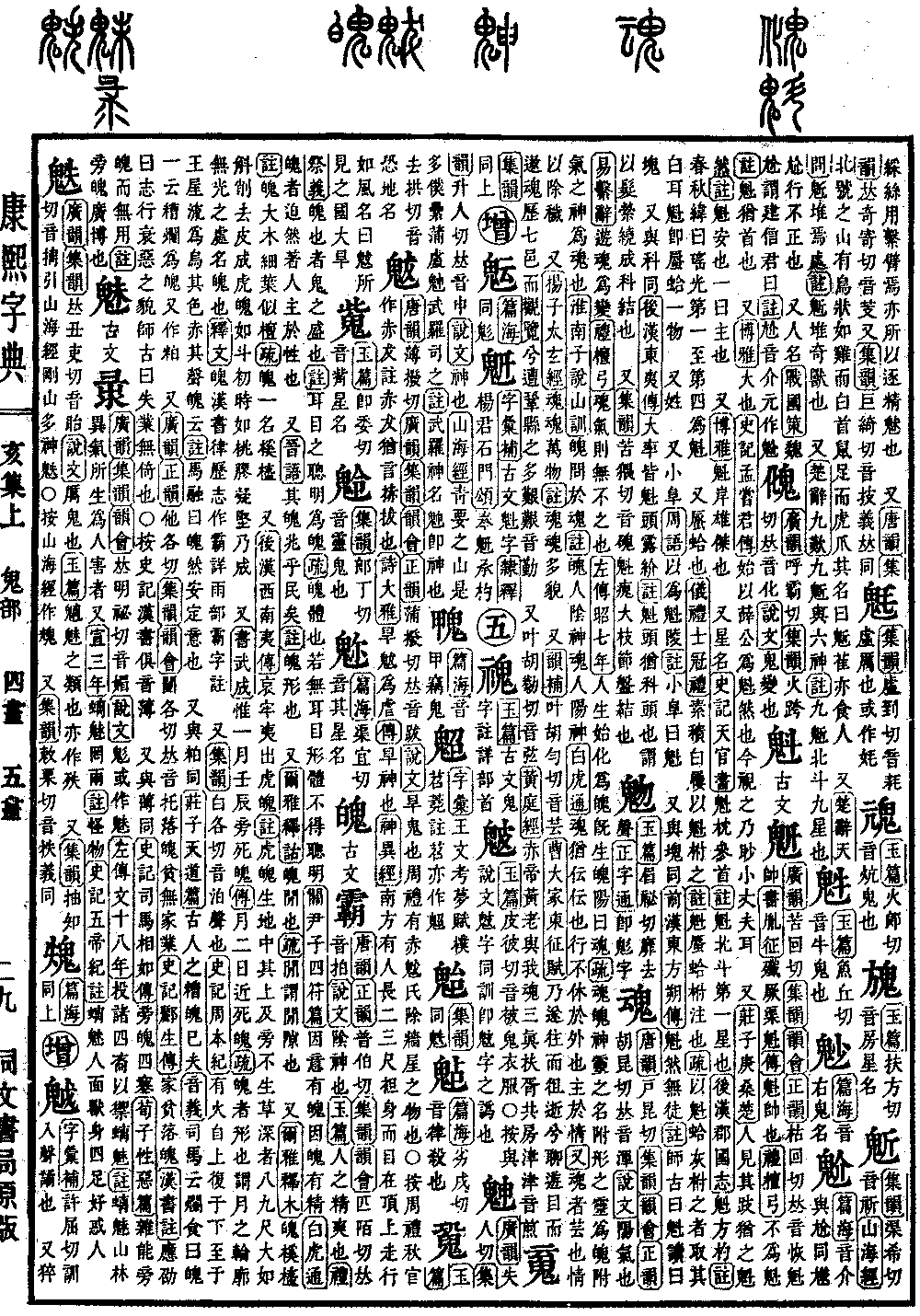
Hai Collection, Upper Volume
Radical: Ghost (guǐ)
14 strokes
Page 1461, Entry 09
Ancient script form. According to the Expanded Rhymes (Guangyun), pronounced hui. According to the Collected Rhymes (Jiyun), the Rhyme Compilation (Yunhui), and the Correct Rhymes (Zhengyun), pronounced hui. Chief or leader.
In the Book of Documents (Shangshu), section Yin Zheng: "Destroy their chiefs and leaders." The commentary states: "A chief is a leader."
In the Book of Rites (Liji), section Tan Gong: "Do not act as a leader." The commentary states: "A leader is like a head."
Also, per the Expanded Elegance (Boya), it means large.
In the Records of the Grand Historian (Shiji), biography of Lord Mengchang: "At first, I thought Lord Xue was a man of large stature. Now looking at him, he is but a tiny, frail man."
In the Zhuangzi, section Geng Sang Chu: "People see his uprightness, which is also grand (kui-ran)." The commentary states: "Kui means stable." Another interpretation is that it means master.
Per the Expanded Elegance (Boya), "kui-an" means heroic and outstanding.
Also, the name of a star. In the Records of the Grand Historian (Shiji), section Treatise on Celestial Offices: "The Kui star rests on the head of the Shen constellation." The commentary states: "Kui is the first star of the Northern Dipper." In the Book of the Later Han (Hou Hanshu), section Treatise on Commanderies and Kingdoms: "The square ladle of the Kui." The commentary states: "The Spring and Autumn Apocrypha says: The first to the fourth stars of the Handle of the Dipper are the Kui."
Also, a type of clam. In the Book of Etiquette and Ceremonial (Yili), section Ritual for the Capping of a Scholar: "White plain silk, white hemp sandals, use clam-dust (kui) to coat them." The commentary states: "Kui refers to the clam-dust coating." The sub-commentary states: "Using clam-dust to coat them is to achieve the white color; kui is the same thing as a clam."
Also a surname.
Also, a small hill. In the Discourses of the States (Guoyu): "Used as a small hill (kui-ling)." The commentary states: "A small hill is called a kui."
Also written as the character for block (kuai). In the Book of the Former Han (Hanshu), biography of Dongfang Shuo: "Alone and solitary (kui-ran)." The commentary by Yan Shigu states: "Read as the character for block (kuai)."
Also written as the character for section (ke). In the Book of the Later Han (Hou Hanshu), section Records of the Eastern Barbarians: "Generally, they all have bare heads with coiled hair (kui-tou)." The commentary states: "Kui-tou is like 'ke-tou,' meaning to wrap the hair into a coiled knot."
According to the Collected Rhymes (Jiyun), pronounced kui. "Kui-hui" refers to large, knotted, and twisted branches.
Textual adjustment: In the Records of the Grand Historian (Shiji), biography of Lord Mengchang, the phrase "tiny, frail man" has been corrected from "tiny, frail official" to match the original text.