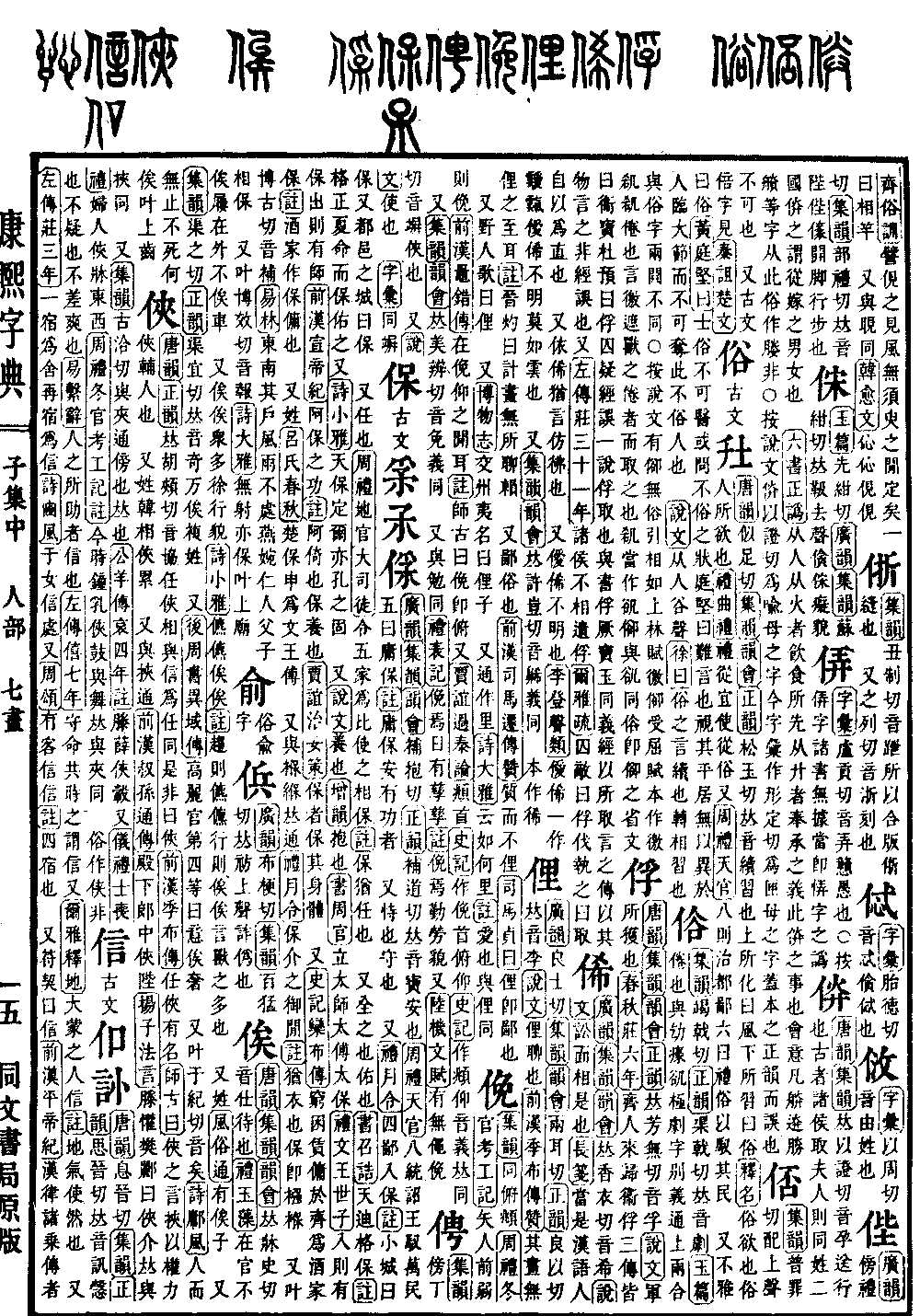
Zi Collection, Middle Volume. Radical: Person (rén). Kangxi Stroke Count: 9. Page 105, Position 12. According to the Tang Rhymes (Tangyun), Collected Rhymes (Jiyun), Rhymes of the Council (Yunhui), and Correct Rhymes (Zhengyun), the fanqie pronunciation is fāng and wú, sounding like fú. Explaining Graphs and Analyzing Characters (Shuowen Jiezi) defines this as that which is captured by an army. In the Spring and Autumn Annals (Chunqiu), during the sixth year of Duke Zhuang, it is recorded that the people of Qi came to return the captives of Wei. The Three Commentaries all record this as the treasures of Wei. Du Yu stated that the term refers to prisoners and suspected the classic text was in error. Another interpretation states that the term fú (capturing) means to take, which is synonymous with the phrase taking their precious gems found in the Book of Documents (Shujing). The classic text refers to the act of taking, whereas the commentaries refer to the objects themselves, thus the classic text is not in error. Additionally, the Commentary of Zuo (Zuozhuan), in the thirty-first year of Duke Zhuang, states that the feudal lords do not send captives to one another. The Commentary on the Erya (Erya Shu) states that to imprison an enemy is called fú (capturing), while to attack and seize them is called qǔ (seizing).