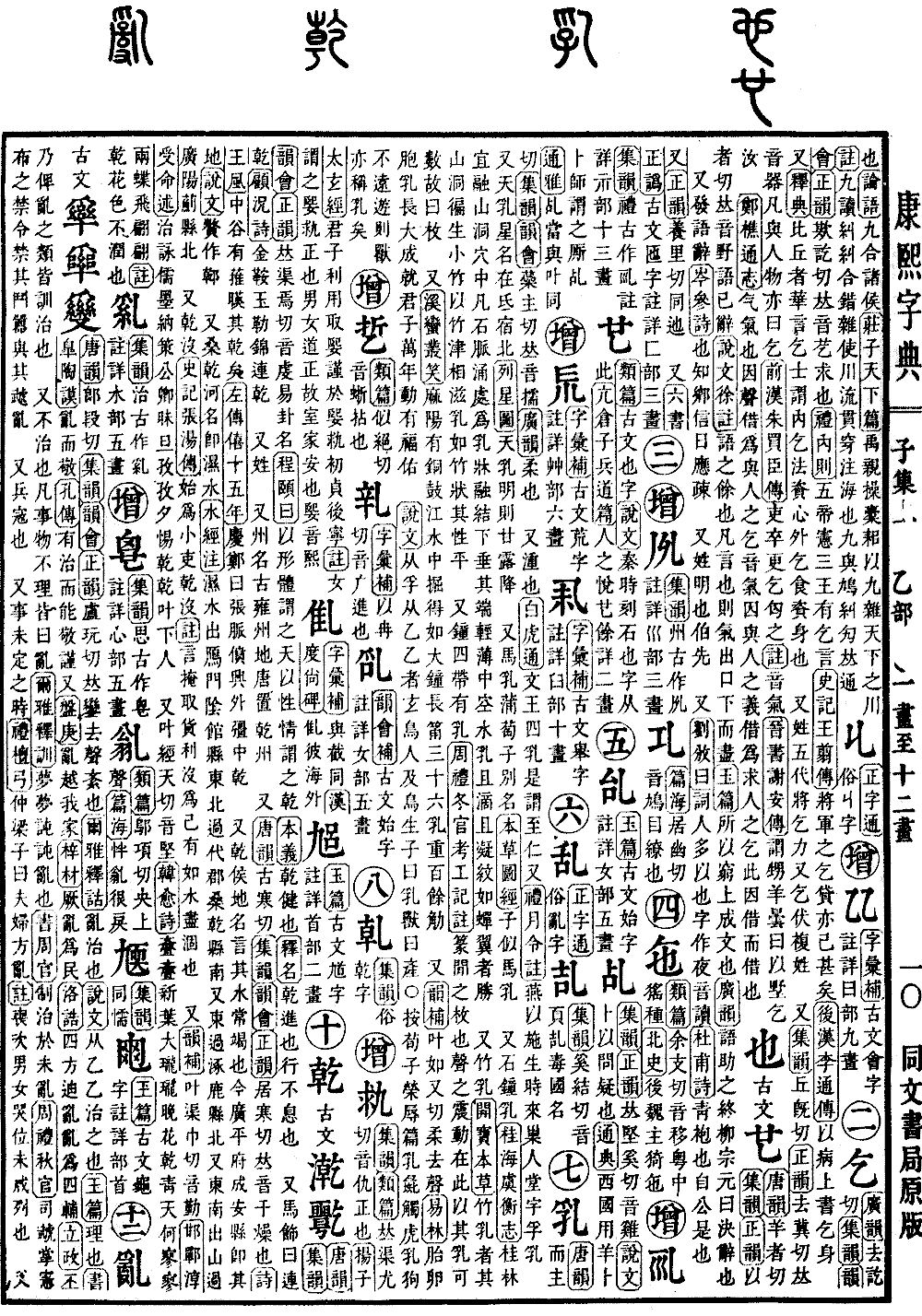
Zi Collection, Page Position: Upper
Radical: Second (yǐ)
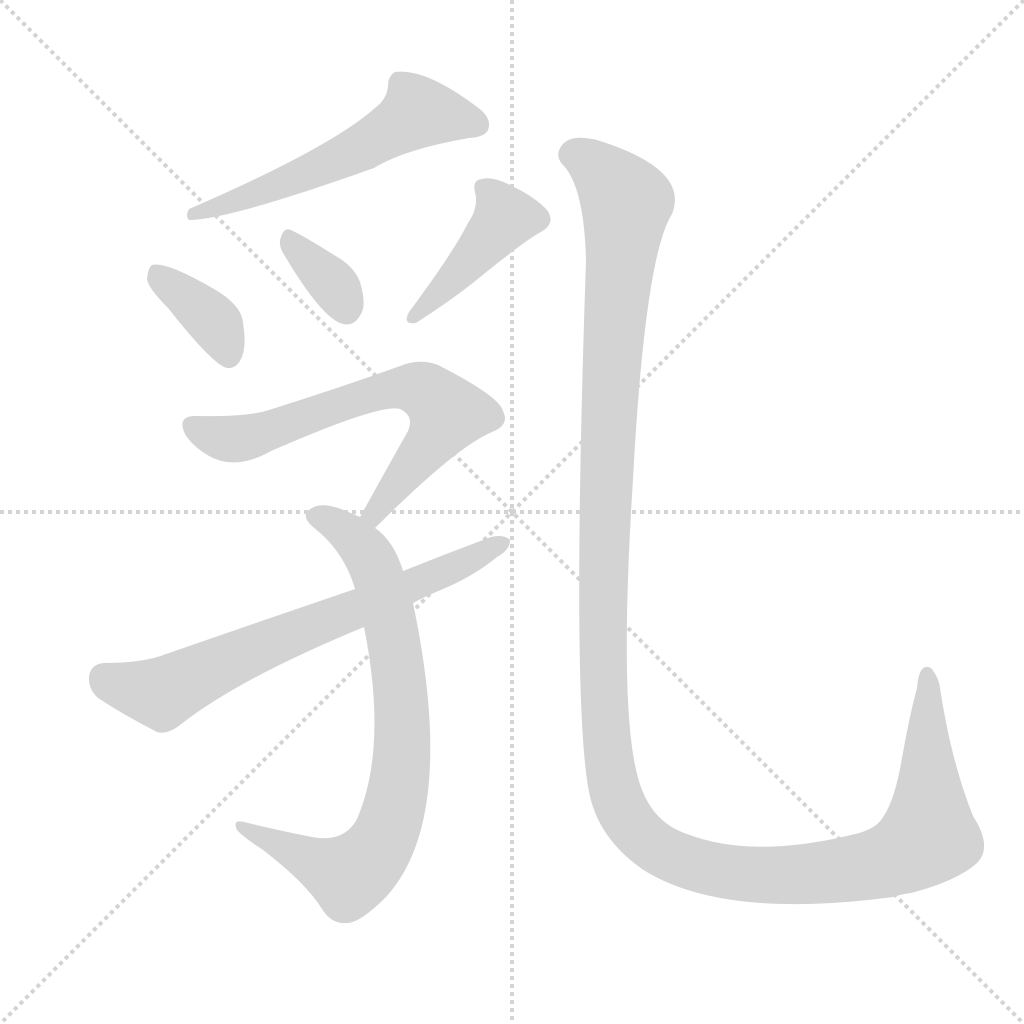
Character: ru
Kangxi Stroke Count: 8
Page 84, Number 17
Tang Rhymes (Tangyun): Pronounced with the initial of er and the final of zhu. Collected Rhymes (Jiyun) and Rhyme Meetings (Yunhui): Pronounced with the initial of rui and the final of zhu. The sound is similar to ru.
Broad Rhymes (Guangyun): Means soft and flexible.
Also refers to milk.
Comprehensive Discussions in the White Tiger Hall (Baihu Tong): King Wen of Zhou had four nipples; this was regarded as a sign of supreme benevolence.
Also, in the Book of Rites (Liji), Monthly Ordinances (Yueling) Commentary: Swallows come to build nests under the eaves of houses to give birth and raise their young during the breeding season.
Also, Heavenly Breast (Tianru), the name of a constellation located to the north of the Root (Di) constellation.
Map of the Arrayed Stars (Liexing Tu): When the Heavenly Breast star is bright, sweet dew will descend.
Also, Horse Nipple (Maru), an alternative name for grapes.
Illustrated Classic of Materia Medica (Bencao Tujing): The fruit resembles the nipple of a horse.
Also, stalactites, known as stone bell milk (shizhongru).
Records of the Guilin Sea and Mountains (Guihai Yuheng Zhi): In the caves of Yirong Mountain in Guilin, wherever stone veins emerge, they form breast-like beds (ruchuang) that condense and hang down. The ends are thin and hollow. As water drips and solidifies, those with textures like cicada wings are considered the finest.
Also, bamboo milk (zhuru).
Materia Medica of the Kaibao Era (Kaibao Bencao): Bamboo milk refers to small bamboo found throughout mountain caves. Nourished by the fluids of the bamboo, it forms a milky substance shaped like bamboo, which is mild in nature.
Also refers to the nipple-like protrusions on the four bands of a bell.
Rites of Zhou (Zhouli), Winter Offices, Record of Trades (Kaogongji) Commentary: The protrusions between the bands of a bell are called mei. The vibration of the sound originates here. Because these nipple-like protrusions can be counted, they are called mei.
Also, Collected Smiles of the Stream Barbarians (Ximan Congxiao): In Mayang, there are bronze drums recovered from the river. They resemble large bells with thirty-six long cylinders and nipple-like protrusions weighing over a hundred catties.
Also, Rhyme Supplement (Yunbu): Rhymes with the initial of ru and the final of you, pronounced like rou in the departing tone.
Forest of Changes (Yilin): Whether born from a womb or an egg, they are suckled and nurtured until they reach adulthood. May the superior man live for ten thousand years, blessed in his every move.
Explaining Graphs and Analyzing Characters (Shuowen): Derived from the components for trust (fu) and the second celestial stem (yi). The element yi represents a bird. Giving birth is called ru for humans and birds, while it is called chan for beasts. However, according to the Xunzi, Honor and Disgrace (Rongru) chapter: A nursing sow dares to attack a tiger, and a nursing dog will not wander far from its young. Thus, the term ru is also used for beasts.