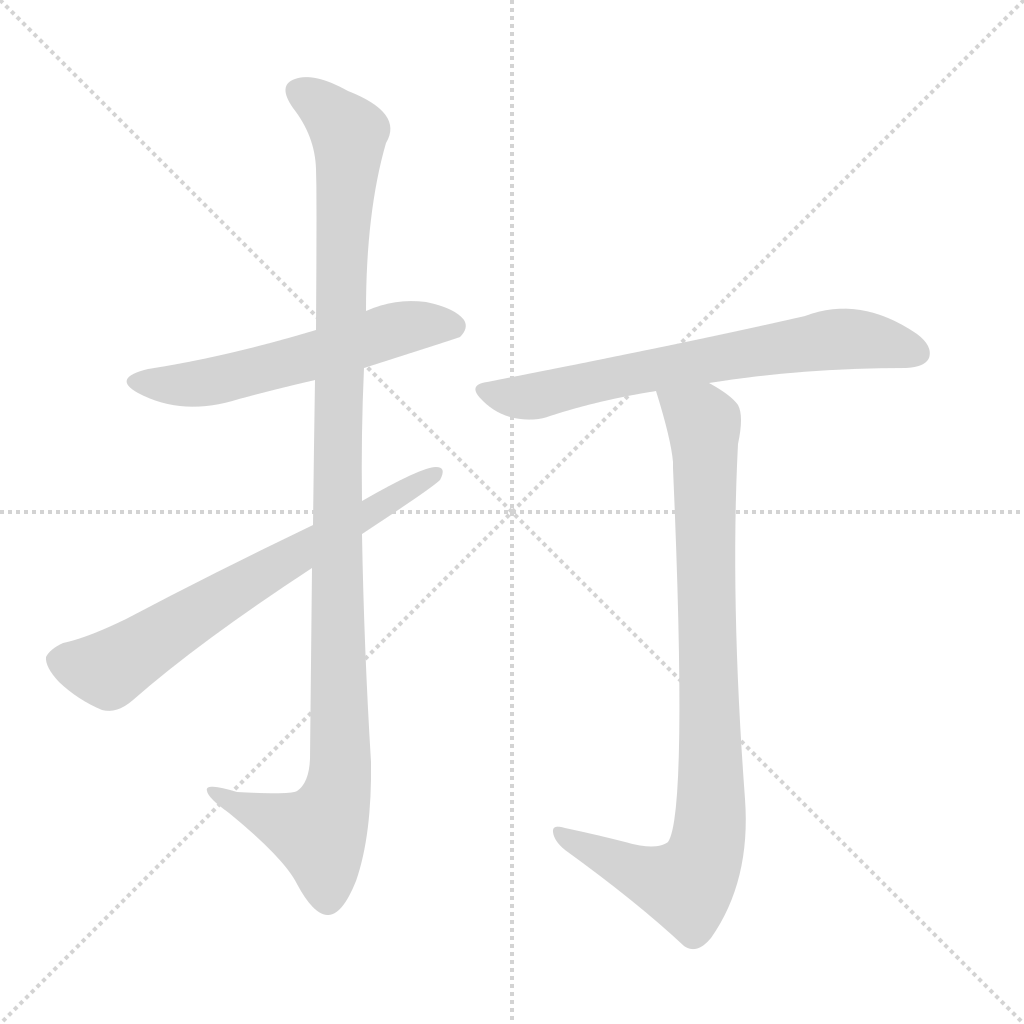
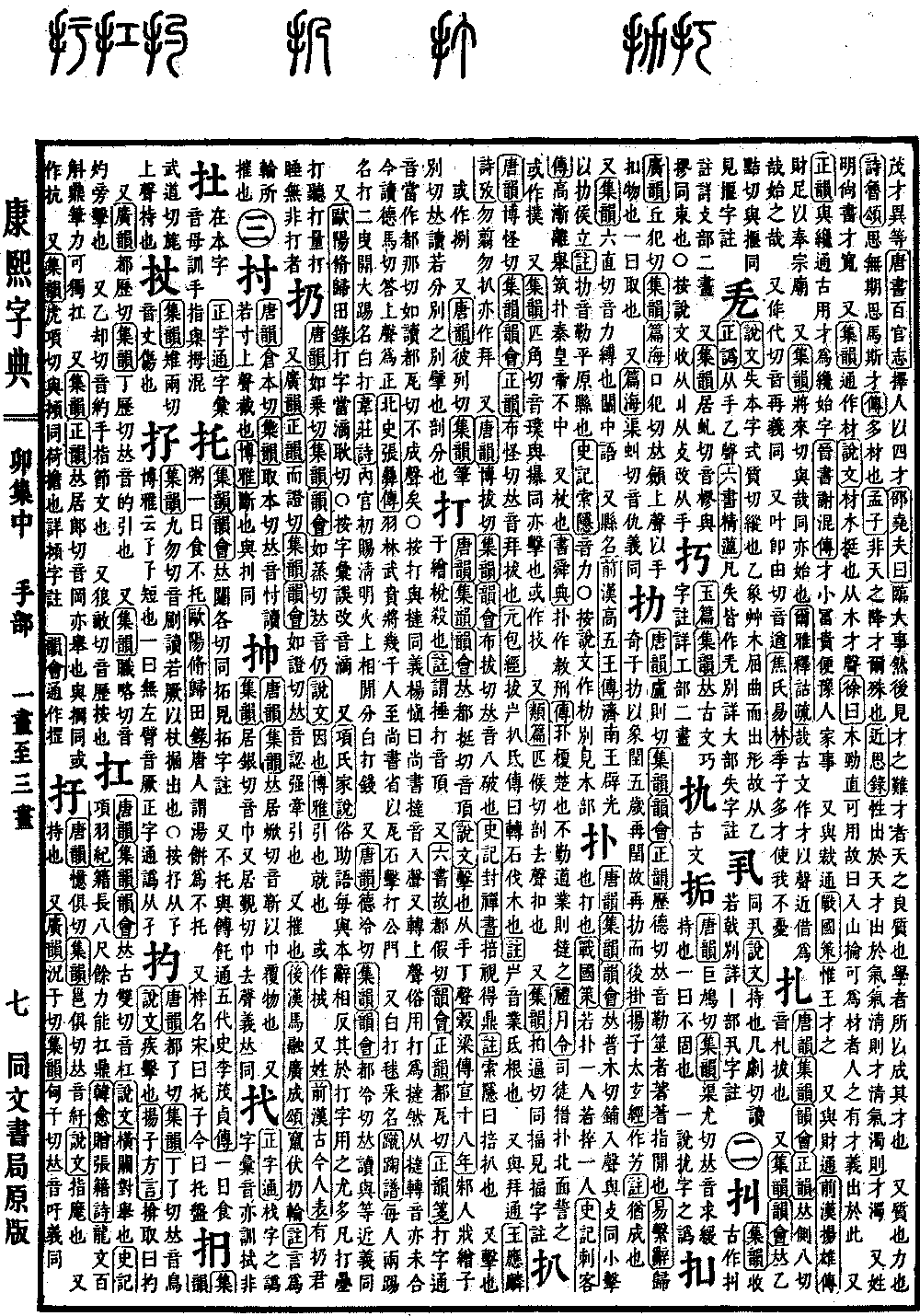
Mao Collection, Middle Volume. Radical: Hand (shǒu). Kangxi strokes: 6. Page 417, Entry 12.
Tang Rhymes (Tangyun), Collection Rhymes (Jiyun), and Rhyme Compendium (Yunhui) record the pronunciation as ding (third tone), sounding the same as the character for top (dǐng). Analytical Dictionary of Characters (Shuowen Jiezi) defines it as to strike or beat. The character structure is derived from the Hand (shǒu) radical, with the character for nail (dīng) serving as the phonetic component.
Gongyang Commentary (Guliang Zhuan), 18th Year of Duke Xuan records: The people of the State of Zhu killed the Viscount of Zeng in the State of Zeng, using clubs to strike and kill him. The commentary notes that this refers to beating. Pronounced ding (third tone).
Furthermore, according to Six Writings Commentary (Liushu Gu), the pronunciation is jia (third tone). Rhyme Compendium (Yunhui) and Correct Rhymes (Zhengyun) record the pronunciation as wa (third tone). The Correct Rhymes Commentary (Zhengyun Jian) suggests that the common pronunciation of the character should be na (third tone); if it were read as wa (third tone), it would not form a proper tonal pattern. Examining the character, it shares the same meaning as the character for lash (tà). Yang Shen notes: In the Book of Documents (Shangshu), the character for lash (tà) is read in the entering tone and also shifts to the rising tone. Colloquially, the character is used to represent the meaning of to lash, but the phonetic shift from to lash does not align perfectly. Currently, it is pronounced da (third tone), matching the rising tone of the character for answer (dá), and this is considered the standard pronunciation.
History of the Northern Dynasties (Beishi), Biography of Zhang Yi records: Several thousand warriors from the Imperial Guard went to the Secretariat and used tiles and stones to strike the gates of the government office.
There is also the term white-strike (báidǎ), which is a name for a type of football game. The Football Manual (Cuju Pu) records: When each person takes two turns kicking, it is called striking twice (dǎ èr), and kicking with great force while adopting a stance is called white-strike (báidǎ). A poem by Wei Zhuang writes: Eunuchs first bestow Qingming fire, and the chancellor in his leisure distributes white-strike money.
Additionally, Tang Rhymes (Tangyun) records the pronunciation as leng (third tone), while Collection Rhymes (Jiyun) and Rhyme Compendium (Yunhui) record the pronunciation as leng (third tone), sounding similar to the character for equal (děng). The meaning is the same.
Furthermore, Ouyang Xiu in Records of Returned Fields (Guitian Lu) believes the character should be pronounced geng (third tone). Note: The Dictionary of Characters (Zihui) incorrectly changes its pronunciation to di (first tone).
Finally, Xiang's Family Sayings (Xiangshi Jiashuo) mentions: Folk auxiliary words are often contrary to the original meaning of the word, and this is especially common in the usage of the character. Whenever it appears in words such as to inquire, to estimate, or to nap, the character does not carry the actual meaning of striking.