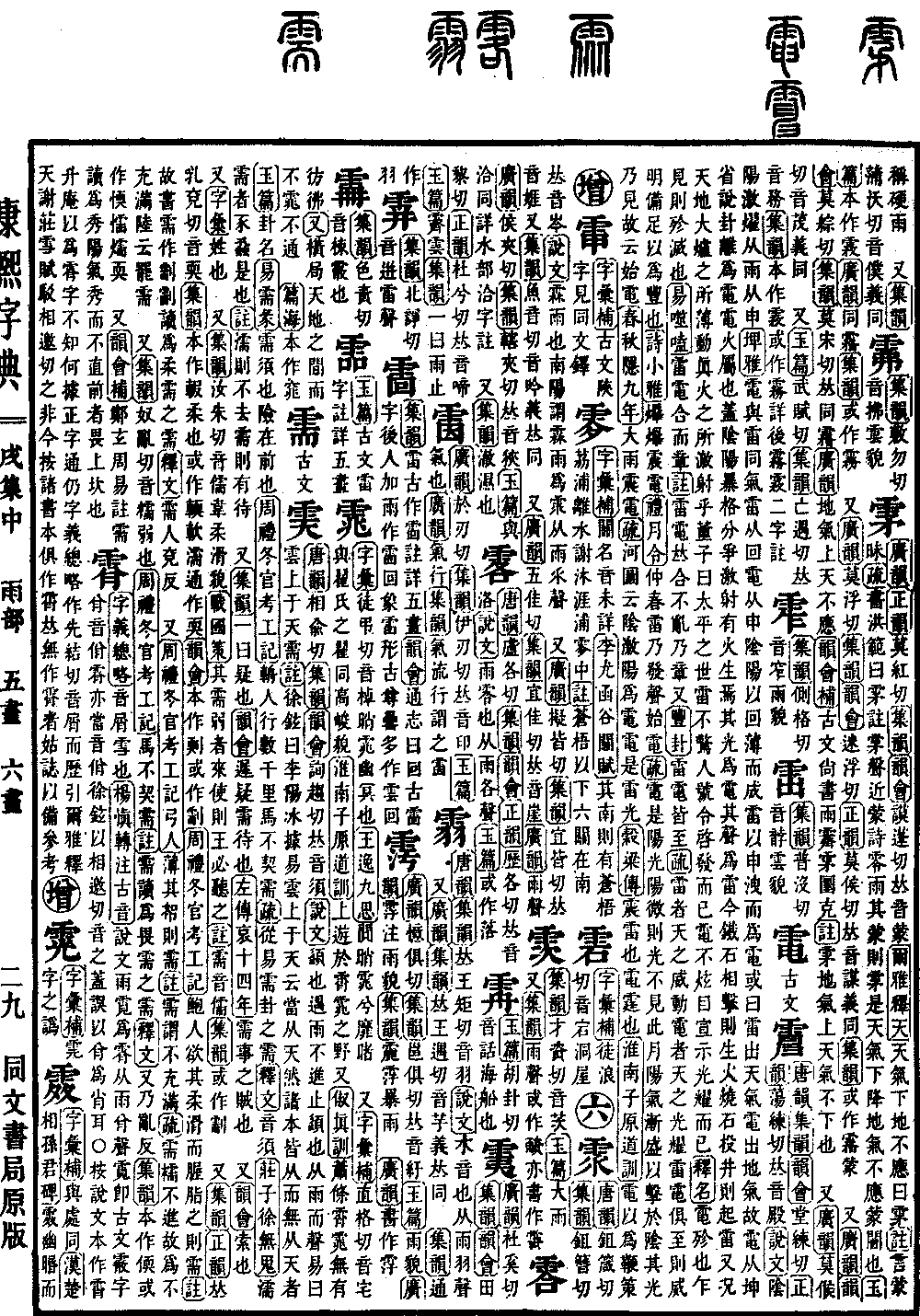
Xu Collection, Middle Volume
Radical: Rain (yǔ)
Character: Lightning
Kangxi Stroke Count: 13
Page 1373, Entry 01
Ancient form. Pronounced dian (falling tone).
According to the Shuowen Jiezi (Explanation of Graphs and Analysis of Characters), it refers to the激耀 (vibrant flash) of yin and yang. Composed of the radicals for rain and the character for the ninth earthly branch.
According to the Piya (Amplified Observations), lightning and thunder share the same vital energy. Thunder follows the character for "revolve," while lightning follows the character for the ninth earthly branch; yin and yang revolve and compress to form thunder, and expand and discharge to form lightning. Others say thunder emerges from celestial energy, and lightning from terrestrial energy, hence lightning is derived from a simplified form of the character for earth. In the Discussion of Trigrams (Shuogua), it is stated that the trigram Li represents lightning. Lightning belongs to the element of fire. When yin and yang clash violently, the resulting friction discharges fire; its brilliance becomes lightning, and its sound becomes thunder. If iron and stone striking together produces fire, or burning stone thrown into a well produces thunder, how much more so when the great furnace of heaven and earth is shaken by the friction and discharge of true fire?
Dong Zhongshu stated: In an era of great peace, thunder does not frighten people, serving only to inspire and awaken; lightning does not dazzle the eyes, serving only to manifest light and glory.
According to the Shiming (Explanation of Names), lightning (dian) implies extinction (tian); it vanishes as soon as it is seen.
In the Book of Changes (Yijing), Hexagram Shihe: Thunder and lightning combine to create order. The commentary notes: When thunder and lightning combine without disorder, there is order. Also in the Feng Hexagram: Thunder and lightning both arrive. The sub-commentary states: Thunder is the movement of heaven's majesty; lightning is the brilliance of heaven. When both arrive, majesty and brightness are fully prepared, creating abundance.
In the Book of Odes (Shijing), Small Odes section: Thunder and lightning.
In the Book of Rites (Liji), Monthly Ordinances: In the second month of spring, the thunder begins to sound, and lightning begins to appear. The sub-commentary states: Lightning is solar brilliance. When the yang energy is weak, this light is not visible; in this month, the yang energy gradually waxes, striking against the yin, and its light becomes visible, hence it is said that lightning begins.
In the Spring and Autumn Annals (Chunqiu), Ninth Year of Duke Yin: Great rain, thunder, and lightning. The sub-commentary states: The Hetu (River Chart) says that yin striking yang creates lightning, and lightning is the light of thunder.
In the Guliang Zhuan (Guliang Commentary): The crash is thunder. The lightning is the flash.
In the Huainanzi (Huainan Masters), Original Way training: Using lightning as a whip.