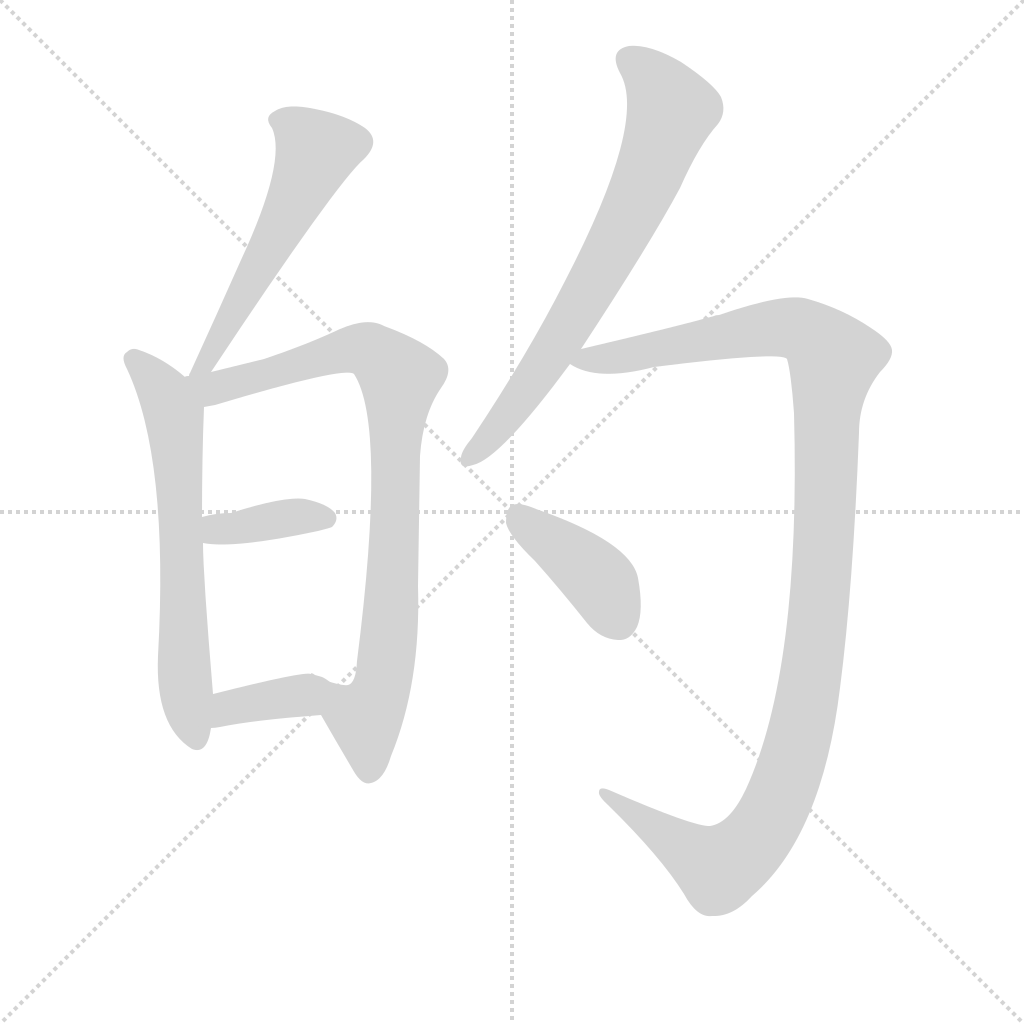
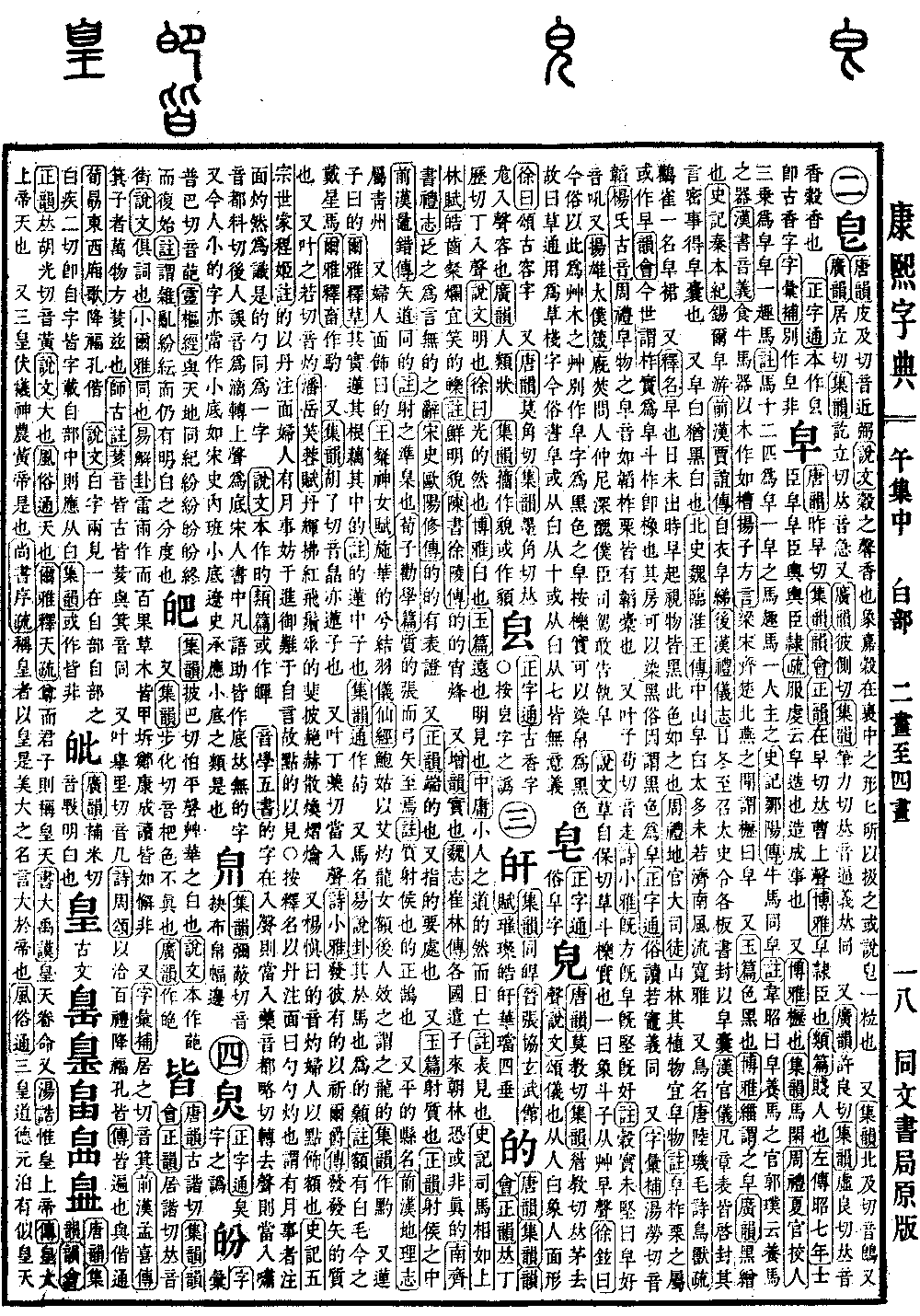
Wu Collection, Middle Volume
Radical: White (bái)
Kangxi Strokes: 8
Page 786, Entry 07
Pronounced di (entering tone).
Explaining Characters (Shuowen): Bright.
Xu Shen says: Shining.
Broad Compendium (Boya): White.
Jade Chapter (Yupian): Distant; clearly seen.
Doctrine of the Mean (Zhongyong): The way of the petty man is clearly apparent and disappears daily.
Commentary: To be clearly visible.
Records of the Grand Historian (Shiji), Rhapsody on the Shanglin Park by Sima Xiangru: With bright teeth and radiant smile, fitting for the glistening appearance.
Commentary: The appearance of being fresh and bright.
Book of Chen (Chenshu), Biography of Xu Ling: The clear night beacon fires.
Also, Expanded Rhymes (Zengyun): Real or true.
Records of the Three Kingdoms (Weizhi), Biography of Cui Lin: Each country sent sons to pay tribute, and Lin feared some might not be the true ones.
Book of Southern Qi (Nanqishu), Treatise on Rites: Broad words, without any certain meaning.
History of the Song (Songshi), Biography of Ouyang Xiu: Clearly having evidence.
Also, Correct Rhymes (Zhengyun): A certainty. Also, the essential point.
Also, Jade Chapter: A target for archery.
Correct Rhymes: The center of an archery target.
History of the Former Han (Qianhanshu), Biography of Chao Cuo: When the paths of the arrows are aimed at the same target.
Commentary: The standard for archery.
Xunzi, Exhortation to Learning: When the target is set up, the bows and arrows arrive.
Commentary: The target, the archery marker. Di, the bullseye.
Also, Pingdi, name of a county.
History of the Former Han (Qianhanshu), Treatise on Geography: Belonged to Qing Province.
Also, a facial ornament worn by women.
Wang Can, Rhapsody on the Goddess: Applying flowery marks to bind the fine appearance.
Classic of Immortals (Xianjing): Bao Gu used moxa to cauterize the forehead of a dragon girl, and later people imitated this, calling it the dragon mark.
Collected Rhymes (Jiyun): Also written in a variant form.
Also, lotus seeds are called di.
Erya, Explaining Plants: The fruit is called lotus, its root is called lotus root, and its center is called di.
Commentary: Di, the seed inside a lotus.
Collected Rhymes: Commonly written as di (variant form).
Also, a type of horse.
Book of Changes (Yijing), Discussion of the Trigrams: Regarding horses, it refers to a horse with a white mark on the forehead.
Commentary: A white tuft of hair on the forehead, known today as a star-marked horse.
Erya, Explaining Domestic Animals: Written as di (variant form).
Also, Collected Rhymes: Pronounced liao. Also means lotus seed.
Also, rhyming with the pronunciation of duo (entering tone).
Book of Odes (Shijing), Lesser Odes: Shooting at that target, to pray for your goblet.
Commentary: Fa means to shoot an arrow; di means the target.
Also, rhyming with the pronunciation of zhuo.
Pan Yue, Rhapsody on the Lotus: Red light brushes the crimson, flying whiskers glistening. Spread out in brilliant, shimmering waves.
Also, Yang Shen states: Di, pronounced zhuo. Women apply spots to decorate their foreheads.
Records of the Grand Historian (Shiji), Lineage of the Five Schools, Commentary on Lady Cheng: Di refers to applying cinnabar to the face. When women have their monthly periods, it is difficult to speak of it, so they apply this mark to make it known.
According to Explaining Names (Shiming), applying cinnabar to the face is called shuo. Shuo is the same as zhuo. It means that those who have their monthly period mark their faces, making it clearly visible as a sign, so di and shuo are the same word.
Explaining Characters (Shuowen): Originally written as di.
Classified Compendium (Leipian): Sometimes written in a variant form.
Five Books on Sound Studies (Yinxue Wushu): The character di is in the entering tone, so it should be placed in the yao rhyme, pronounced du-lü. If shifted to the departing tone, it should be in the xiao rhyme, pronounced du-liao. Later generations mistakenly pronounced it as di, and shifted it to the rising tone as di. In Song dynasty texts, all particles are written as di, and the character di is not used. Furthermore, the modern word for "small" should also be written as small-di. Examples include the small-di of the inner court in the History of the Song and the small-di officials of the Liao History.